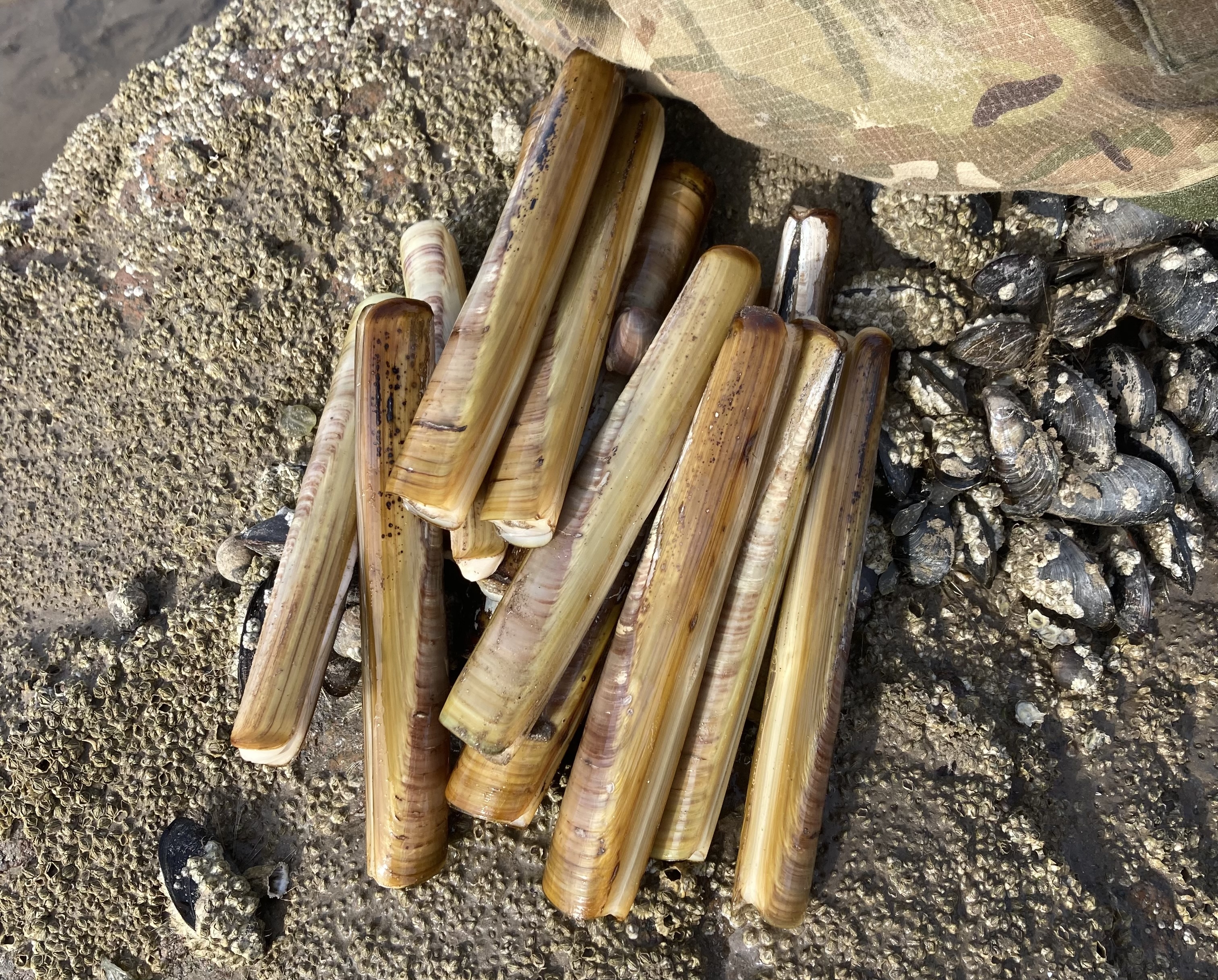
We woke up early and walked to the far-retreating tide – out across the crab holes and the sad, abandoned lumps of stranded jellyfish to a point at which the currents gave way altogether. The slackness found us on a blank expanse of mud where the last of the seawater drained and gurgled around our ankles, and the lugworms heaped their coils of sediment in tangles like forkfuls of overcooked pasta. And having arrived in this spot, we stopped talking and walked more slowly, looking for signs of life in the mud.
They were hard to see at first, and sometimes when the tide has fallen more steeply off into deeper holes, the work is altogether more easy because there are juts of shells and pointing ends to hunt for in the mud. No such hints on this cool morning in early April – and only the sudden spurt of seawater to catch our eyes, because as razor clams detect your movements nearby, they jerk suddenly down into the mud and conceal themselves. The squeeze produces a small ejaculation of salt water – and a hole which is very quickly backfilled by brine and sediment. That’s why we call these creatures “spoots” – the spout of water is like the bullseye of a hidden target, revealed for a moment in a squirt of salted lightness.
The clams burrow deeply, but in the moment of their “spooting”, there’s a chance to spring forward and pour salt into the open hole; salt from the kitchen table, usually poured from a plastic container or a jamjar, and nothing more spectacular than that. If you’ve found them in time, the results are almost immediate.
For reasons known only to themselves, the spoots are appalled by a surfeit of salt. They seem to choke on it, and it brings them up into a surge of belching and flatulence. You can tell when the trick has worked because the mud begins to heave and swell like a sickness. The movement is reminiscent of food-poisoning as the molluscs dig both down and up at once, panicking and disgusted by the salt assault. And if you’re lucky, they burst diagonally out of the mud like damaged submarines, breaching the surface and leaping fulling out into the fresh air. That’s when they’ll lie on their sides, stranded and gasping – and the person who showed me how to do this had no specific interest in watching the performance. He would walk across a bed of spoots and pour salt into likely-looking holes without ever looking back. At the end of a sweep, he’d walk back and pick up the clams as if they were so much litter – because once flushed from the mud, they seem unable to climb back into safety again. Perhaps they would if given enough time, but if you don’t pick them up and take them away, the seagulls surely will.
In twenty golden minutes, we pulled sixteen of these spoots from their fortress in the low tide. And all the while, the sea’s reek was weighed against the scent which rose from banks of bluebells on the shore nearby; the sound of oystercatchers, a cuckoo and the furious, petulant bellow of a roebuck. We took the first decent haul of the year – wrapped in a sock – and we carried them to the rocks nearby. Then in a fire made of driftwood, we baked them open and slurped down the sweet muscles, which almost match the rich and freshened flavour of scallops.
It was coming on for seven o’clock in the morning, and the fire chewed its way through flakes of discarded shells so that by the time we left and went home to work, the remains were nothing more than might have been left by our ancestors who fished and ate like this after the last Ice Age.


Leave a Reply