We’re all aware that curlews are declining across the UK – but that doesn’t mean that their absence can’t take us by surprise. Ever since my own curlews failed, I’ve taken a rough circuit of the hills around my home during the course of March and April each year, usually from the seat of a bicycle. I can cover a lot of ground like that, and forays of twenty or thirty miles can take a full day when I carry a grill pan, some sausages and a flask of coffee. Ready for any outcome, I stop and explore as I go, flinging my bike behind a hedge and setting off on foot when the ground looks promising. There are far more official and scientific ways to monitor wader numbers, but I prefer my approach. Repeated often enough, I usually get a pretty good idea of what’s where – and I also get a chance to poach some trout and roast them in leaves of wild garlic.
I was devastated when my own curlews failed in 2021, but it has surprised me just how quickly curlews have failed across this entire piece of Galloway in the last five years. Steepening declines have resolved into complete extirpation in almost no time at all. We know that curlews can live for many years without producing youngsters, so it follows that entire populations can seem to fail with a suddenness which feels shocking. In 2021, there were sixteen pairs within five miles of where I write these words. Last year there were five pairs. On multiple trips out on the bicycle over the last fortnight, I have covered over a hundred miles – and it seems likely that this will be the first year for at least three contiguous parishes in which no curlews will even attempt to breed. The game is over, and while I’ve been anticipating this moment for some time, the reality has caught me on the hop.
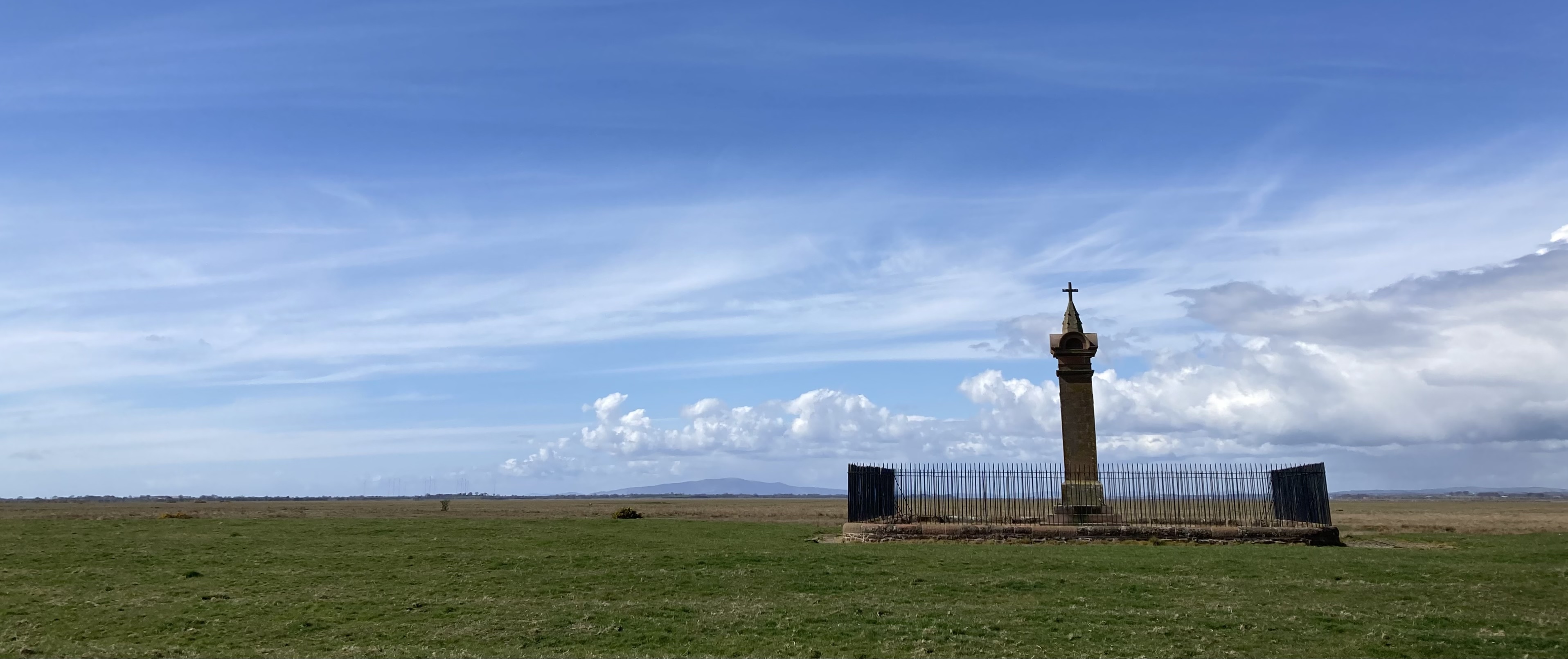
There’s a monument to King Edward I on the merse below Burgh by Sands, five miles northwest of Carlisle. It marks the spot where he died in 1307, and it’s fair to imagine that Scotland breathed a sigh of relief when they heard the news of his passing. He was on the way north to give us another kicking, and chances are that “The Hammer of the Scots” would have thrashed us yet again. We revel in Robert the Bruce’s victory at Bannockburn, but it probably would have been a different outcome in Edward had lived to fight that day. The King died of dysentery, and it was an oddly ignominious end for an extraordinary monarch who travelled across the known world during the course of his life, battering the hell out of everybody he met.
Skylarks sang above the monument as I approached it last week. Small flights of geese rearranged themselves in a bitterly cold wind as I walked. The Solway was being churned to white foam by that wind, and I watched the water tremble and buck across miles of sand-coloured seagrass and salting. This part of the Firth is a bizarrely enthralling flatscape, dotted with stunted gorse bushes and dominated by a strong and overbearing sky. To the north, Dumfriesshire looms in a surge of rising blues and rainshowers beyond Burnswark and out towards Langholm. The impressive bulk of Criffel stands to the west in a pattern of shapes and swellings which has often provided a surge of welcome reassurance after long trips away – it’s the first sign you can see of Galloway from the train windows or the motorway which brings you mercifully north and home again.
As I leaned into a feeling of tininess on this vast, wind-raked borderland, a curlew rose up and began to display towards the marsh. It coursed around in an undulating loop which brought it within five hundred yards of where I sat. I could hear every note in the glittering trill; the flare of its white underwings shone against the bruisy blue of rising ground beyond Annan. It was the first curlew I’ve seen breeding this year – and I realised just how much I have missed that sound, which used to be as familiar to me as human speech.


 Bog Myrtle & Peat
Leave a reply to Jane Shepherd Cancel reply