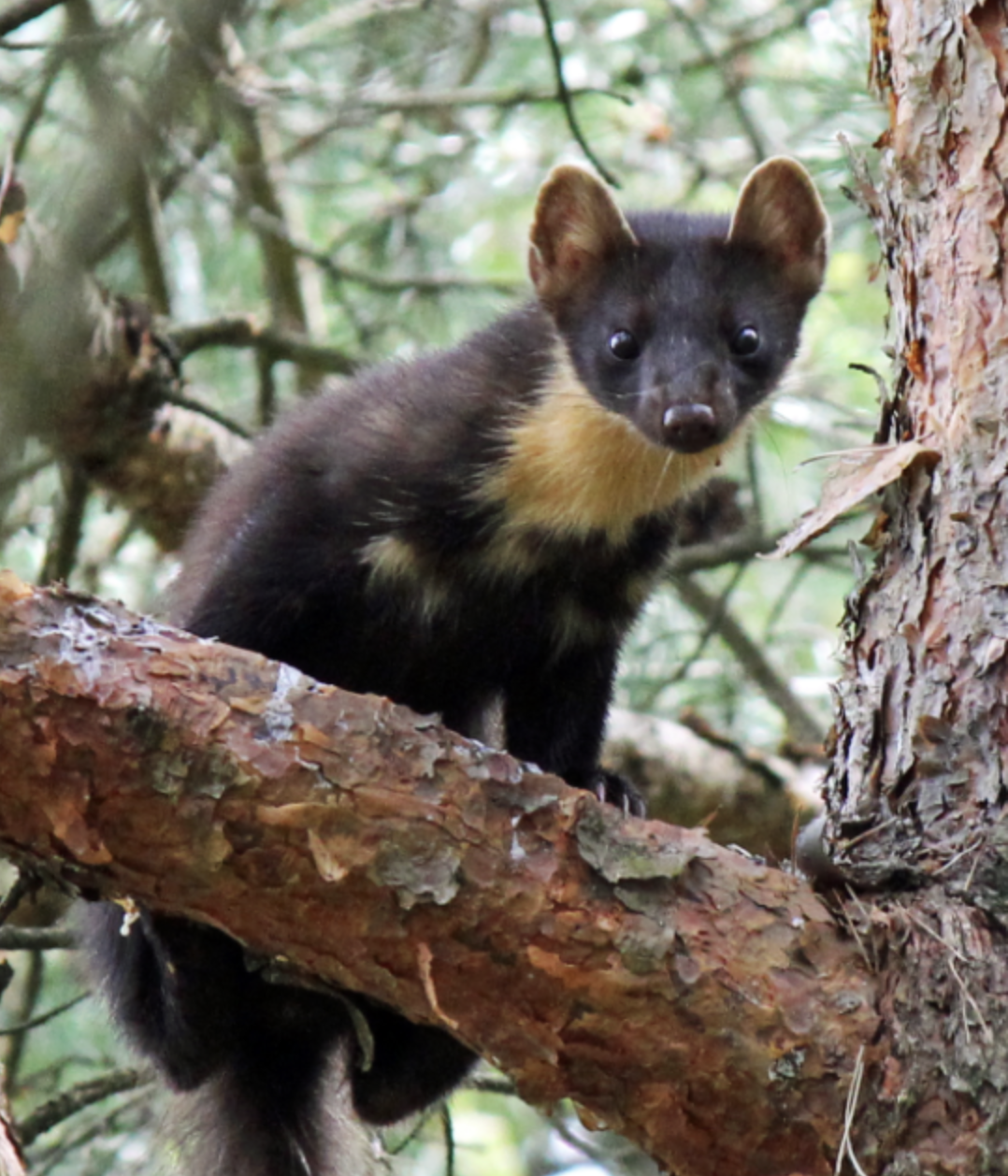
Having written at extreme length on And The Yellow Ale about an otter killed in the traffic near my home, a reader got in touch to say that he’d spotted a dead pine marten on a local road. He’d moved the corpse to the verge, but it was already pretty mangled and heavily pecked by crows by the time he’d found it. I have no specific interest in roadkill, but otters and pine martens have an extraordinary charisma and kudos – and given that they’re so rarely encountered in the wild, the chance to study dead bodies is often as close as you’re able to get. So it seems inevitable that I would drop what I was doing and rushed out to see this marten where it lay in the leafy roadside grass.
Pine martens were reintroduced to Galloway in the 1980s, and subsequent reports suggested that their population was restricted to a few locations around Newton Stewart and Glentrool. Ecologists wondered why their numbers weren’t expanding, but of course they were – the process was simply playing out in strange and unpredictable ways. It’s fair to say that martens are now widely distributed across this part of Galloway, all the way from the highest tops to the coastal marshes (one was recently found dead on the beach at Carsluith, although it’s unclear whether this animal died in the hills and was washed down a stream or drowned while trying to swim across Wigtown Bay).
Aside from a few hotspots in the Glenkens, martens are rarely abundant in this county – but they’re no longer unusual here, and I think that’s a fantastic news story in the light of so much loss and decline. I could be grim and worry that the addition of another predator is just the latest in a long line of problems for groundnesting birds, but the threat posed by martens probably needs to be seen in context of many factors. I’m certain that martens don’t help, but they certainly aren’t a major cause of concern.
The individual marten on the roadside was far beyond the point of concern to himself or anything else. His head was flat and his entire tongue and soft palate was bursting out of his mouth. A young male, he weighed almost precisely four pounds and measured thirty three inches from the tip of his extravagantly beautiful tail to the sadly distorted fold of gum where his nose should’ve been. I was extremely impressed by the length of his legs and the brawny, bearskin power of his feet, which seemed to belong to a much bigger animal. The dull, fudgy brown of his coat darkened to blackness the colour of burnt biscuits around his lower legs as if he’d been wading through peat pools and stained himself a pair of fuzzy moonboots.
Medieval furriers were obsessed with marten skins, and the fur trade is believed to be one of the main reasons why these creatures were made extinct here – but while this animal’s skin displayed a beautiful blend of colours, it was less spectacularly smooth and lustrous than a fox or an ermine. Canadian friends inform me that timing and seasonality are important when it comes to skins and skinning; perhaps I wasn’t seeing a marten’s fur at its best, but knowing how many martens were killed out of Galloway and the South of Scotland during the Medieval period, it was hard to see what all the fuss was about.
The dead marten’s claws were fiercely sharp, and when pressed they emerged in amber curves from the deep, felty wad of his toes. Those toes were massed in odd configurations, with something like a thumb to one side of the pads; five claws arranged in a span like a workman’s glove. These are all adaptations for climbing and grasping, but they made an impression of thickness and power which lay out of all proportion to the slender, tubular body – which although slight, was bunched with heavy chords of dark, burgundy muscle. Notably, there was no smell whatsoever. Most small, predatory creatures exude a powerful reek – a dead stoat is a force to be reckoned with – but this marten only carried a faint scent of warm leafmould.
Fragments of teeth were visible in the mush of his maw; his canines were stubby and sharp and grooved like the roots of a tree. I took my pen knife and cut open his stomach, finding it almost completely empty apart from a few tiny fragments of well-digested bone. Emptying these out onto a sheet of paper, I discovered the knuckles and joint-ends of a bird around the size of a thrush. All the finer detail had been melted away, but this was enough of a clue to feed the imagination.
To protect this corpse from the ignominy of crow-pecking, I buried it. I had won answers to all kinds of questions, but many new questions had immediately taken the place of the old – and if I was drawn to explore this animal for the sake of curiosity, I came away admiring them even more.
[Picture above by “Green Yoshi” – Wikipedia]


 Bog Myrtle & Peat
Leave a reply to Stephen Shellard Cancel reply