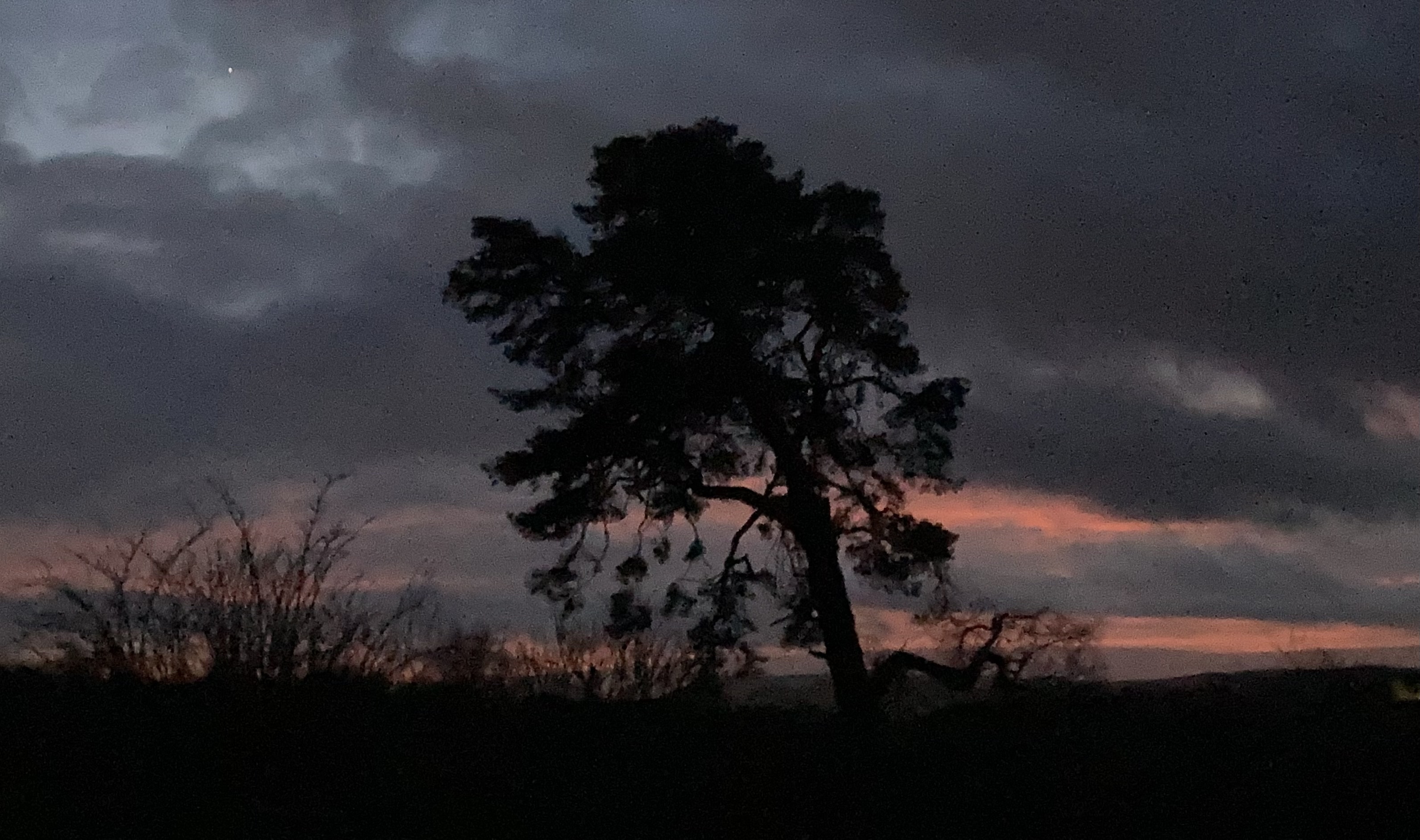
This farm was laid along old southwesterly lines. Everything here is designed to accommodate the steady winds which ride inland from the Irish Sea. Where they can’t be fought against, they’re avoided. The buildings with the biggest doors face north, and even though the southern sun is needed for the sake of work and hope in midwinter, it’s only permitted to enter the old sheds through narrow arrow slots. Some of these are old enough to have been used for the purposes of defence, and several have been bunged up with coalsacks and scraps of fallen masonry. It’s dark and often damp in these old farm sheds, but at least the wind’s kept out.
The latest gales came from an unexpected angle. They rushed down from the north-northwest, and they seemed to catch the yard off guard. I feed the bull and his mates in the lee of the stackyard so they can have shelter, but the bales were burst and blown away by the risen wind. The calmest corners had been overturned, and the buildings creaked and swayed in confusion.
Ash trees came down on the riverside, not because the gale had finally crushed them into submission, but because they weren’t used to being pushed like that – and there was almost a note of complaint in their falling, as if it wasn’t fair and the damage was cheating. Big chestnut trees tumbled onto the main road at Munches and Kirkennan and closed it for several hours until men came out like ants from their nest to remove the obstacle. I used to have a black-and-white photograph of this road in 1912, when the mile-long length was planted with even-aged chestnut trees which splashed their shade across the dust. The road was calm prosperity then, but now these trees have warped the tarmac and every winter pulls more down from the sky. It’s hard to believe they ever formed an avenue, and the few survivors make such clear a statement of isolation that they can’t be seen as part of a pattern anymore.
The wind rose and buckets blew around the fields at home; silage wrapping billowed from its snags and was gathered in a rush. Towards darkness, the geese in the meadow grew restless and gathered in tight groups behind banks of alder and willow scrub. They were hating the wind, keeping their heads down and facing into it. Then as stars were revealed in brief, momentary snatches through rushing banks of cloud, the birds rose up and shook themselves into a skein. I was sweeping in the byre when they came, and the roar of their wings arose in shifting folds of lost and sudden sound.
Geese fly low in the wind; they’re frightened of being blown off course, so they hug the contours and creep behind the shelter of hedges and dykes. And there was time for me to run to the house for my gun as the first birds showed themselves through a heaviness of the dusk. They were calling, but the sound was flung downwind until they had crept at head-height along the dykebacks and over the little fences I build and maintain to keep the cows at home. These geese make this trip every night, but they’re usually three or four hundred feet high by the time they pass my yard. This time they were low.
Geese are hard and heavy birds; they have to be very close for a shot to be effective. Learning this work as a child beside adults, I was maddened by the enforced patience and equilibrium of waiting. As soon as geese were heard or seen, I wanted to spring the trap and get stuck in, but I was sworn at and told to keep still. When I was finally given permission to rise up and shoot, it seemed like the birds were landing in our laps – and it was always closer than I thought. We could have fired sooner, but I was taught to shoot by men who wanted geese for eating. They had no specific sympathy for shot-blasted birds which moped around the fields trailing their broken wings in the grass until the wounds went green and killed them. They were simply wasted, and that was death without purpose. In a world where shooting was taking for the table, if you found the work exciting then that was a bonus – but you never shot unless you were sure to kill stone dead.
Moments before those sea-bound-geese tumbled into my yard, the wind paused and turned upon itself in a snarling eddy. Sacks rattled, straw tumbled in shreds and the roaring chatter of birds found space to reverberate like the organ in a cathedral. Then the blacked-out skeins of geese were all around me at head height, surging through the gateway to the inbye fields, rounding the henhouse door like a surge of water. Some of the skein was forced to hurdle the shed roofs, rubbing their bellies on the sandstone copes and dropping down across the tractor’s cab between the exhaust and the windscreen. The yard was drowned in heavy birds like ponies in panic, each one on the string of its undulating skein, pressed low to the ground and roaring for the risk of a crash. Forget shooting; I could have pulled them down by hand.
Finding me not far below but eye-to-eye in their midst, they seemed to realise the danger in an instant. Wrapped in sudden silence, they fought to gain height – but the wind swirled and pushed them back down towards the cobbles. Against the horizon, trees swayed and bucked and the grass hissed its agony. Slowly, inch-by-inch as if on a ladder, they rose vertically up in a quaking, shivering formation – and they might have been killed in great numbers then – almost-stationary targets ten or twelve feet off the ground, working hard but going nowhere.
My single shot found one bird and the shape vanished downwind as if its anchor chain had snapped in a tearing tide. I found it later, stone-dead and curled around the rushes seventy yards away beyond the cattle pens. The others rose harder and slower still until the clouds ripped and a slice of back-swept moon lit the pounding silhouettes with linings of shiny white light – backlit, shimmering reflections against the toiling night. And at a certain altitude, the wind remembered those birds and gathered them out to the middle-distance. The black mass of panic was gone, and the wind began to work in earnest for the night.


 Bog Myrtle & Peat
Leave a reply to rogerdowald Cancel reply