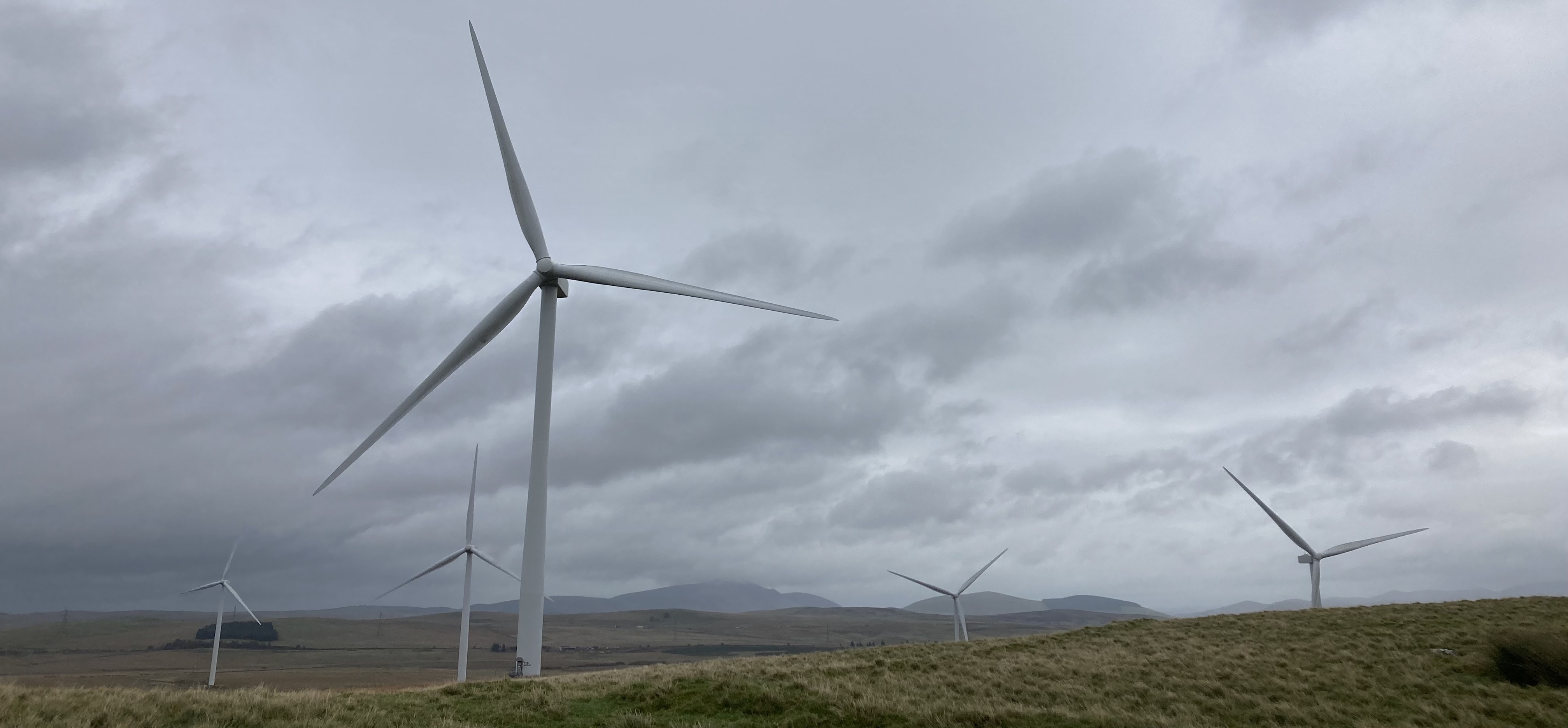
The National Park conversation grinds on in Galloway, but an important new piece of evidence points to serious concerns about the consultation process. It brings us back to renewable energy, and the perennial fear that southwest Scotland is becoming a “windfarm dump”. It’s certainly true that this landscape has received an inordinate amount of turbines over the last twenty years, and local communities have often felt disempowered by an inability to influence what happens here. All too often, development proposals have been rejected at a local level and then carried through on appeal in Holyrood. No matter how you feel about windfarms, there have been some ugly pinchpoints here, and it’s no wonder that people have turned to the idea of a National Park in the hope that their voices will be heard.
Wind development is not permitted in the other Scottish National Parks, so it’s fair to imagine that a Galloway Park would be protected too. In fact, one of the reasons why the proposed boundary takes such a massive squiggly detour across the region is to ensure that the park doesn’t retrospectively designate some of the most heavily developed wind farm areas. When you look at the online consultation portal, the subject of windfarms comes up all the time. Many people argue for a National Park because they want to be protected from this kind of development – but at the public meeting held at Wallets Marts last week, civil servants from NatureSCOT conceded that the government is minded to overturn its moratorium on renewable developments inside designated areas. Which is to say that a National Park will probably not stop wind development here. That’s a massively important piece of information, and exactly the kind of information people need in order to make up their minds. It’s worrying that it only came up by accident in response to broader questions about land use.
You’d like to think that NatureSCOT would acknowledge this kind of misunderstanding on the consultation portal, because the engagement exercise goes much further than “do you want a National Park or not”. The project purports to uncover not only what we think, but why. On that basis, when there’s evidence that a lot of people are making their minds up on the grounds of misleading information, the project starts to fall apart. Can a YES TO A NATIONAL PARK response be counted if it’s justified by a mistake? Would the respondent feel differently if they knew the truth? The same blade cuts both ways, because we have to ask if there is any value in a NO TO A NATIONAL PARK response that is justified by a fear of things that don’t exist. In theory, both contributions should be completely inadmissible – they’re just wrong. But in the end, there must come a point at which the sheer weight of misunderstanding turns the consultation into mince.
It seems likely that a majority of local people don’t want a National Park in Galloway, but we don’t really know for sure. Without a referendum, it also has to be possible that NatureSCOT will return a verdict of “unproven” because there’s a growing store of evidence that we don’t really understand the question anyway. That’s not our fault; the conversation has been mismanaged from day one, and there has never been any trusted provider of objective evidence to answer even basic questions. The Galloway National Park Association has provided lots of top-level information, but it’s all geared towards supporting their own views. It’s hard to see how this can be taken at face value, and their current wording on wind farms is shakily aspirational. They’d like a Galloway National Park to influence policy on renewable developments, but that won’t count for much if the law is set to change.
At the same time, we’re still being given repeated reassurances that “our National Park” can be whatever we want it to be when that’s simply not true. In the case of windfarms, we can create a park that doesn’t have renewable energy development and then afterwards discover that the law has changed and we get turbines anyway. So it seems like our National Park can be exactly what we want it to be – as long as it fits inside a relatively narrow envelope of what changeable government policy permits. Every time we’re told that this process starts from a blank sheet of paper, another strand of trust and credibility dies.
As it happens, I don’t have a problem with windfarms – but the issue stands as a good example to highlight fundamental flaws with the consultation process and the repeated untruth that we can have whatever we want. Because it’s not about windfarms anyway – the same misunderstandings may also be true for issues around forestry, housing, farming, planning and tourism. We don’t know how any of these issues will be affected – and without help to interpret the evidence, people are just using any argument to support any opinion. The consultation looks like a nonsense – and for no obvious reason, timelines are tight. We’re already in too deep to start again. We now have a few weeks to thrash and wail our confusion before it’s taken out of our hands. Whatever mistaken beliefs we held won’t matter then – the decision will be made for us.


 Bog Myrtle & Peat
Leave a reply to Duncan Bryden Cancel reply