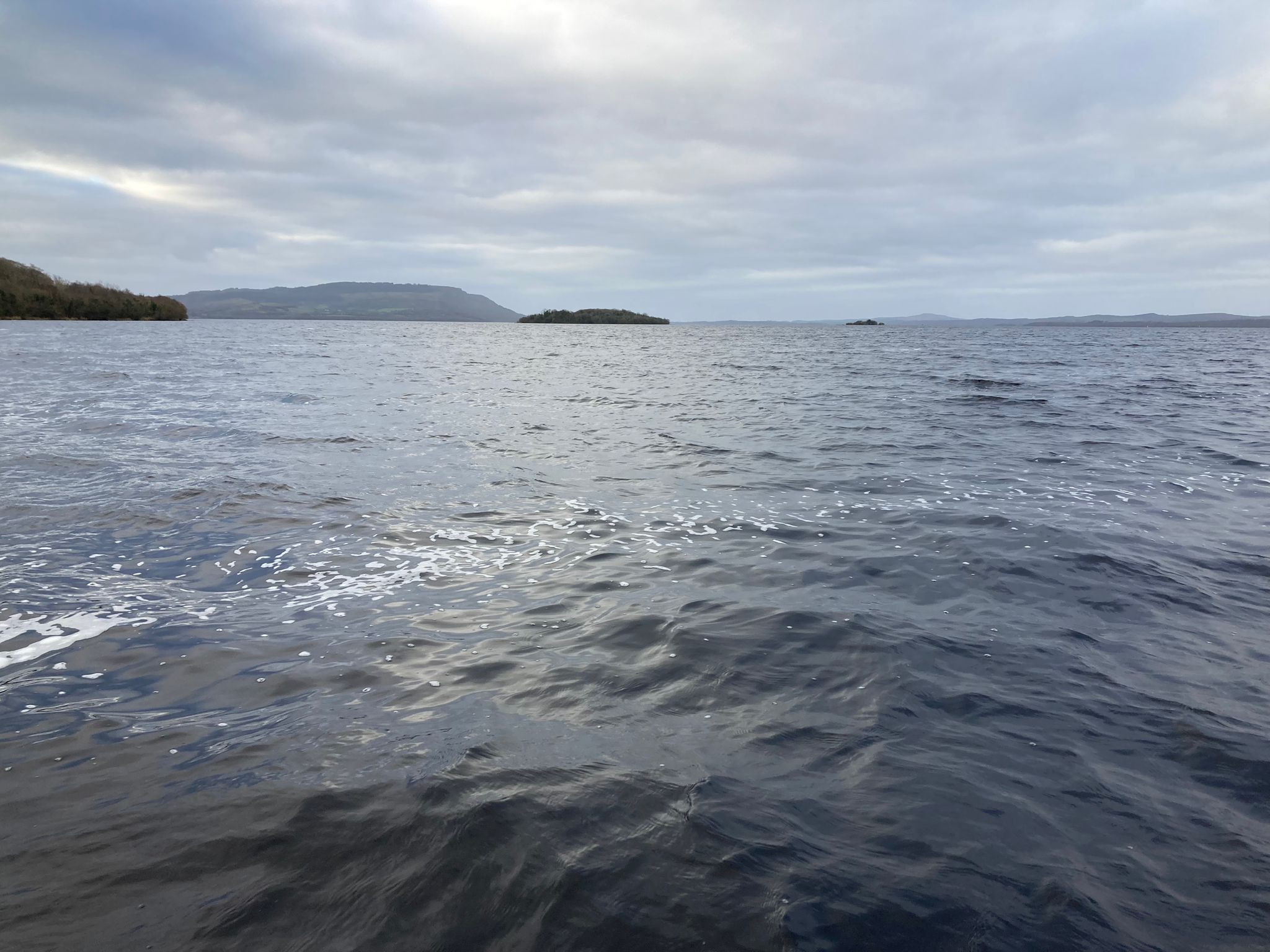
As we came at last to Inishmacsaint, the engine stopped and the lough lapped loudly on the hull of the boat. Whooper swans swam before us, then with a rousing pound of effort, they rose up to fly round and away. I saw five birds climbing; two white adults and three youngsters in murky shades of dirt and brown. Nothing could have spoken more deeply of Yeats than the weight of those swans as they worked above the dark horizon of Fermanagh, and it’s only thirty miles to Sligo and the great man’s grave. I would normally be shy of visiting a poet’s final resting place, but I’ve been to see the famous stone at Drumcliffe and was cowed by it. It cost a lot and gave me nothing, because Yeats himself is not really there. But in the sight of those swans and with rain piling up from the west, I shivered.
We’d already been to White Island and seen the early Christian carvings which have been raised on a rack for the sake of display. Shielded from the rain by a concrete lintel, they gurned and pouted, blowing out their cheeks with expressions of enduring patience. They meant more to the medieval pilgrims who used Lough Erne as a route to access Lough Derg and St Patrick’s Purgatory – but that’s not to say they mean nothing to us. Through the wreckage of walls and the snailish bend of a Romanesque doorway, they stand and stare dead ahead like guardsmen before a palace. Redwings moved in formation above us, and a cow coughed in the silence.
It seems like every island in Lough Erne has more to offer than the last. But Inishmacsaint shone for me in the final days of November – a small green island of less than seventy acres, the site of a monastery founded by St Ninnidh in the sixth century. The original building was pulled down by Viking raiders who made Lough Erne their playground, but even these more recent remains date back a thousand years or more. The stonework has crumbled and grown patchy and leprous with lichen the colour of ducks’ eggs, and ash leaves gather conspiratorially in the sheltered corners. Beyond these ruins, through brambles and the wine-dark spines of blackthorn trees, a high cross stands between the mud and the overhanging cloud.
We can all learn more about the significance of high crosses, and technical guidance can gradually help to unpick the enormity of symbolism and stonework in places like Ardboe and Monasterboice. These monuments are incredible, and new research is forever unfurling more detail and greater nuance about what they meant and how they were made. But I can’t help judging them simply upon the initial impact they make; the powerful punch conveyed by a strategic enormity of stone. Carvings and decorations are pretty and intriguing, but they’re of secondary interest beside that first reaction.
And that’s why I came unstuck at Inishmacsaint, because the high cross there is extremely plain. It’s simply a tall slab of grey rock, champhered down to a tenon at the top. Upon this tenon, a three-pointed stone has been hollowed out to create a mortice. The two parts slot together so obviously that you can almost hear the “clop” of contact made when they were placed together ten centuries ago. And this effect is even more compelling because there’s no specific narrative to boast or declare to the world at Inishmacsaint. There are no clever carvings or biblical scenes laid into the cross with care or attention – no dressing or freshening of stone to brighten the show or make a point. The cross at Inishmacsaint was thrown up in response to a deeper, more immediate need. It simply had to be there, and I can imagine those ancient masons gathering pace in their labour and creation as the work came together, just as you or I might rush with laughter or delight to complete the final pieces of a jigsaw puzzle. Surrounded by low hills and a dark expanse of fleck-lined water, they would have known they were right.


 Bog Myrtle & Peat
Leave a reply to Jane Shepherd Cancel reply