At the outbreak of the Second World War, my grandfather was farming in Tweedsmuir, a few miles south of Edinburgh. Without his widowed mother’s knowledge, he’d been training as a pilot at the weekends, and his call-up papers from 603 (City of Edinburgh) Squadron led to a chilly exchange over dinner. Within a few months, he was transferred south to Tangmere in Sussex just as the Battle of Britain erupted over the Channel. He would go on to shoot down nineteen German and Italian aircraft, and he ended the war as Group Captain with a mess of medals on his chest.
When we think of spitfire pilots today, we usually imagine an English public schoolboy in the style of David Niven – aristocratic, courageous and devilishly handsome. My grandfather lay outside that stereotype; he looked like me, and a streak of presbyterian dourness ran through him. In the heightened bravado of the time, it was normal for pilots to give each other nicknames, and these were often teasing or imaginative. Young men were making light of the terror and the relentless pressure of almost certain death, and from the outset of the war and to many of his friends for the rest of his life, my grandfather was called “sheep”. The name wouldn’t have made much sense to him at first, because everybody he knew from home was involved in farming. Perhaps it was a jibe, but he was a novelty to his peers in the RAF, most of whom were drawn from upper and middle class professionals in the city. “Sheep” says more about them than it does about him, but I can’t help feeling that he welcomed the name. He was proud of his roots, which had been the work of his family for generations. Besides, he had a fearsome temper too. “Sheep” wouldn’t have lasted long as a nickname if he hadn’t liked it.
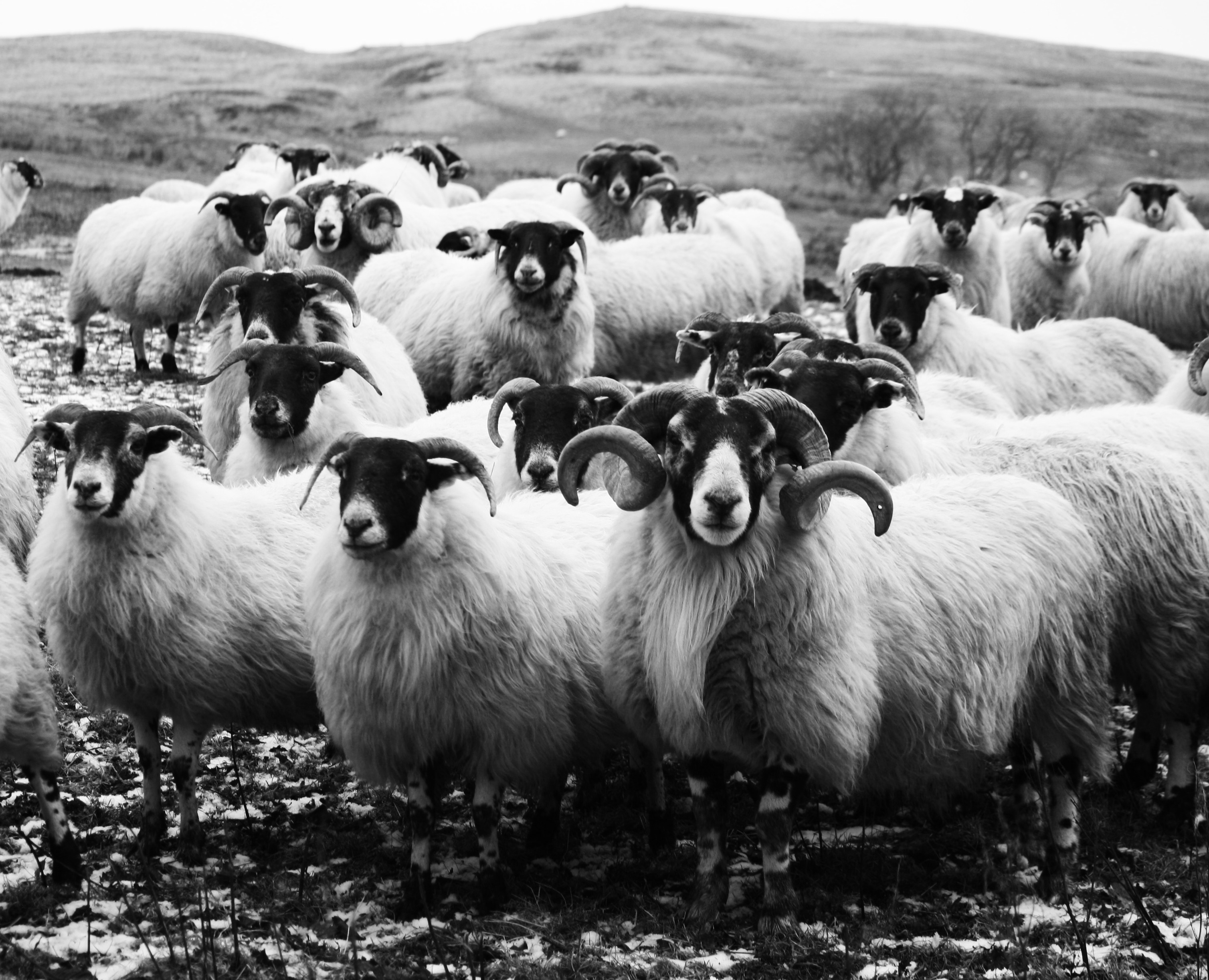
In the squadron diaries from October 1940, a caricature of “sheep” shows my grandfather standing in profile with a sullen, gloomy expression on his face. He has hands in his pockets and a pistol sticking out of his boot. Behind him, hills of sheep rise to the far horizon, at which point they blend into clouds and the sky is revealed in a tangle of fleeces and horns.
My grandfather died when I was twelve, and my memories of him are blurred into a wealth of stories and official accounts which detail his tenacious bravery in combat. But I do remember feeling frightened of him sometimes, not because he posed a threat or a risk to me, but because he carried a reputation for fearlessness. He courted danger, and he was never happier than when bulls ran wild or machinery span out of control. He’d be found laughing and gasping for breath with delight in the wake of terrible accidents which would have traumatised a sensible man. Farming was more dangerous in those days, but he seemed to play the odds to maximise their terror, and it seems inevitable that he was utterly unsuited to fatherhood – if not by inherent temperament, then certainly as a consequence of his war. The Battle of Britain has vanished into history over the past eight decades, but that man’s daughter became my mother, and they’re more than ripples that have rolled through two generations. And he could not have been more fascinating to a young boy in early apprenticeship for manhood in the 1990s. When I have tried to measure my own life against his, the comparison is never flattering – but now I begin to see that he was the outlier, and my smallnesses are normal.
In later life, my grandfather advanced into cattle and excelled with his galloways. They must have offered an exciting degree of danger, but sheep ran through him like sap through a tree until the day he died. And in him, my life and our landscape was crystallised as a clear expression of character, temperament and resilience. In truth, he was nothing special in the South of Scotland – just a man raised within the confines of an old tradition. But he was freed to ramp it up and play his parts on a wide, dramatic stage, his story like a condensation of a thousand others which rose and fell unseen in the silent hills. So when I think of home, I think of him – not in the literal expression of a stubborn, damaged man, but as an archetype – and all the quiet fury and patience of place expressed in flesh and blood.
The Cornish are hard as the tin from their mines; the Brummies are tempered by the swell of heavy industry. Think of the Geordie’s Coal, the Welshman’s slate and all the inhabitants of a thousand towns made famous by the sea. And realise that these Southern Uplands exist in the quiet, relentless dewform of endurance that is characterised by sheep; sheep in the guttering hills; sheep, and all that trickles down to the mart and the slaughterhouse; the clippers and the tangled mill.
None of these things should matter nowadays – we’re global citizens stirred up by a century of change, and my antennae for matters of belonging are unhelpfully attuned to the smallest details. But sheep are a fact of life here; they’re everywhere in everything, even as they now seem to ebb into irrelevance. In the past when I have criticised sheep for the harm they’ve done to our hills, I’ve spoken with a lump of guilt in my throat. Because sheep are not so much to blame for the damage as humans are, and it’s very like us to create a problem and then pass the buck to something else. I sympathise with ecologists who sneer at sheep, calling them woolly maggots; many hills are “sheepwrecked”, but coming as I do from a family of farmers, I have to measure my shame against the pride of generations which drew their lives from sheep. And it’s hard to hear sheep criticised without a sense that I’m being criticised too.
When I went to farming, I chose cattle because my grandfather had them. Besides, sheep were becoming unpopular in those days, and cows were an easier sell when it came to conversations about conservation. But after eight years, I realise that sheep and cows are part of the same equation, and suddenly I need them for a list of pragmatic reasons relating to grazing, conservation and productivity. I didn’t want to make this move, but even the first few steps in this direction have pulled me deeper into the bright, incessant cage of this place. And if all this sounds like subjective and emotive stuff, I swear that it’s relevant – because on the road to buy sheep in Lanark on Saturday morning, the hills at Dalvene and Crawfordjohn were noisy with ghosts.


 Bog Myrtle & Peat
Leave a reply to rogerdowald Cancel reply