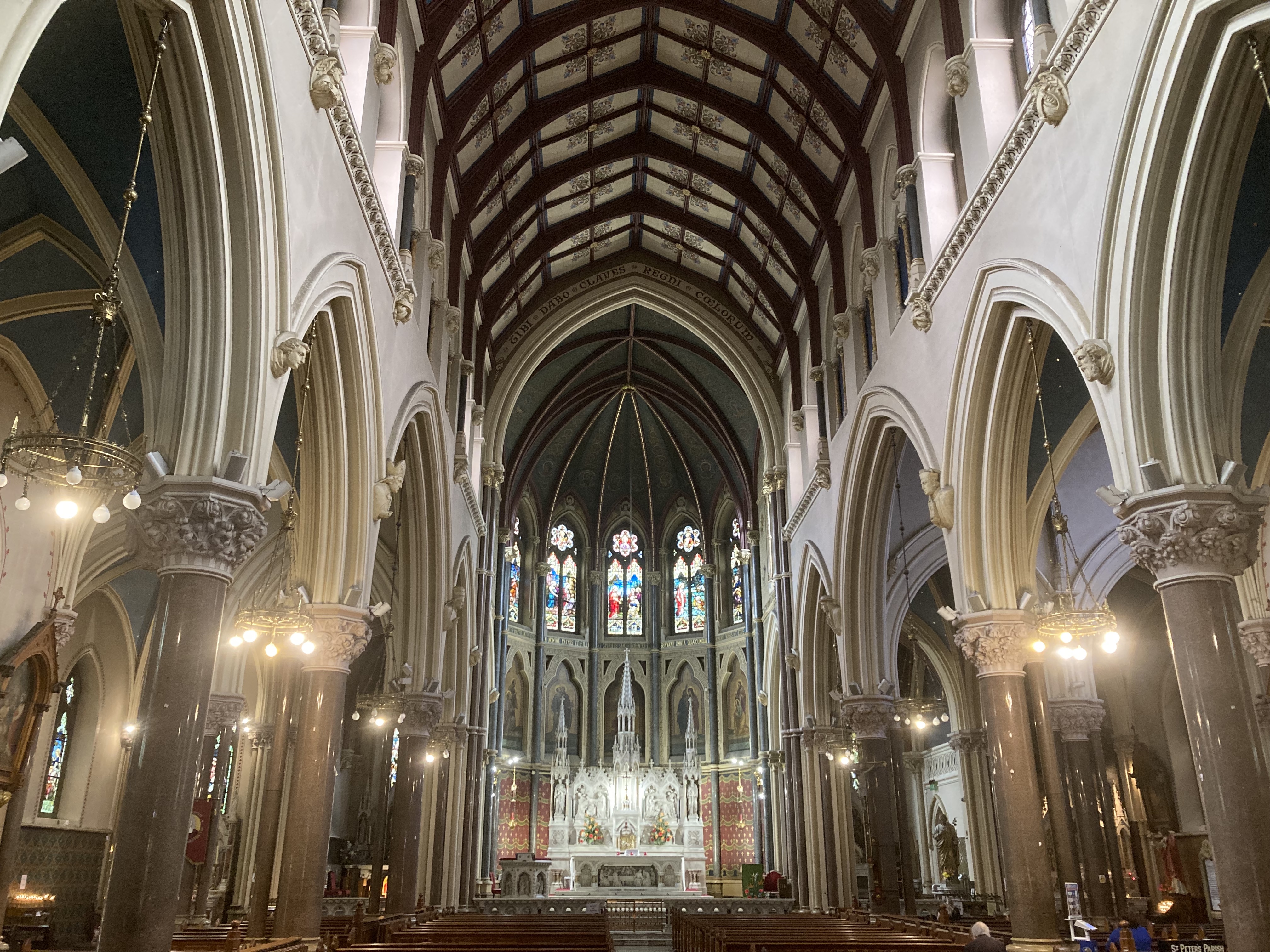
I’ve chewed over the memory of St Oliver Plunkett before. I found traces of the man at the Cathedral of St Patrick in Armagh last year, and I wrote at length about Saints and relics from the perspective of a secular Calvinist. But the statue at Armagh is merely one of many focal points for the memory of St Oliver Plunkett, and the National Shrine lies at the Cathedral of St Peter in Drogheda. It made sense to see it when I was passing nearby.
St Peter’s Cathedral is dressed from floor to ceiling in a pattern of cream and red and riotous emerald green. Light floods in from the clerestory, but whenever the doors are quietly opened or closed, the arcades tremble in a glow of candlelight. There’s a powerful tang of incense throughout the building, and several people sat apart in prayer as I arrived. Most were silent, but some were mouthing words noisily enough that I could hear their lips crackling.
The door of St Oliver Plunkett’s prison cell is on display at St Peter’s. The man was held at Newgate for eight months before he was executed in 1681, and the door is an imposing slab of chocolate-coloured oak, bound together with cast iron fittings. Nearby there’s a cupboard which contains a collarbone and a shoulderblade from the body of St Oliver himself. They’re brown and brittle-looking, and I thought they might as well be sticks of whinn for all they spoke of sainthood. But as I turned to face the nave, my eye was drawn towards a tremendous frame of glass and brass which rose in a single spire from the floor to the vaulted ceiling. The spectacle is designed to imitate a shaft of light descending from heaven, and it naturally draws the eye down toward a glass-fronted box which stands roughly three feet above the ground.
And it’s dark inside that box. Such attention has been paid to framing the space that at first it appears to be empty – but there’s a grinning shape in the shadows, and the head of St Oliver Plunkett is smaller than I had imagined, and drier than an unhusked coconut. A dark discolouration divides the face in two halves; the jaw and cheeks are chocolate brown, but above a line which runs along the cheekbones and over the bridge of the nose, he’s the same sad tan as a second-hand teabag. I noticed that there were a few whisps of hair above his shrivelled ears, but he’s otherwise bald and his nose is hard as horn. Over the course of three centuries, St Oliver Plunkett’s eyes have shrivelled into smallness. Skilful embalmers have teased the concave eyelids into a semblance of restfulness, but his most recognisably human feature are his teeth, three of which are whitely revealed beneath a distorted lower lip. Once you have oriented yourself to understand that this is a human face, you begin to see that it’s wearing a faint expression of disgust.
Feeling unsure how to engage with this piece of a man, I stood apart from it. Then I sat nearby. And as I sat, a man came and leaned before St Oliver Plunkett’s head, resting his hand on a ledge of the display case as he began to pray. Continuing his prayer, he walked three times around the shrine before pausing to kiss the spot where his hand had been. Not long afterwards, the process was repeated by two old women, one of whom was holding a loaf of bread in a bag which hung whitely from her wrist in the shape of a teardrop. Later still, a lay minister came and cleaned the glass with a squirt of fluid and piece of chammy leather. I hadn’t seen any fingerprints, but he must have known that people are in the habit of touching the shrine- and even if that’s not allowed, perhaps it’s inevitable when proximity is the name of this game.
I have no idea how to petition the power of a dead man’s head. My instinct was to stand apart and give the relic room to breathe, but as time passed, I began to feel as though I had taken the wrong tack. I watched as more visitors came and kissed and prayed around the shrine, and two children stood beside a multipack of Coca Cola as their mother bowed her head and took her turn. That’s when it seemed that while Catholicism is unquestionably thrilling and magical, life itself is often not – and in the ninety minutes I spent at the shrine of St Oliver Plunkett, spiritual engagement with human remains began to feel unexpectedly quotidian. To be clear, I didn’t see anything you could describe as disrespectful to the memory of a well-beloved Saint – but I did detect a moment or two when praying to a human head was just something else on a list of things to do that day, like buying stamps or waiting for the traffic lights to change.
Without causing offence, I could easily have asked some of those suppliants how they’d prayed and how I might go about doing the same – I bet they’d have told me, but I also wonder how their advice might have differed from that of a Priest or a Bishop. And from the church’s perspective, it must be hard to manage the interface between the sacred and the profane, preserving holiness in the face of normal, busy lives.
I thought that going to see St Oliver Plunkett “in the flesh” at Drogheda would be a nice way to tie off questions which arose last year in Armagh. But every answered question seems to provoke a dozen more which require exploration and thought.


Leave a Reply