I’ve sometimes complained about badgers, particularly in relation to groundnesting birds. It’s clear that badgers are a problem for waders in my part of the country, but I have to concede that the issues are complex and they vary according to a range of issues.
Badger numbers have risen sharply in Galloway over the last ten years. But in writing that, I’ve exposed myself to controversy because in truth we have nothing like a usable population estimate for this species. People who defend badgers find that this ambiguity suits them down to the ground. Until it’s finally proven that badgers are abundant, it’s easy to cast them as endangered and in need of special care. So if I say that badger numbers have risen sharply in Galloway over the last ten years, I can only base that claim on my own observations. I think most people would agree that it’s true – but there is almost no peer reviewed data to “prove” it.
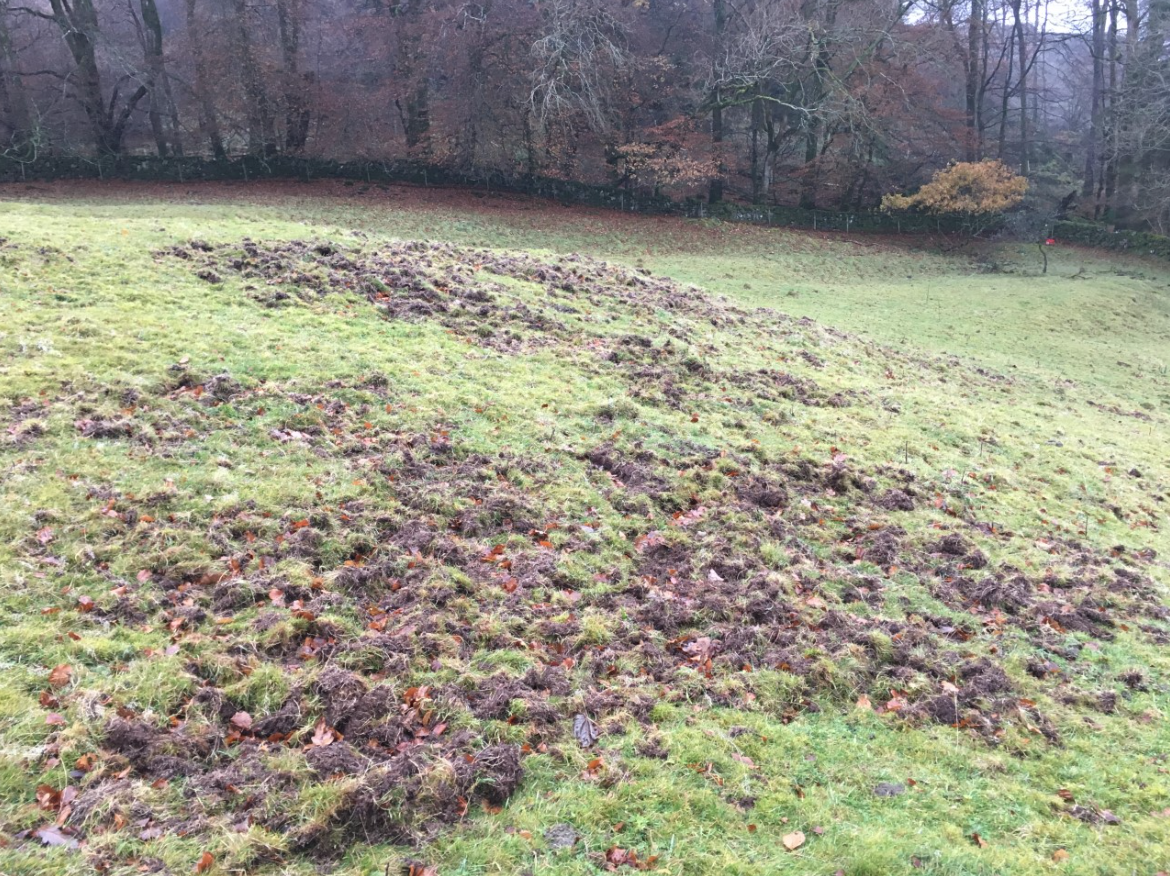
Here in Galloway, the decline of waders is just one of many associated consequences of a greatly increased population of badgers. Another consequence is the damage caused to pasture and grassland by badgers rooting for worms and grubs. This can be surprisingly bad, and I’ve been documenting a number of cases which are so dramatic they could be mistaken for the rippings of wild boar. I’ve had big areas of good grass turned over into mud, and it’s been frustrating to realise that there is no clear mechanism to fund the repair work.
One area of grassland was so badly damaged that it required a complete reseed, but when I asked NatureScot if there were payments to support this, they explained that there is no precedent for funding this kind of work. They said that for a start, there is no evidence that badgers could ever damage grassland seriously enough to warrant a reseed. I wasn’t seriously expecting compensation. I was only trying it on, but it seemed to confirm my impression that the story of badgers in modern Scotland is a tale of missing data and ungathered evidence. We basically have no idea what badgers are up to – and on the basis that “no news is good news”, people who defend badgers are happy to keep the lights switched off.
I know plenty of farmers who complain about badger damage on grassland. It’s a common issue nowadays, not only for the loss of grass but also because a damaged sward is more likely to be penetrated by weeds. And here’s where I sense a degree of hypocrisy in myself, because I’m specifically managing some of this land for biodiversity. I’ve now gathered multiple examples of grassland which has been damaged by badgers which afterwards grew on to be more diverse; the “weeds” turned out to be wildflowers. This should be no surprise, but knowing there is evidence to show how wader chicks do better in diverse grassland, it’s actually possible that badgers are improving wader habitats by rooting up the grass and introducing diversity to the sward. I’m only half-playing here. Badgers could be a wader’s friend.
Two responses arise from this. The first is that when I’ve shared this observation informally, lots of people have liked it. It sounds great, but we must remember that it has no data to support it. It’s only a hunch, but I’ve been surprised to find it’s being taken seriously by all kinds of conservationists. I can’t help but measure that sense of interested approval against the similarly unsupported hunch I have that badgers are a problem for wading birds. That’s ignored or disparaged because… it has no data to support it. The lesson is perhaps that “good things” are often accepted from anecdotal evidence, but “bad things” require data to prove them.
The second response relates to badger PR. If badgers create good habitats for wading birds, that’s a good news story. Forget the fact they also undo that good by eating up all the nests – the bigger issue is that I’ve only noticed this mechanism because there are so many badgers around. To promote the idea that badgers have become a force for good, we also have to acknowledge that something has changed. That something is that badgers are abundant now, and they’re having an impact on the landscape. But that’s a surprisingly controversial point, particularly for people who promote the narrative that badgers are uniquely scarce and benign.
There’s an opportunity here. We could look at ways to encourage badgers onto wader breeding habitats when waders aren’t there. During spring and summer when eggs and chicks are vulnerable, we could see if there’s a way to restrict badger access. This sounds finnicky and difficult to implement, but given that I’m in favour of lethal control of badgers, I think it’s fair for me to compromise and be open to non-lethal deterrents. Everybody stands to gain from a little give and take, but not if the people involved in badger protection continue to insist that there’s nothing to see here.
I’m only thinking aloud with this idea. I don’t expect to be taken seriously, but I wonder how far badger enthusiasts damage their own cause by refusing to engage with real-world conservation.
Picture: Signs of badger rooting in one of my fields – 27/10/2020 – this has recently come back with a strong preponderance of wildflowers.


 Bog Myrtle & Peat
Leave a reply to neil steven Cancel reply