I wrote an essay about eels for a competition in 2021. I was pleased when it was longlisted, but it went no further than that. After the dust had settled, I went back to my words and rewrote them in the spirit of practice and refinement. I wanted to be utterly precise, and I was interested in the challenge posed by balancing descriptive writing against more analytical material. To make certain points regarding the symbolic ambivalence of eels, I used quotes from Eugenio Montale and Ted Hughes, then balanced them back against my own clearly-held memory of cutting the heads off eels as a teenager. Some of it was fairly “on the nose”, and other parts were flabby. I must’ve worked and reworked that essay ten times until I’d rubbed all the fun out of it. Then I left it.
There’s an almost defunct eel works at Toome on the edge of Lough Neagh. It’s very close to where the poet Seamus Heaney grew up, and it must have been some place in its heyday. Eels are a continual presence in Heaney’s writing. They allow him to straddle a boundary between ancient and modern worlds, focussing on a transition between the two. So his eels are both ghoulish and quotidian, a mythologised commodity that’s never rendered with much stability. I’m fixated by that tension in his work.
In an interview cited by RF Foster, Heaney talks about his writing as a response to wider changes in Ireland since the Second World War, particularly a transition from “the sacred to the profane”. He’s anchoring these words in a wider transition from Catholicism to secularism, but they’re universal too. His work is a constant tussle between magic and pragmatism; nostalgia and modernity – and one of the features of his poetry is that nimble ability to shift from the heavy, handily chosen symbol to the weightless universal.
Bearing this “sacred / profane” motif in mind, examples continually spring into view in his poetry – not least a description of his childhood located “between the haystack and the sunset sky/ Between oak tree and slated roof” (from A Herbal). Once you tune into this pattern, it’s engrossing – and far larger than any one context. Hammering my thoughts, I find a fair measure of my own thinking reflected in this too, rarely expressed with greater clarity than when I visited Toome and saw the eel works for myself on Tuesday morning last week.
Factory sheds stand above a huge and rusting concrete weir, reinforced by sheets of weldmesh and girders. Here is where the eels are marshalled to their fate in the sullen water of the River Bann. Vast, inescapable crates are lowered down into the river on ratchets and pulleys, and when they’re raised again, they’re heavy with a new catch. Eels have been traded from Lough Neagh for thousands of years, but this weir is a Twentieth Century response to the problem of catching fish; an industrial refinement complete with cranes, crank handles and thin leaks of oil which shimmer on the river’s surface. It’s the logical conclusion of Heaney’s progression from the sacred to the profane, and it’s no wonder this place captured his imagination when he knew it in the 1970s, treading an uneasy line between those who could remember the old ways of catching eels and a new generation impatient to refine and improve.
But there’s an additional rub here, because nobody eats eels in Northern Ireland anymore. Eels themselves are endangered, and the site only operates thanks to a special derogation granted on the grounds of cultural heritage and ecological sustainability. Eels caught in Lough Neagh are exported to a European market, and Toome is only a shadow of its former self. Much of the old equipment looks like it has passed beyond repair; there’s a crumbliness to the eelworks now, and a smell of stagnant water, which really is the smell of eels themselves. When eel meat is sold from this place, there’s value added in words like “traditionally caught” – a telltale suggestion of efficiency confounded; raw economics finding a new direction in quality above quantity.
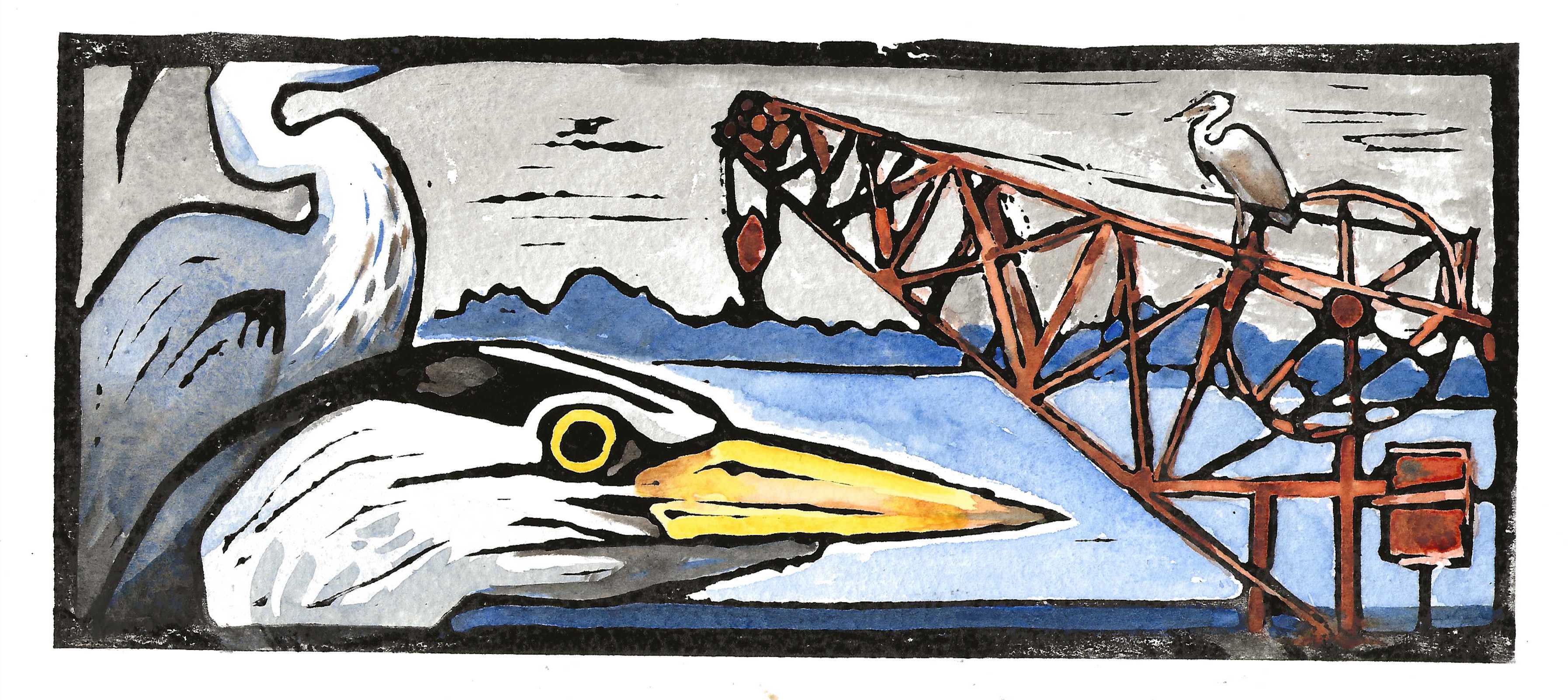
The main beneficiaries here are herons, which stand in endless patience beside the outlet of a pipe where pieces of eel are sometimes blown back into the water. The birds shriek and scart on the rivets, and even in August, youngsters still beg their parents for something new. In the midst of this post-industrial wasteland, there’s an almost biblical sense of reversion which evokes the aftermath of Edom’s destruction in Isiah 34:11 – “But the cormorant and the bittern shall possess it; the owl also and the raven shall dwell in it: and He shall stretch out upon it the line of confusion, and the stones of emptiness“.
I sat on the weir for two hours, during which time a handful of people walked their dogs nearby. One man drew up in a plain white van and, with the engine ticking over, he shouted “Are you Michael?” out of the window. I said “No”, and then I asked “Do you work here?” He ignored me and spat a pellet of green phlegm onto the tarmac. Then lighting a cigarette, he walked over to throw up the rollerdoor on a nearby warehouse; a racket which drove most of the herons back into flight.
I was glad of this man, and pleased for his rudeness and the moment’s discomfort he caused me. It was a reminder that he was at work, and Toome is not some neutered tourist attraction where the staff are always pleased to see you. There’s a sculpture of eels by the main gates, but there’s a satisfyingly repellent “fuck you” attitude on the quay itself. Before I left, I was able to buy some Lough Neagh eels from somebody in the factory. It wasn’t straightforward. They’re not really set up for direct sales to the public, and it took some time to work it out. In the end, a man gave me three grey shapes curled like ropes together in a vacuum pack; all the wild mythology of western Europe rendered headless, hard and grey. I took more from the experience of buying those eels than I did from eating them later.
Heaney wrote of the sacred and the profane as if they lay at opposite ends of the same continuum, with time or progress drawing us from former to latter. I rail at this because it seems to imply yet another thing my generation has missed – if the sacred world has gone, that leaves me only with profanity. But in truth, those words are wholly subjective; Heaney’s sense of the profane encompasses much of what people my age would call sacred. And nothing exists in either state entirely; if what’s literal has gone, a desire to find something like them remains, so even that hot gobbet of foaming spittle landing on Edom’s broken tarmac fell somewhere between the two states.
If we allow for backwash and eddies in the transition from sacred to profane, Toome proves an eelish ability to moves both forward and backwards. Perhaps the transition was clearer for Heaney when he first waded in, but now the waters have been muddied; nutritious old sediments are free to swirl, exchanging weight for shifting wonder. Perhaps he’d say that my generation has missed the boat, but I prefer to think this journey’s just getting started.
Picture: Herons at Toome 13/8/22


 Bog Myrtle & Peat
Leave a reply to Stephen Shellard Cancel reply