I got almost everything I needed from the Tourist Information Office in Donegal. The woman there was very helpful, and when I asked for a map of walking routes into the hills, she gave me a laminated card with a red line marked neatly across its middle. “It’s called the Bluestack Way”, she said. “There’s your route”. I thanked her, but remarked that “The Bluestack Mountains are huge, and there must be many ways to find them?” “Yes, there’s the route”, she said, pointing at the red line again. I frowned. I said “So how do I get up there?”, pointing to a hill which lay far away from the line. “Why do you want to go?”, she said.
We parted company, each feeling that we’d failed to make our position clear. In the event, I drove up into the mountains, abandoned the car in a forest layby and jumped over a fence. It wasn’t easy walking, not least because there was no obvious path. But I hadn’t just chosen a silly place to start; as I climbed higher up into the hills, I found that there were no paths at all – and nothing more than a few narrow sheepwalks which led away on distracted routes through the heather. Water gurgled through beds of butterwort and asphodel. Lough Eske opened out beneath me, and it was tempting to imagine that I was the first person ever to have walked that route.
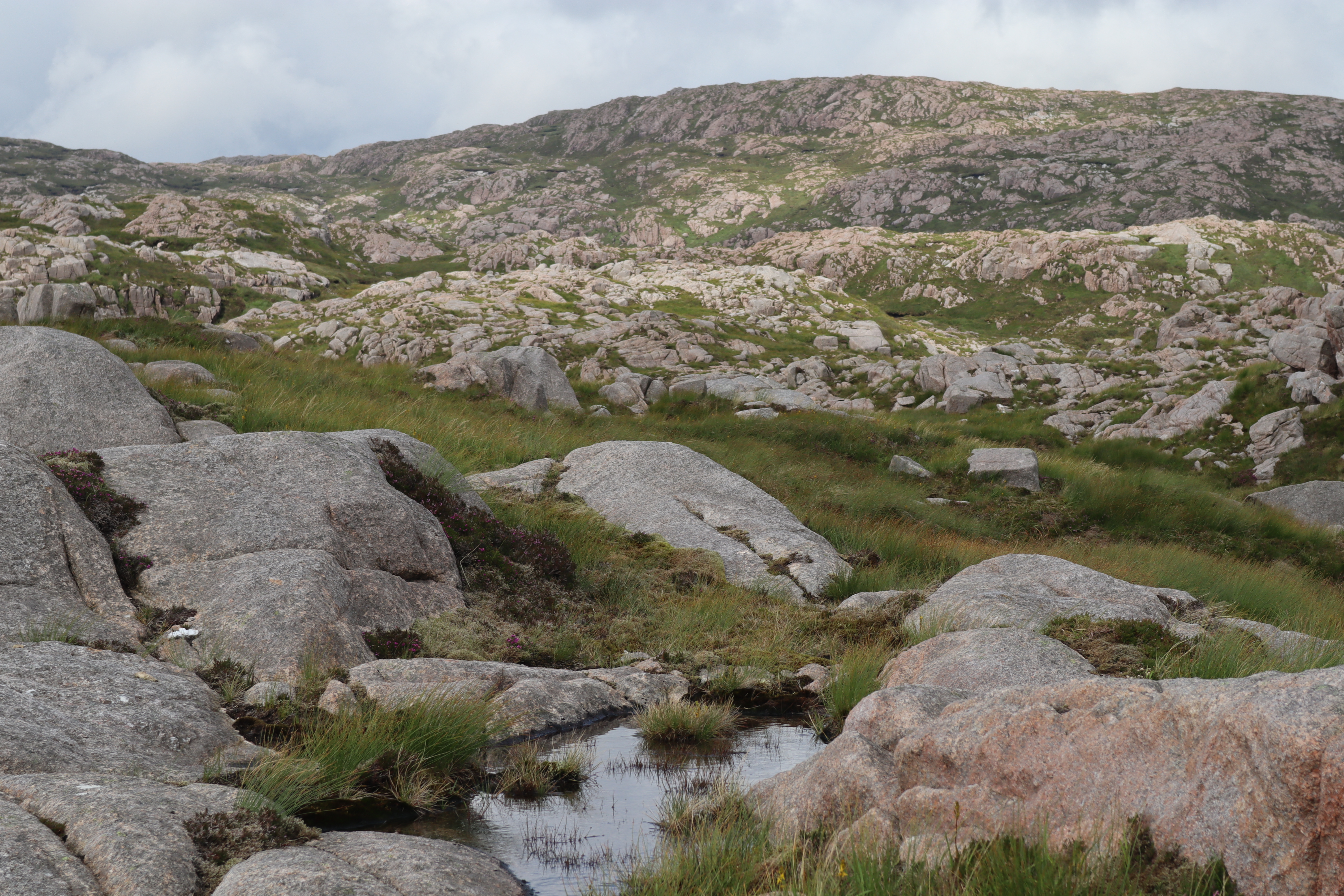
Above a certain height, the hills dropped any pretence of kindliness. What had passed on the lower slopes for scruffy charm became open hostility on the glaciated rock. The moss vanished, giving way to a series of slender seams which ran wherever the water could hold them; a thin green fishnet of vegetation between extensive mounds of bitterly sharp granite. I zigzagged back and forth through endless boulder fields, dodging vast glacial erratics which propped themselves like cars and buildings before me. I often found myself at dead-ends and was forced to retrace my steps in search of other ways onto a shoulder of the hill.
That Bluestack rubble reminded me of the worst hills in Galloway; Craignaw and the Dungeon, hardly the tallest or the most glorious, but devastatingly austere and beautiful. I call these hills the “worst”, but in truth they’re my favourites. I can lose entire days up there, wandering between the rocks and the ravens. They’re only “the worst” because they’re so demanding; relentless lunar landscapes which are hard to reach and harder to leave. And I loved these Bluestack Mountains for the same reason; the endless curiosity of rocks deposited by long-dead glacial flows, and a sense of theatrical drama in the cloud which came and went from the west. If anything, the shoulders of Croaghgorm are more severe than the Dungeon Hills, and potentially prettier too, given the pink mineral cast of the rocks in the afternoon sun. It’s only grey in Galloway, and monochromatic as a newspaper photograph from the 1960s.
I sat for a time at the summit, looking north across an unfamiliar pattern of loughs and mountains. But when the sun came, it warmed the grass and grounded me in a scent of acrid water; of moss and myrtle. I’d know and love these ingredients anywhere, particularly in August with the first clean movements of meadow pipits across the high ground when the hills are almost soundless apart from the crickety tseep of small birds on passage. But in all those five hours of walking, I had not seen another human soul on the hill. Once at lunch I reached for my binoculars and watched a car pull up next to a picnic spot two miles below me towards the sea. Three people got out, and for the next half hour they seemed to be eating at a plastic table. Then they left, following the map’s red line of the “Bluestack Way” in their car. Perhaps it’s fair enough to leave the hard walking to suckers like me, but it seemed like this walking route is commonly patronised by vehicles.
I recognise so much of this place in the texture and smell of Outer Western Europe. Donegal is almost an anagram of Galloway; the same constituent parts rendered in a softly different order. But measuring Scotland against Ireland, I felt like there was a divergence in our attitudes towards landscape and nature. The Bluestack Mountains are culturally crucial; almost every postcard in Donegal has a view of the bogs and the rough hill contours which stand above the town. But there’s also a closely held memory that life in the hills is hard and best avoided. I began to feel like truly wild places have little romantic appeal to the popular consciousness here; they’re not to be enjoyed for the sake of themselves.
Even away from difficult hills, I also sense that where nature is presented (in the form of “beauty spots” or “scenic areas”) for public consumption, it’s frequently tidied up and smartened out with picnic benches and tarmac. If you want “wilderness”, it’s made available in a series of tidy and curated spoonfuls. I was suddenly conscious of how Scotland makes nature available, not only in a universal Right to Roam, but in the sheer quantity of people who are actively exercising that Right. Perhaps there are generational or socio-political demographic divides which conspire to speak the same words in a different accent in Ireland, but while what’s here is no better or worse than attitudes at home, it’s unavoidably different.
As if to confirm that early sense of confusion established in the Tourist Information Office, I met a man on the walk back to my truck. He was loading a tractor’s trailer with bags of peat, and I offered to give him a hand. He could hardly have been more friendly, and he asked me where I’d been. Lifting sacks of brick-hard peat onto the wooden boards of the trailer, I turned and pointed up to the summit of Croaghgorm, which loomed above us in the evening sun. I said “I’ve been up there”. He frowned and asked “Why?” I wasn’t able to give him a clean answer, and I wasn’t surprised when he later said “I’ve never been up the top of that hill”, despite having lived in its shadow for almost sixty years.
Picture: Across the south face of Croaghgorm towards Mullaghnadreesruhan 5/8/22


 Bog Myrtle & Peat
Leave a reply to bitofanactor Cancel reply