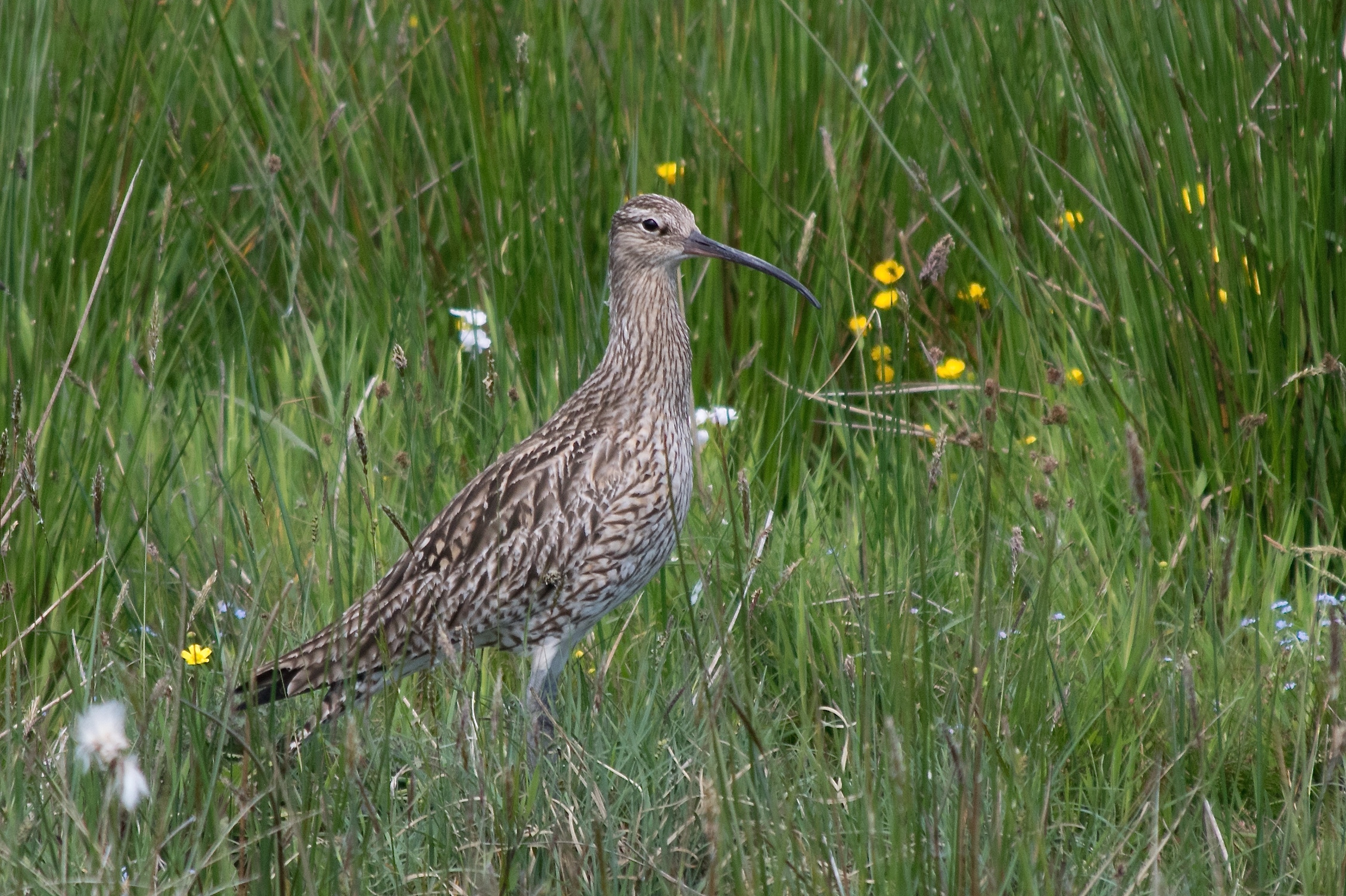
I’m staggered by the absence of curlews on the hill this year. I knew they were struggling, but I did not expect them to fail so completely or so soon. I thought there was still time to sort things out, and while it’s not impossible that birds might return in the future, curlews are so faithful to their old traditional breeding sites that it’s surely quite unlikely.
In the aftermath of this old tradition, I spent a few hours digging through old notes to compile a picture of curlews over the last twelve years on my grandfather’s hill farm; a place I’ve know all my life. I used spend a great deal of time on these notes, but I didn’t realise they’d come in handy for such a gloomy task. Now that I see these details brought together in one place, it’s patently obvious that the birds should’ve failed and I’m only surprised that it took them so long. Twelve seasons, and not a single certain chick to show for all that work.
2010
Roughly twelve pairs of curlews came to breed on the hill. Most arrived on March 1st, but all were holding territories and displaying by the middle of that month. There’s hardly a single entry in my notes which does not refer to curlews. On June 24th, I recorded the fact that curlews seemed to have stopped calling. I didn’t know at the time that this probably indicated failure of most if not all curlew pairs.
2011
I didn’t repeat any attempt to count curlews, but the first returning bird was seen on March 2nd. My notes describe “many” pairs of curlews on the hill. On May 2nd, I found a nest containing four eggs, but I was evidently more interested in the discovery of an adder’s skin. By 15th June, I noticed that curlews had “gone very quiet”. I can’t be sure so long after the event, but it’s unlikely that any curlews bred successfully in this year. On July 1st, I found part of a curlew’s egg which had been predated by a crow.
2012
“At least eight pairs” of curlews, including one nest very near the road containing two eggs on April 27th. This was a disastrous summer – it rained from May until August, and it became impossible to tell what happened to the birds. I found and photographed curlew eggshells which had been munched by a badger, and also discovered the remains of an adult curlew predated by a raptor on June 3rd. Curlews were either very quiet or absent from the first week in June.
2013
Curlews returned on March 7th. I counted four pairs in the fields where I was repairing a dyke, but also described hearing “many more” on the hill. One male bird had a very obviously broken leg and was christened “Dropleg”. Horrendous snow came in the last week of March and lay until May. The weather was fine and grouse did very well this year, but I recorded my feeling that curlews “have all gone without raising a single chick”.
2014
Curlews were late back – March 15th. Dropleg was in the same corner of the old hayfield, and seven pairs were counted and confirmed, including one which may or may not have laid their eggs just over the march dyke on the neighbour’s place. By pure accident, I found two day-old curlew chicks on the hill track – the first I had ever seen on our place. I never saw them again, and the parents were gone the next time I went that way. It’s clear that these chicks were predated.
2015
Four pairs came in the middle of March, and another pair turned up in April. Dropleg held his territory from March 25th and was spotted feeding in a surprisingly wide area across three farms. We had five pairs of curlews in all, and my notes clearly show my increased level of interest in these birds. I found two nests, both with three eggs. Both were predated, and all birds had left the hill by June 25th when I went to turn peat.
2016
Four pairs arrived in the middle of March, but they seemed to be more tightly focussed on a handful of fields than before. We had a small but beautiful black grouse lek this year, so my attention was focussed away from curlews. Dropleg held the same territory and his partner laid a nest of four eggs by April 28th. This nest was gone by May 5th.
2017
The first of several very cold, dry springs. Three pairs arrived in late March, but dropleg was not with them. One pair nested in precisely the same location as 2015; to within ten feet. This nest was raided by the next day when I went back with a camera. There was no damage to the nest, but the eggs had simply vanished. On June 3rd, I found a single week-old curlew chick on the hill. I watched this youngster on-and-off for two weeks before it disappeared and was never seen again.
2018
Three pairs of curlews came at the end of a hard, frosty March, but it was hard to see where their territories were, and there might have been five or seven birds. No nests were located, but two very small (and rather smelly) curlew chicks were found dead at a fox den on June 7th. I don’t know where these came from. All curlews had gone by June 12th.
2019
Three pairs returned on April 7th. A mass of curlew feathers was discovered on April 10th, suggesting that at least one of these birds had been killed and eaten. Two nests were found on May 17th, both with two eggs. Both nests were empty by May 21st. Several individual curlews arrived on the hill in the first week of June, and some of these birds displayed as if they were setting up territories, but nothing came of this.
2020
One pair was seen for a time on the hill from April 17th. The birds seemed to disappear, but later emerged as if from nowhere with three chicks on June 1st. Two of these chicks made it to three weeks and one to four. None survived to fledge. Other birds sometimes arrived and contributed to a confusion of behaviour elsewhere on the farm, but there was no outcome from this activity.
2021
One curlew returned to the hill in March and was occasionally joined by another in April. Neither made any particular connection to the place, and both would fly off in a state of exaggerated panic when disturbed. A friend from BTO came to look at curlews and saw two birds displaying together across a very large area of moorland as if they couldn’t make their minds up where to be. These birds were gone by mid May, and only an occasional bird showed up after this point. On Midsummer’s Eve, I found a very freshly dead adult curlew lying on a quadbike track. It was scarred with tooth or clawmarks and had clearly escaped predation to die of its wounds afterwards.
2022
No curlews returned.


 Bog Myrtle & Peat
Leave a reply to elwyn73 Cancel reply