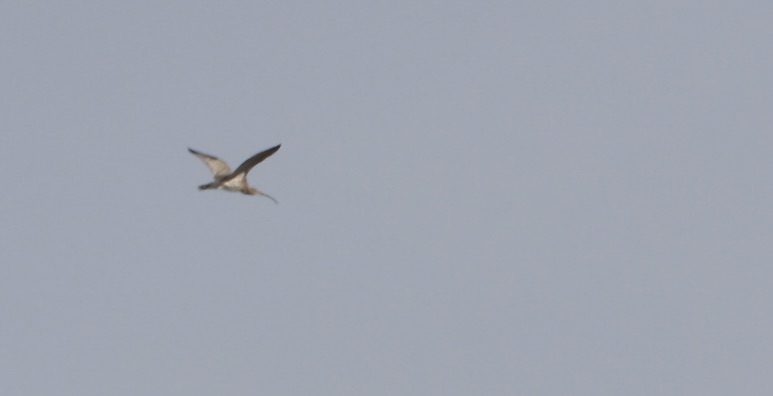
I’ve been banging on about curlews for years, usually from a dismal angle of decline and loss. I’ve been aware that the birds have been vanishing in Galloway ever since I began to count them in 2010, but now we’re really down to a skeleton crew. I fret and worry about these survivors, but I can only do so much as one man on his own. I’ve done my best with the birds on my own place and I’ve also delivered some constructive work with my neighbours, but curlews need help across large areas which I simply cannot provide.
Perhaps the scope of the problem is now too enormous to fix, particularly as extensive areas of traditional curlew breeding habitat continue to be planted with commercial forestry each year. But even at this late date, maybe there is still value in trying to bring things together for these birds on a bigger scale. I need to be clear and say it’s quite clear why curlews aren’t doing well – a survey won’t fix anything on its own. However, a survey does allow resources to be mobilised and brought to bear where they’re needed. I’ve now done enough work for wader conservation to understand that help does not come looking for you – you have to go out and find it, and it’s hard to sell the idea of a large-scale curlew conservation project to any potential supporter or funding body without some data to illustrate the problem. Even if you can get people interested without data, the first thing they’ll want to do is a survey. So I’ve decided to do one, and thereby establish something like a baseline to begin with.
Over the last week, I’ve begun to draw together a survey of curlews in eastern Galloway. The map below highlights the area I’m interested in, but it’s essentially the catchment of the River Urr to the west and the rivers Nith and Esslin/Cairn to the east and north. This is a large and very hard-working part of Galloway, dominated by spruce trees and dairy farms, which each cause different kinds of trouble for the birds. I chose this patch because it’s where I live, but the landscape of the river Urr also represents a fair microcosm of the curlew’s year in Britain, featuring habitats which run all the way down from white, peat-dominated moorland to estuary and salt marsh. It’s a good case study for many other unsung areas of curlew habitat in Scotland and beyond.
I’ve started asking people to get in touch with me if they see or hear curlews displaying in this area between April 1st and May 15th 2022. This is not a guarantee of breeding activity, but it’s a fair start towards identifying important areas for these birds. Where more information is needed, I’ll do follow-up visits to find out more. If we can find nests, I might even be able to monitor the eggs with cameras provided by the Working for Waders project. That’ll add even more detail to demonstrate the nature of the problem.
It’s rather surprising to realise that I have no evidence to support the certain truth that curlews are failing here – there are no existing surveys or records. All I can do is share my “anecdotal” tales of nest failure, but I’m often surprised by how many people fail to accept that curlews aren’t doing well in Galloway. That’s partly a result of the fact that the birds don’t behave in a way that you’d expect from a species on the edge of extinction – it’s easy for us to get the wrong end of the stick. But it’s also because people cannot believe a bird that was once so abundant now stands on the brink of collapse. I know plenty of farmers who hear curlews return at this time of year and thereafter believe that all is well. They don’t bother spending time on curlew conservation because they cannot really believe that there’s anything wrong.
I think a survey of curlews would be a productive first step towards a bigger project for the birds. Working with a few friends and volunteers, I’ve already begun to stick pins a map to record the location of birds in eastern Galloway. It’s turned up some pairs that I wasn’t expecting, but it’s also revealed that several locations may have lost their curlews altogether even in the last three or four years. That’s useful to know.
I’m working with scientists from the British Trust for Ornithology on this piece of work. They’re counselling me to avoid predictions and work around my own internal biases. But I’d like to guess right now that I’ll find a hundred pairs; that’s a figure that I can reasonably expect to manage. I’ve already found twelve, and I’ve hardly even started yet, but the precise figure I get in the end is almost meaningless in isolation. I wish I could compare it to similar figures from 2012 and 2002 – that would bring the situation home. But I have nothing to compare this figure to, and that’s the inevitable curse of starting a piece of work that should have begun years ago.
It’s also worth noting that I would love to have done a project like this for lapwings, but there are now so few breeding pairs in this area that the work is largely pointless. At a guess, I’d say lapwings are down to fewer than twenty pairs in this 650km2 area, and that includes an RSPB reserve where lapwings are considered to be the flagship species. I’m determined that curlews should not vanish in the same vein, lost, overlooked and gone without so much as a farewell.
So can I ask that if you find curlews in the area illustrated below between 1st April and 15th May, please send me an email at gallowaycurlew@gmail.com.
Updates will inevitably follow on this blog!


 Bog Myrtle & Peat
Leave a reply to Christopher Land Cancel reply