Up to my neck in wading birds over the last few weeks, I’ve been hard-pressed to keep on top of my notes and journals. Every day seems to bring some new fragment of evidence or discovery, and in writing this quick article, I’ve had to force myself to make time for my computer to record a particularly shiny gem.
Golden plover used to be an extremely abundant bird in Galloway, but their numbers have crashed dramatically over the last few years. The specific drivers for their decline are linked to many of the other pressures which have devastated most hill and moorland species here – you could generalise theses issues as a huge expansion in commercial forestry, a complete withdrawal of predator control and changes in hill farming which have made habitats less appealing for the birds. It’s notable that I have a 1989 RSPB guide to birdwatching in Galloway which explains that plovers declined here since heather burning fell out of favour in the 70s and 80s. Golden plovers like the very short vegetation which comes after a fire, but having recently taken against burning on account of its links to grouse shooting, this is a rare admission from the RSPB that proactive moorland management can be really important for many upland species.
So golden plover have become madly obscure here, and it’s not surprising that their declines have taken place without much popular protest or complaint. We don’t miss them, and when we come to weigh up the pros and cons of land use change over the last half century, plovers add less than a single feather to weigh against political arguments of industry and progress. That doesn’t make them any less valuable to me, but losing a species without acknowledgement or understanding makes me feel really uneasy.
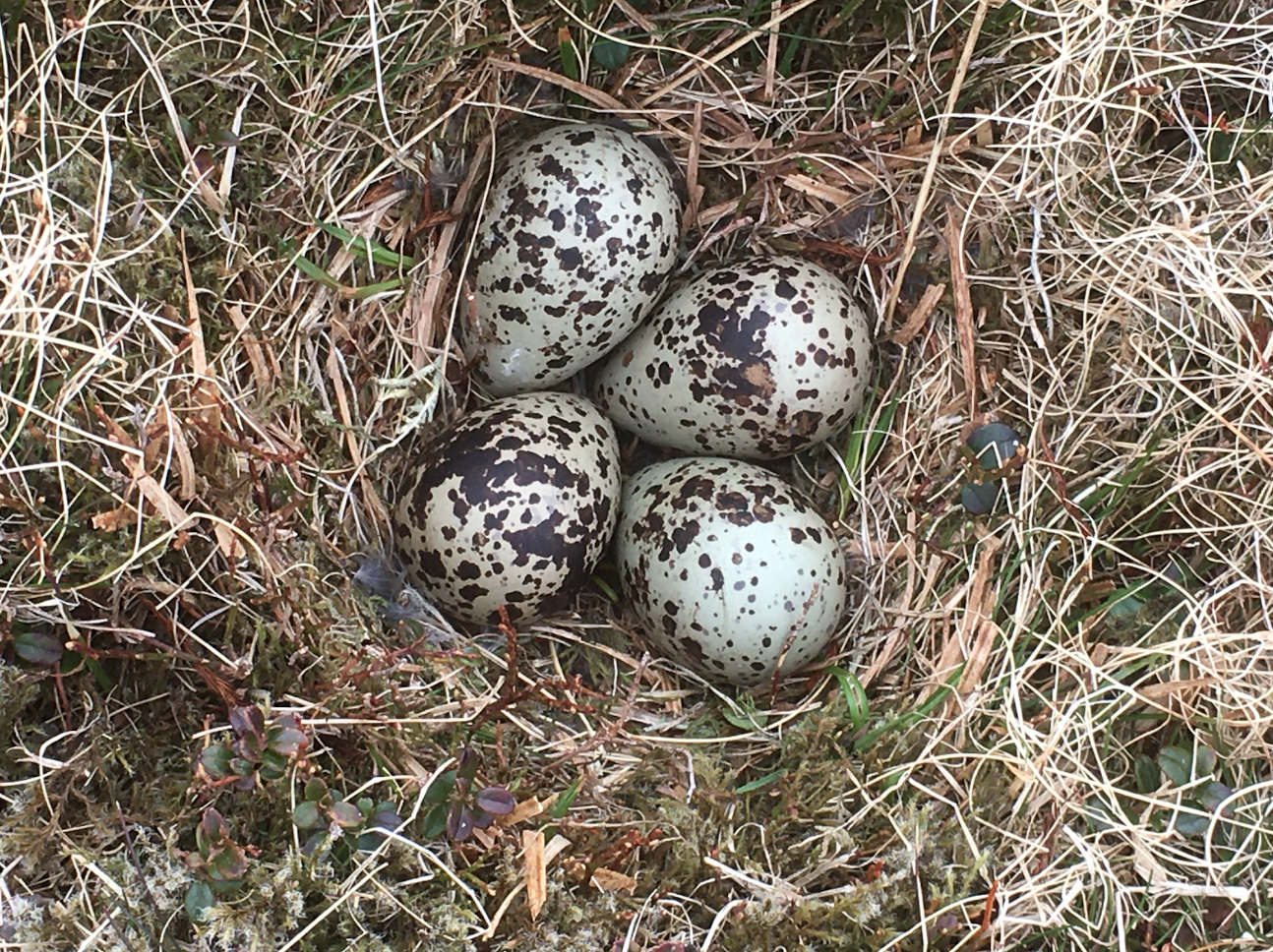
By complete accident, I happened to find a plover’s nest while walking in the hills on Sunday. I love the Galloway Hills, but I can’t ignore the fact that these remote landscapes are devastatingly quiet nowadays. We’ve lost an entire swathe of wildlife from the peaks and bogs, and in places which used to ring to the sound of redshank, dunlin and plover, it’s now quite easy to walk for hours without seeing anything more than a pipit. As I mooched around the scree, a little bird leaped up from the moss and fluttered away, feigning distress. It was a fair performance, but I was conscious that she was spinning me a yarn. Sure enough, her nest lay almost at my feet – a shallow cup of wind-nipped blaeberry containing four eggs. This was at an altitude of around 750 metres in one of the most spectacularly beautiful and remote locations I know – the first golden plover nest I have ever found in Galloway.
Given that I’m currently working on a project to monitor wader nests, it seemed obvious that I should record this breeding attempt. I’ve been supplied with satellite cameras to monitor birds from the comfort of my sofa, but there were some grievous logistical challenges to overcome in setting a camera up near this bird. For a start, returning home for a camera was a five hour round trip walking across some horribly challenging boulderfields and marshland. Finding the nest for a second time would be damn tricky, and I would have to follow some careful protocols to avoid disturbing the bird too much.
Sometimes you stumble upon a project or an idea which takes precedent over every other facet of your life. I cancelled all the appointments I had made for the next day and prepared to retrace my steps with a camera in my rucksack.


 Bog Myrtle & Peat
Leave a reply to bitofanactor Cancel reply