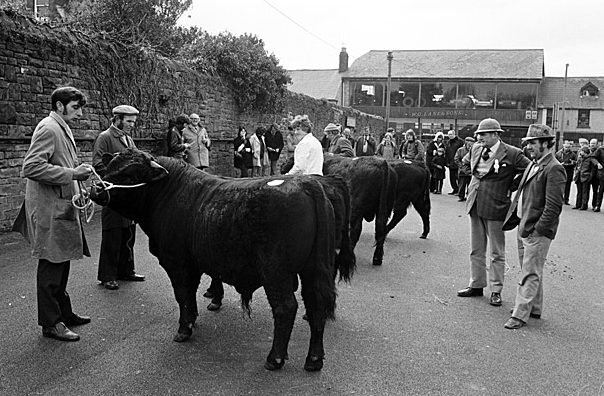
Perhaps I (and this blog) am becoming a little preoccupied with agriculture. The original purpose of this project when it was first launched in 2010 was to improve the conservation value of a dilapidated hill farm, and I’ve followed all kinds of threads since then. This latest swing towards farming is in response to my growing belief that many of our most pressing conservation issues can be resolved by understanding the link between agriculture and wildlife.
Along the way, I have thrown in my lot with native breeds of cattle. For me, an unexpectedly fascinating thread of the “Working for Grouse” project has been developing an understanding of rare breeds and traditional farming methods. My six heifers will be ready for the bull in August, and in looking around for a suitable suitor, I’ve been speaking to like-minded farmers from Devon to Perthshire. In so doing, I’ve stumbled across an entire galaxy of people who keep animals which are often weird and are always wonderful. Riggit galloways are not formally recognised as a “rare breed” (even though they are sufficiently uncommon), but the lessons I’ve learnt from riggits apply to all kinds of other marginal or endangered breeds.
In terms of providing a background for rare breeds, the Twentieth Century saw dramatic changes in traditional livestock farming. Regionally distinct animals which had been bred for centuries became “extinct” in just a few years as more profitable continental breeds came in to offer faster growth and greater profits. The momentum was so much in favour of quantity over quality that many marginal breeds of livestock were lost simply because they could not compete in the new market. In just a few years, we lost the sheeted somerset cow, the roscommon sheep and the lincolnshire buff chicken, along with twenty three other breeds which had taken generations to create.
The Rare Breeds Survival Trust now acts as a hub to prevent the loss of any more native livestock breeds, but it has been extremely interesting to meet the real-life men and women who keep old or obscure breeds ticking over. As a general rule, breeds become rare because they are unprofitable; they don’t fit a modern market designed to produce large quantities in a hurry. It follows then that the people who keep rare breeds are doing so because they are taking a different angle. Some farmers are able to sell meat at a premium because customers are willing to buy into a vision of quality, culture and heritage. Other people keep rare breeds because grants systems will fund the use of “heritage” animals in the name of conservation grazing. Most farmers are making their rare breeds work either for a profit or at an acceptable loss because it is a labour of love, but some of the best projects have become an expensive (often very expensive) hobby for the wealthy.
At the same time, scientifically minded folk see the value of maintaining a wide variety of genetic material as an insurance against unknown future challenges. Rare breeds might have been slower to provide meat for the table, but they certainly had other abilities which might have had major benefits to modern farming. Quoting from the RBST website, “The Lincolnshire Curly Coat was a robust, outdoor pig with a coat of long white quite unlike that of any other British breed. The breed became extinct in 1972 when the last pigs were sent to slaughter yet they would have been invaluable in extensive outdoor farming systems”. In the same way the “Limestone Sheep, otherwise known as the Silverdale or Farleton Crag was a unique hill breed. It combined hardiness with high wool quality and an ability to give birth at different times of the year in a way that no modern hill breed can do”. In the pursuit of high turnovers, some babies were thrown out with the bathwater. If you imagine genetic material in culinary terms, we’ve thrown away all kinds of ingredients because the current recipe book doesn’t call for them, but we haven’t stopped to wonder what we might want to cook tomorrow.
In a more general sense, I am incredibly buoyed by the fact many people are involved in rare breed livestock because they simply have a vague idea that it’s the “right” thing to do. It’s a gesture of respect and devotion to sustain the existence of these animals, which are quite literally a living part of our cultural heritage. Perhaps I am jaded by my relationship with a world that so often feels short-sighted and wilfully negligent, but finding people who frequently spend a good deal of their own time and money on a project simply because it’s “right” comes as a real comfort.


 Bog Myrtle & Peat
Leave a reply to Michelle Werrett Cancel reply