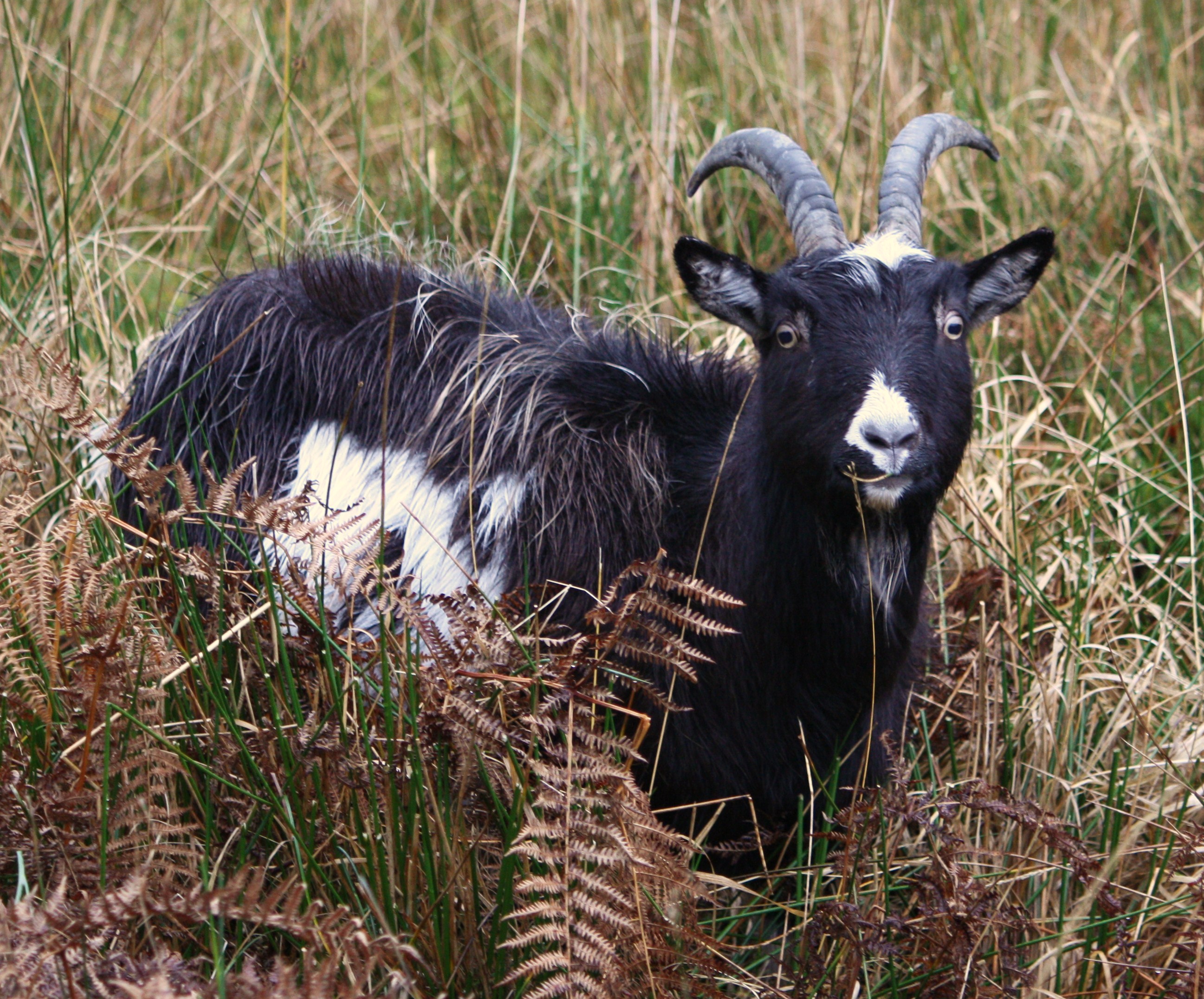
Dealing with wild (or properly “feral”) goats over the past couple of weeks, I managed to pick up a great book on the subject by G. Kenneth Whitehead. Goats have been in the news recently after the RSPB decided to cull some on the banks of Loch Lomond and over to Loch Katrine where I spent a great deal of time walking and exploring while a student in Glasgow. Partly to get an idea of the roots of this controversy (which in reality is no controversy at all) and partly to better understand the well-known and high-profile herds of goats in Galloway, I bought the book online and have been raking through it with great delight. I would be lying if I said that goats really “floated my boat”, but they have undeniable value and deserve consideration when looking at the management of moorland.
What struck me most dramatically was the history of goats in Galloway, which, since the Second World War has been a story of loss and collapse. The goats which are now found near Clatteringshaws are wheeled out as a spectacle for visitors by the Forestry Commission, and several of them depend on a supply of feed set out by rangers, who conveniently place their hecks next to the road. It seems, however, that the goats have not always enjoyed such lauded celebrity status in the eyes of the foresters.
An appendix in the book details every known herd of wild goats in Britain, including notes on the current status of each. In Galloway, the list is a long one, but all too often the comments include the simple sentence: “Exterminated by the Forestry Commission”. Herds of goats at Dalbeattie, Screel and Bengairn, Kirroughtree, Craignelder, Cairn Edward and across huge swathes of what is now the “Galloway Forest” were wiped out when the foresters arrived to plant the hills. Some of these herds had been on site for centuries, and it puts the current RSPB position at Inversnaid into context. The Forestry Commission was not out to “cull” or “control” these goats, but deliberately annihilated them, root and branch.
We will probably never really come to terms with the staggering damage caused to our uplands since the Second World War, but the loss of these irreplaceable goats, many of which had local characteristics now permanently consigned to history, is just another symptom of what happened when the foresters came to town. Only now are we beginning to come to terms with the gravity of peat loss and ruined upland Carbon storage, and the crowning failure of the Commercial sitka plantation will be the moment when, having spent thousands of pounds of tax payers’ money in subsidy to plant the trees, the general public will be asked to subsidise the restoration of the damage caused. Perhaps this was excusable when we “didn’t know any better”, but nobody is in any doubt as to the harm caused by ploughing and planting in the uplands today, and yet still the foresters rip up the peat and bury the heather beneath a serrated mesh-work of foreign spruces.
It is why I look at wind turbines as something of a benign curiosity. Before a wind developer is able to even stick a bamboo marker in the ground, extensive bird surveys and ecological tooth-sucking have to take place. Huge sums of money are set aside to mitigate the damage caused by the temporary appearance of heavy machinery. Imagine the uproar if a windfarm was shown to have displaced a single hen harrier, let alone annihilate a population of wild goats or cause the county-scale destruction of the moorland environment. As an industry, wind development is ineffably more conservation minded, and yet turbines attract all the criticism while the Forestry Commission continues to destroy the uplands with the smiling support of government and society.
I’d love to say that ranting and raving has made me feel better, but it hasn’t.


 Bog Myrtle & Peat
Leave a reply to Mike Groves Cancel reply