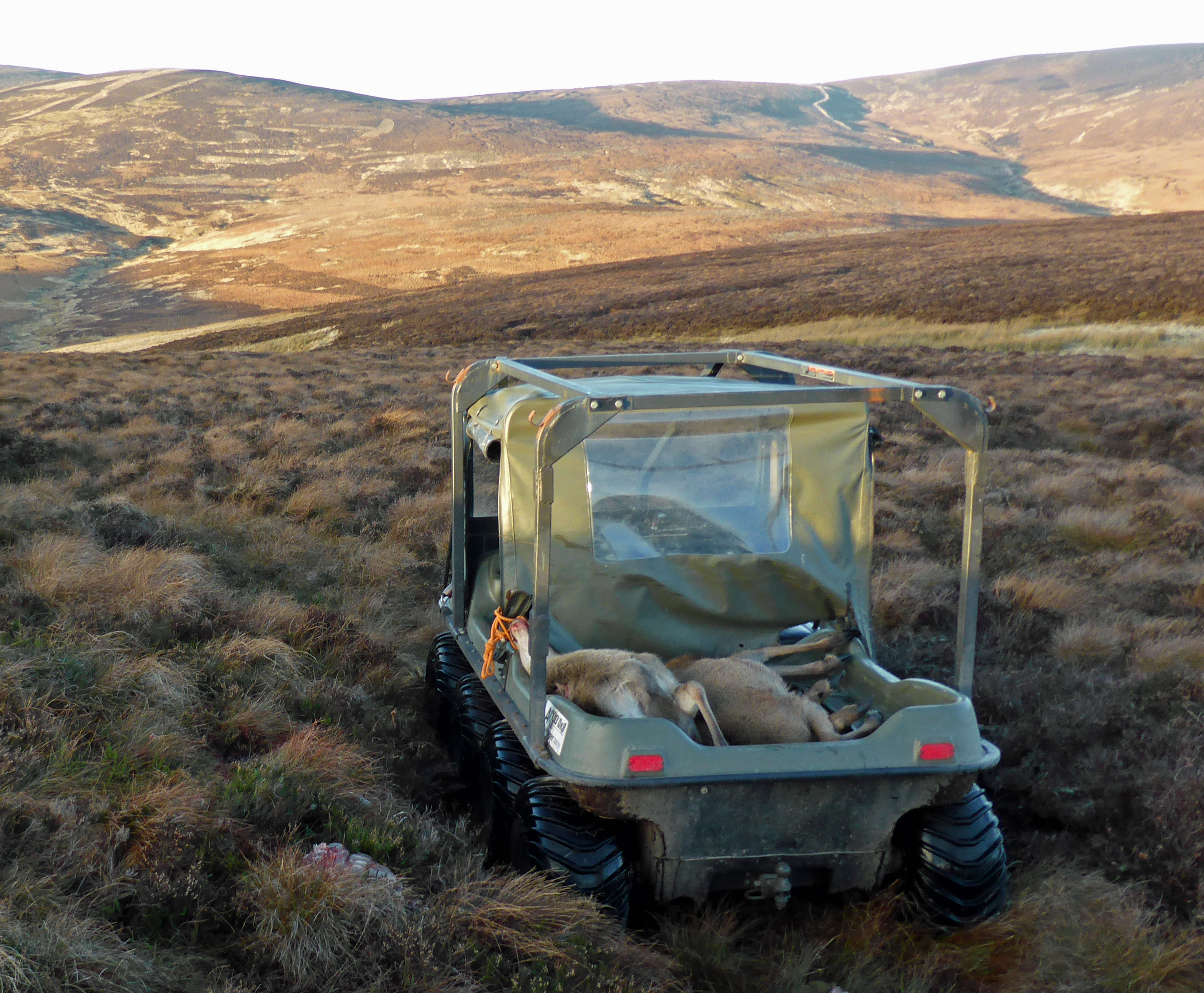
Just as a further mention of the day’s hind stalking I had last week in Aberdeenshire, I must say that my eyes are opening to the world of deer. The group of hinds we stalked was spectacular in the bright winter sunlight, and the experience of crawling through the black grass made my heart thump in my chest. By accident more than design, we found ourselves within fifty yards of a large group of hinds which were lying down in the heather, and the few minutes during which we waited for them to stand and present a shot seemed like an eternity. One hind seemed to be looking straight at me, chewing her cud and blinking vacantly. I wondered how on earth it could be that she could not see me, but lying still with the .308 in my shoulder, I must have been invisible, even at such close range.
When a beast rose, looking away, I knocked it over and the rifle beside me found another target. The resting deer rose in a body and moved away, but because we lay so quietly and without moving after the shot, they soon settled again just a few hundred yards away. All the while, grouse rose up and cackled and the wind hissed through the heather. For the rest of the day, we followed in the wake of this group of hinds, which bumped into and attracted several other groups, ultimately forming a long line of beasts which moved away along the contours and into the blue shade of a hollow. It seemed more than once that we would have the chance at another shot, but the moment never came. High up in a caustic wind overlooking the Grampians and the Mearns below them, I saw yet another side to grouse management.
While the stalking itself was an exhilarating challenge, the real interest was in the reasons behind this form of deer management. Still recovering from excessive overgrazing by deer, this piece of land can only bear the burden of a set number of beasts. According to the GWCT, one red deer hind has the same forage requirements as two sheep, and it is easy to imagine how this effect can build up to present a real management issue. There is no real commercial stalking interest, and the deer are culled not only to minimise their effect on the grazing, but also as a means to manage the ticks. Quota targets are set and followed through each year, and yet even then it is a struggle to keep on top of their numbers.
We loaded the hinds into the argocat and headed back down to the pickup, following the red track back down the hill to the low ground. An eagle appeared high up on the face above the vehicle, working slowly along and flushing grouse like popping corn from the darkening hillside. At one point, it folded its wings in and made a dummy stoop on a panicked grouse, then scornfully worked those massive wings further off into the gloom. Having spent the day in the company of red deer, the spectacle was a fitting end for a Galloway boy’s day in the Highlands.
Now into its fifth year, this project has taken on a totally unexpected enormity. Thanks to support from friends, employers and readers of this blog, I have been given the opportunity to follow my interest in grouse and black grouse from Exmoor to Caithness, and the one guiding principle of everything I work on is my determination to physically “get involved”. The practical side of this project is not only huge fun but it is also enormously informative, and on days like that in Aberdeenshire, I can almost feel my brain growing. The only problem is that I have so much organised for 2014 that it will be a struggle to get any work done…


 Bog Myrtle & Peat
Leave a reply to Mike Groves Cancel reply