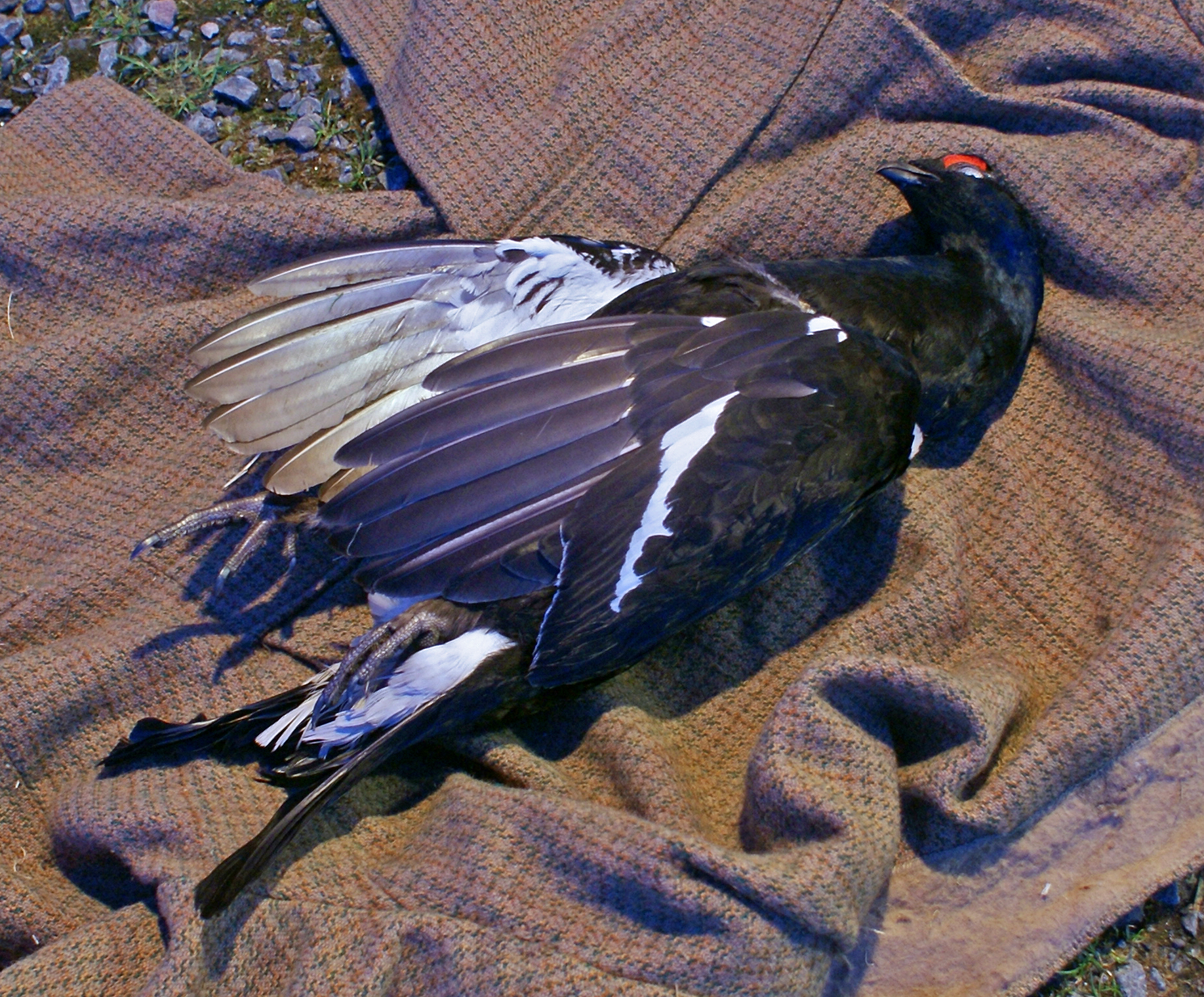
Almost two years since his discovery on the Chayne, my favourite blackcock’s reign of terror has come to an end. We found him dead this evening, lying behind a patch of dry rushes on the burn side. The injuries inflicted on him last week seem to have finally done him in at last, and he had slumped just a few hundred yards from the spot where I first saw him. Looking at him closely, the gash in his feathers had scraped the skin and ended in a deep puncture wound at the point where his wing met his neck. There was another deep scuff on his neck mid-way up which hadn’t broken the skin, and another bump on the back of his head. It looks like he had a close call with something which either bit him or drove him into an accidental collision. While he had escaped being eaten, he was doomed.
I have mixed emotions about the death of this bird. On one hand, I am embarrassingly distraught. This was my first ever blackcock, and I have been watching him almost every day for two years. He became part of my life, and through him, I learned some fascinating things. Something about the very nature of black grouse invites a huge amount of affection, and it’s no exaggeration to say that I was smitten with this bird. I wrote a book about him, and sketched him from every conceivable angle to provide illustrations for that book. He caught me on the species, and has directed my career as a writer and artist to such an extent that to consider working in any area other than with grouse and moorland management is now totally unimaginable. He has changed my life, and he’ll be sorely missed.
At the same time, he lived alone. He lekked alone and although he could well have served greyhens that I never knew about, his was a largely solitary existence. Black grouse evolved to live in large communal packs, and my bird’s behaviour always had a rather tragic overtone to it. The solitary blackcock has become a symbol of just how badly we have treated our uplands over the last fifty years, and while I loved my bird, he represented the faded embers of something which had once been great. Now he’s gone, the vacant lek, once populated by fifty blackcock, is nothing more than a damning indictment of just how little wildlife means to us when we are offered the choice between birds and money.
Over the next few months and years, I will bring black grouse back to the Chayne. There are other blackcock up on the hill, and greyhens pass through from the neighbouring ground quite frequently. The wheels are already in motion to begin a captive breeding project, and the habitat on the hill is improving with every passing season. To be quite honest, creating and managing black grouse habitat is one of the hardest and most challenging projects that anyone can be involved in. There have been a few times when I have fallen into bed at the end of a long day on the hill, exhausted, bruised and bleeding, wondering what on earth I’m breaking my back for. Then I lie in the darkness and remember the sound of the lek.
Working for grouse is hard, but there are no other birds in the world that are quite so worth it.


 Bog Myrtle & Peat
Leave a reply to Snakehuts Cancel reply