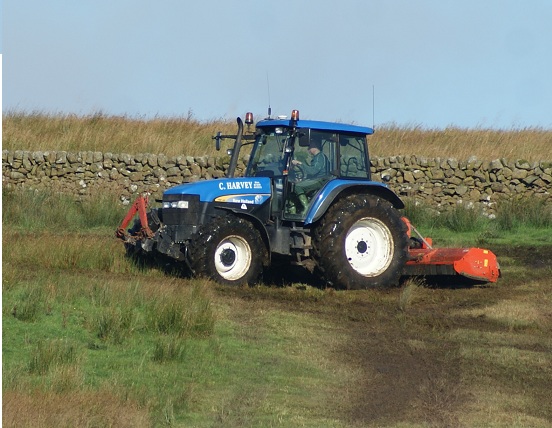
While the last couple of years have been quite slow for my project on the hill, I feel like things are starting to pick up pace. I now understand what needs to be done to help black grouse and all ground nesting birds, and I’ve whittled down my various habitat management theories into a handful of ideas which are not only feasible but should make an amazing impact on the wildlife. The foundations are laid, and the first steps are at hand.
My theory for the management of rushes was put to the test yesterday in no uncertain terms by a massive tractor and a furiously noisy chain flail. As mentioned in a previous post, rushes are a real problem on the Chayne, if for no other reason than the fact their very uniformity prevents birds of all species from getting in and using them. They do provide good cover, but not if the birds can’t get in amongst them, so the tractor was brought in to break up the chest high oceans of rushes in the hope that they might become a little more welcoming to snipe, curlew and black grouse.
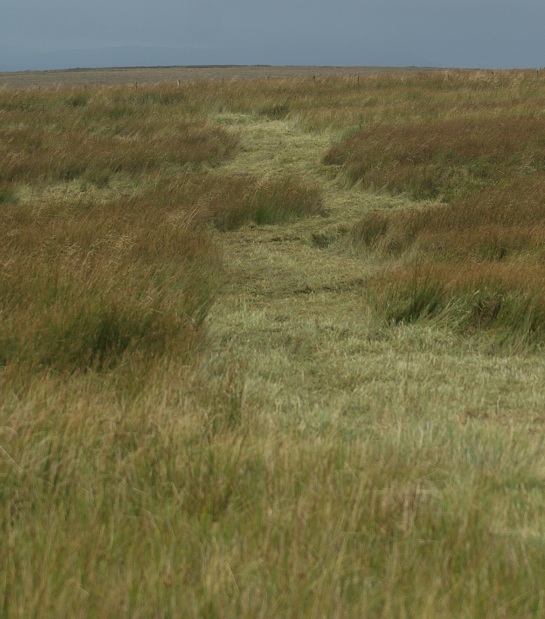
Rather than clear geometrically perfect shapes in the rushes, I asked the contractor to make a mess. Spirals, twists, loops and clearings were the order of the day, and straight lines were off the cards altogether. There’s nothing that a bird of prey likes more than a nice landing strip that it can look down from end to end, swooping in to hammer any chicks which are unfortunate enough to emerge too far into the open. If the flail went for more than one hundred yards in a straight line, it was lifted up for a few feet and put back down again to create a block which not only gives cover but will also stop the wind whistling up the chest high rides.
The effect is dramatic, and I can’t wait until the spring to find out how the bird respond to the changes. If I’m right, I’ve chosen a good spot to open up for ground nesting birds and the improvements will be obvious. I’ll get the flail in to do the same job next year and the year after so that the rushes will gradually be bashed and knocked into a variety of different ages and heights to create a patchwork which I hope that nesting birds will love.


 Bog Myrtle & Peat
Leave a reply to Croick Cancel reply