Bog Myrtle & Peat

Life and Work in Galloway


My New Hero

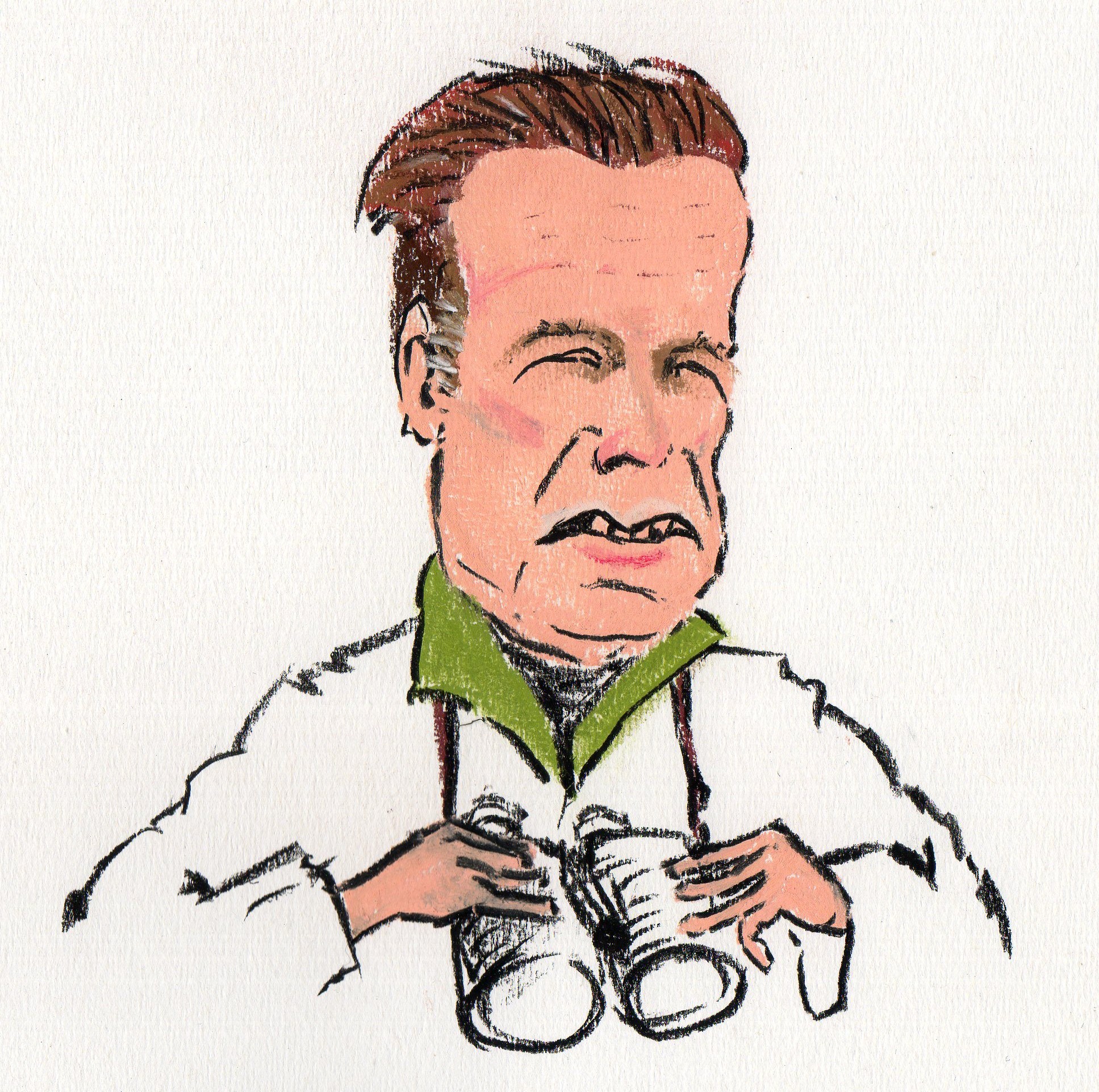
I couldn't resist having a go at drawing Chris Packham. Sometimes, you just can't help yourself.

I have never really liked Chris Packham, and I certainly never thought I’d see the day when one of his television programmes about the countryside actually made sense. “The Truth About Wildlife” has been a three part series of documentaries looking at the continued and worrying decline of British wildlife, despite government attempts to stem it, and I must admit that Packham has been the star of the show.

Interviewing GWCT researchers to find out more about the disappearance of the grey partridge showed an unusually balanced view on conservation in an environment where the RSPB are the monolithic “go-to guys” for any ornithological questions. Packham passed over shooting as a sport with total ambivalence, which was appropriate. The programme was not about shooting, and although many other presenters would have taken the opportunity to criticise field sports, Packham mentioned it only in passing.

Where he really shone was in the latest episode, where he got a fantastic opportunity to put his boot into the Forestry Commission on behalf of everyone who has ever cursed a block of sitka spruce. He didn’t miss his moment, but judging by the ornamental halfling who had been wheeled out to counter him, it was always going to be a walkover. Packham asked why forestry blocks were not being planted with wildlife in mind, and he was met with surprising claims that commercial forestry is actually very good for various “flagship” species such as goshawks, red squirrels and crossbills. Despite its being clear that all three of those species are merely “making do” with Norway Spruce and would far rather have multi-tiered indiginous scots pine forest, Packham held himself back from tumbling the uninspiring jobsworth into the nearest ditch and parking a JCB on him.

It’s about time that someone asked the Forestry Commission why they persist in planting abhorrent blocks of trees across the country while feigning an interest in wildlife and conservation. The fact that the whimsically coiffed representative from the FC was unable to give a straight answer speaks volumes.

“Good on you, Packham” I said to the television screen. I then watched as he wandered over a shockingly overgrazed and burned plain in Dartmoor and fell at last to talking about Dormice. Packham’s problem with dormice is simple. Is too much money being directed at single species purely because it captures the public imagination? Could money spent on dormice be better spent on conservation at a wider level? Packham argued that perhaps it is wrong that dormice attract charitable investment because of their cuteness, and that that this work and finance should possibly be directed at a variety of other equally endangered species.

That made sense.

Until you remember that Packham, as one of the RSPB’s vice presidents, is responsible for governing a charity which has recently become characterised by “single species” conservation projects like the attempt to save the dormouse. While arguing that we should be objective in assessing matters of conservation concern and ignore our human inclination to sympathise with aesthetics, he is overseeing the romantic repackaging of hen harriers as “sky dancers”.

There is a contradiction here, and as much as he can rail against spending money on popularly appealling projects, he must admit  that he is as guilty as anyone.


2 responses to “My New Hero”

  1. Your account of the forestry exchange is misleading and misunderstood.
    CP took the unrealistic approach of a wildlife fundamentalist
    The idea that the Forestry Commission could be singularly concerned with wildlife and habitat provision is unrealistic, as that is not their role. – the forest estate is managed to fulfil social, environmental and economic outcomes. CP should have made this clear from the outset I am sure he was very aware of the inherent restrictions and compromises necessary to balancing the 3 principles.
    It was barely heard at the start of the item, but the Forset of Dean is in fact 60% conifer, 40% broadleaf. There are plenty of broadleaved woodland associated habitats and conservation projects there including ancient woodland restoration on plantation conifer sites. For the fundamentalist though anything short of total compliance is not enough. The truth is a complex picture that CP & co were not interested in conveying. The Forest of Dean was merely used to make a blunt point about the shortcomings of conifers for wildlife. They chose to focus on an economic stand of Douglas fir (not Norway spruce as you state), the premise was clear, its a hackneyed one…’you choose to plant these nasty exotic trees that are useless for wildlife because you’re only interested in the timber value’ The FC guy pointed to the fact that the fir do have wildlife associations (albeit minor in comparison), they are not ‘specifically’ economic. This is true in the same way oak grown there has predominently landscape and wildlife value but this also is more than ‘specific’ as there too is a economic aspect as many will provide timber of value, albiet over a longer rotation and less predictable. In offering some defence of the conifer as wildlife host it by no means implies it is a serious option, its key value is economic which it delivers. This however was the baited hook, CP was able to cease the exchange and reflect that ‘he was’nt buying it…the goshawks etc would be happy with broadleaves’ , the impression was the forestry commission guy was a charlatan, trying to claim black was white. It reminded me of the kind of approach the tabloids have to reporting ie polarise and make emotive – sod the consequences however injurious to reputations.
    Incidentally, who mentioned ‘multi tiered scots pine forest’?? I assume this is something dear to you as it was not mentioned in the programme. As it happens there is quite a lot of scots pine in the forest of dean, there is also a fair amont of red band needle blight infection among it as well, consequently in years to come it may provide some useful habitat… for woodpeckers and dead wood specialists !!

    1. I appreciate that a great deal was skipped over in Packham’s programme, but if he wanted to make the point that commercial planting creates a conservation black hole, he should have come to Galloway.
      It may well be that the Forest of Dean is operated as a high profile conservation site for the FC, demonstrating their ability to balance environmental interests with economic and social demands. I have no doubt that it can be done, and in some areas it is, but in Dumfries and Galloway, nobody is trying.
      Having been born and raised in the most commercially forested county in Britain (more than 25% of the area is devoted to growing trees as a crop), it is extremely tiresome to hear the FC even attempting to illustrate the wildlife benefits of commercial woodland.
      The area around the Chayne where I have been working to conserve black grouse is devoted to more than 17,000 acres of sitka spruce and lodgepole pine plantation. Thirty years ago, that was 17,000 acres of blanket bog, white hill and moorland.
      Ignoring public resistance, the FC continues to plant on blanket bog, laying sterile new trees upon important breeding habitats for a huge variety of wildlife.

      You will surely understand that when the people who can be held largely responsible for the total destruction of birds like the black grouse in southern Scotland and Northern England attempt to present themselves as a force for conservation, I feel a little peeved.

Leave a reply to gallowayfarm Cancel reply

About

Shout on, Morgan. You’ll be nothing tomorrow

Swn y galon fach yn torri, 1952

Also at: https://andtheyellowale.substack.com