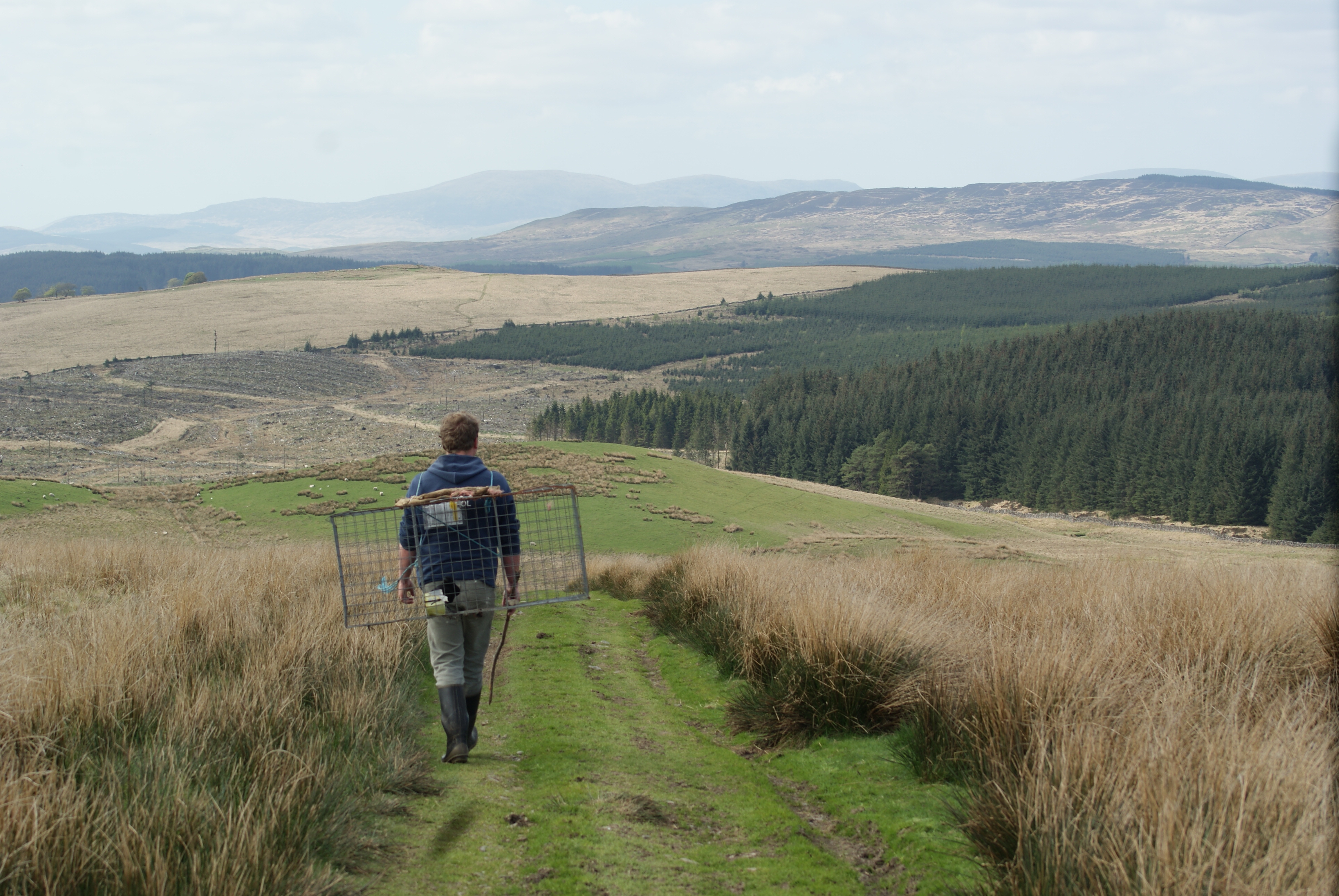
It’s slowly becoming clear that although larsen traps are extremely useful for catching crows, they are not inherently effective. To work well, they need a great deal of careful thought and strategic planning, and the past few weeks have been a real baptism of fire to the world of cage trapping.
In theory (and in practice in many areas), using a larsen is simply a matter of setting and checking. My experience of the traps before this project began was confined to operating a single timber and mesh larsen on a farm which was filled with trees and surrounded on all sides by forest. There, it was simple to achieve success by leaving a trap more or less anywhere and returning at first light the following morning. Hardly surprisingly, running a larsen on the Chayne is a different kettle of fish altogether.
Since a larsen trap depends for its success upon the territorial aggression of the local breeding pair of crows, it should follow that the primary objective of the trap should be to catch both members of that pair. Traps should be positioned in a spot near to a nest, so that the local pair will come in, attack the intruder and become caught themselves. You would think that on a moor with hardly any trees, I would have a good head start in spotting any new nests very early on, but my crows are crafty.
After a great deal of reconnaissance work, I realised that the few nesting pairs would only move in and out from their nests at the first and last possible sparks of daylight each day, disassociating themselves from their vulnerable eggs and chicks. Without looking carefully, I would have had no idea at all where to look for nests or nesting pairs. Setting a trap more than half a mile away from the nearest visible crow seemed ludicrous, but it was dependent upon the knowledge that although they never sat around their nests during the day, they were coming in and out every morning and night. Sure enough, the traps started to fill up.
It would often take just twenty four hours, but some reluctant crows took more than a week to catch. As soon as the pair was accounted for, I would move the trap and keep an eye on the vacant territory. For a few days, the recently cleared area would remain free of any crows. Perhaps a large gang of non-territorial crows would pass through after a week and three or four would break off to stay. Over the next few days, those birds would whittle down to two, and those two would start to look at nesting. It was then just a matter of moving the trap back once the new pair felt as though they had built something worth defending.
The Chayne is swamped with crows, but as the GWCT explains, the larsen trapper’s objective should possibly not be to trap them all. A single larsen can cause such chaos and mayhem amongst a population of crows that, while they squabble and fight between themselves, the eggs and chicks of songbirds and gamebirds go unnoticed. Next year, I plan to build a ladder trap to clear up larger numbers of non territorial crows as and when they move in, and my work this year has shown the good (and bad) places to site larsen traps on the farm.
I may not have been as thorough as I could have been with my trapping programme this year, but, like everything on this project, I have learned enough to be twice as effective next year. Bit by bit, I’m learning how to get in amongst those damn crows.


 Bog Myrtle & Peat
Leave a reply to Tom Mckinnon Cancel reply