When red grouse fly in packed coveys before the waiting guns, it would seem like the natural culmination of moorland management; a season’s hard work released in one wild flurry of birds. It is a natural progression to think that, by August, the keeper’s work is put in and that the rest will just fall naturally into place. Well, having taken a day’s grouse beating on the hills to the east of Edinburgh, I can formally declare that getting the valuable birds over the butts is one of the hardest jobs out there.
It quickly struck home that this was not going to be a walk in the park. As we tumbled out of a land rover onto the verge of a narrow strip of tarmac through the heather, I looked around me. On every side, sheer hill faces reared steeply up into a vague blanket of smirry cloud. It was clear that, whatever way we were headed, it was going to be up. As the company filed up through a thin ribbon of bracken and on to the moor, the first grouse began to call. For the next eight hours, that sound provided the soundtrack to my life. At one stage, I tried to count the seconds between each grouse cock’s call. I never made it higher than fifteen.
The traditional grouse call is a mechanical gabble, followed shortly after by the renowned “go-back, go-back, go-back”. After a quarter of an hour waiting on the hillside while the other beaters fanned out to my left, I heard countless fascinating variations. Some cocks shrilly gobbled like turkeys; others picked up unexpectedly like a two-stroke engine, bubbling along in a monotone before stalling abruptly. My favourite was a series of angry exclamations that can best be spelt as “gu Gwee-oo”. Idly watching a single grouse cock strutting his stuff through a patch of freshly burned heather, I almost missed the start of the drive.
Within seconds, I was lagging behind. Tall keepers who pass heather under their legs for a living were yelling at me to keep the line, and with alternating phases of running and brisk walking, I just managed to keep up as we soared almost vertically into the mist. Blue hares meandered between us as we cracked our flags and birds in small groups rose up ahead. Reaching what was presumably the summit of a cloud smothered hill, a mighty pack of forty grouse came back racing overhead. Their wings sounded like an acre of burning molinia, and I saw one tip its head to look at me as I passed beneath.
Drive after drive went by, and birds rose in clouds. Sometimes we could hear the distant crackle of shots, but my mind was mainly set upon keeping up with the others. At one point, a huge pack rose up to one hundred and fifty feet to pass over an electricty pylon, then set their wings to fall like fighter planes on the far side. All the while, blue hares and snipe rose up from my feet and the keepers yelled in time to my footsteps.
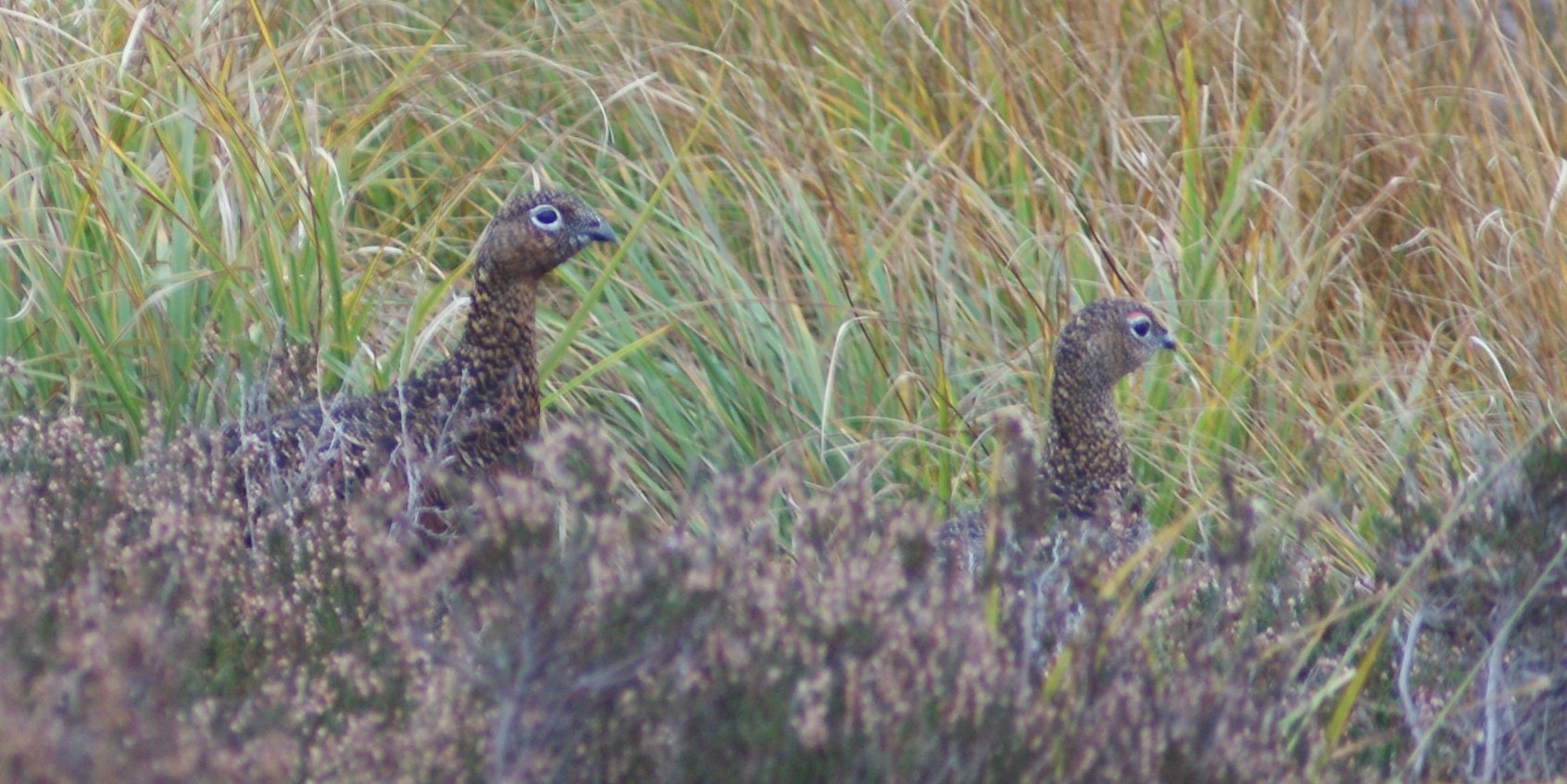
To say that the experience was exhausting is something of an understatement. Never caught without my camera (especially after Thursday’s debacle), I did manage to photograph a pair of hen grouse (pictured above), but multitasking is a difficult business when you are waiting on the flank for precise orders as to when you should drop in and join the line as it passes in a deep corrie beneath you. Much of the day was spent in a grim struggle for survival, biting back stitches and wringing out cramps. Perhaps remarkably, my enduring impression was that it was tremendous fun.
When the day was over, calling grouse still rang in my ears as I stopped in the chip shop at Biggar for a well deserved return to the world of comfort.


Leave a comment