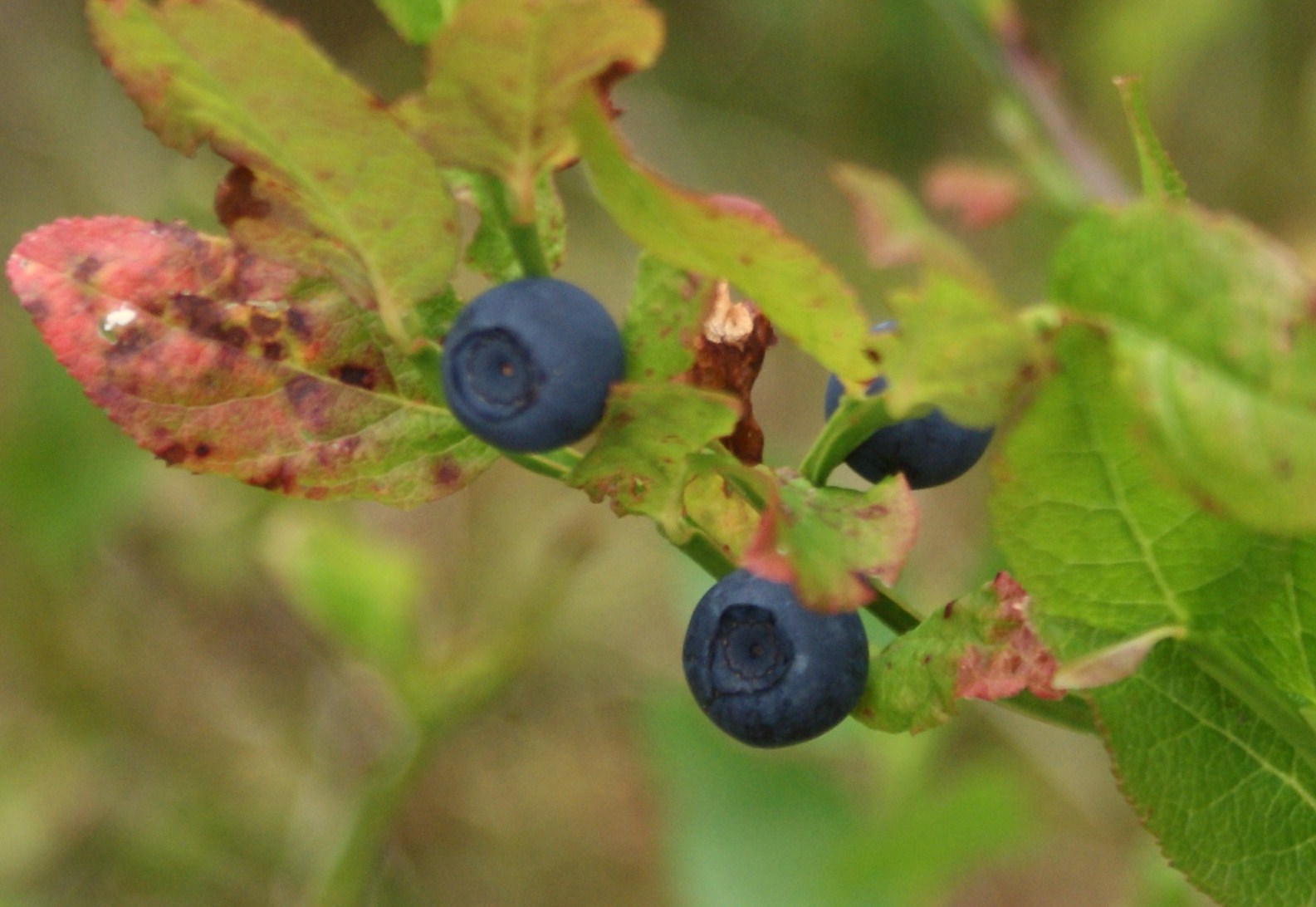
It has now been six months since I started thinning out the woodcock strip and the effect that that work has had on the blaeberry has been really fantastic. As I brashed the trees, strained stalks emerged from the needles underneath the bottom branches. Most of the blaeberry appeared to have died away, but there were green stalks here and there. After a spring and a summer in the daylight, it has staged an amazing recovery.
When I took the chainsaw up for another go at the trees yesterday, I found berries on some of the plants that I uncovered in the spring and which would have probably faded away into nothing without my help. I pushed a way into the woods and found a large patch of blaeberry which was almost choked to death by the shade of the trees overhead. Blaeberry doesn’t usually grow to be very tall, but some of these shoots were almost two and a half feet high. They had had so little light that they hadn’t produced berries, and many of the plants were brown and woody. I cleared three trees and brashed a path to the boundary of the wood where I found a massive pine completely smothering a nice rowan tree. Within half an hour, I had knocked the pine over (although it fell onto the fence and crushed a fencepost into sawdust – oops) and freed the rowan, leaving a nice path through thirty yards of trees, which will hopefully now fill up with healthy blaeberry plants.
Clearing the trees to save blaeberry suits my purposes for two main reasons. Dr. Phil Warren told me that black grouse don’t like forestry blocks, and that if I wanted birds to use the strip, I would have to thin it out by almost ninety five percent. Black grouse love blaeberry, so the more of this plant that I can make available to them, the more attractive they are going to find it. Also, woodcock like to have clear spaces in densely packed forest land so that they can move around it quickly when they are being pursued by enemies. I have piled the brash into stacks so that it doesn’t smother the blaeberry, but also to provide cover and shelter for woodcock as they rest during the day.


 Bog Myrtle & Peat
Leave a reply to chris land Cancel reply