Finding bilberry on the Chayne was a great boost. When I started work on the farm, I was under the impression that nothing had survived forty years of semi-intensive grazing by the local sheep population, but on closer inspection, little gems of bio diversity still held out. Because of the stock proof fencing around the pine strip, tufts of bilberry and ling grew in far greater abundance than anywhere else on the farm. Preventing the sheep from grazing on the whole moor would doubtless boost the heather and encourage dwindling stocks of other valuable plants across the farm.
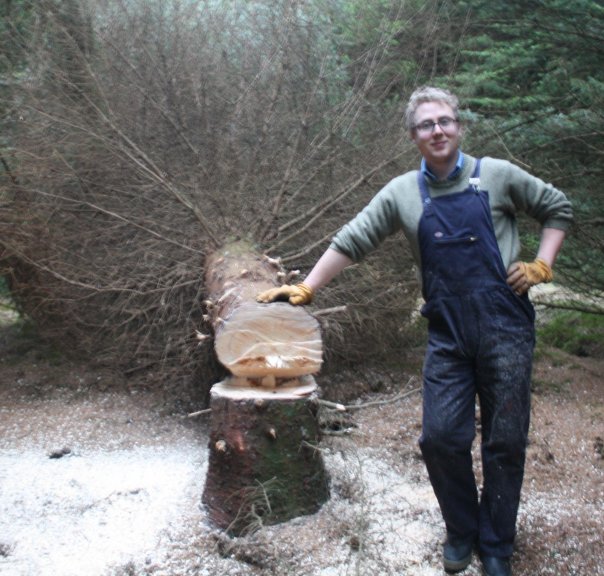
The pine strip is one of the Chayne’s most valuable assets. As we had found on New Year’s Day, woodcock use it to roost over the winter months, and opening it up would not only allow greater access for beaters and guns but it would also let sunlight in to the undergrowth, bringing on the bilberry and allowing bracken and other low-lying vegetation to come through. I was going to build a woodcock sanctuary and there was one tool that was going to make it happen. It was chainsaw time…
The strip is almost perfect for black grouse. Mature douglas firs, beech trees and blackthorn scrub surrounds a thirty yard wide core of sitka spruce. At ground level, patches of heather and bilberry are common. It is well drained in parts and damp in others, with access to wide expanses of moorland in every direction. However, the majority of sitkas have grown beyond the stage where they can support much life, and much of the ground is covered in a thick mat of dead needles, permanently shaded by the branches above. Black grouse and woodcock have access to thousands of acres of this sort of woodland all around the farm. It was our mission to make this little strip their destination of choice.
Brashing the pines to a height of five feet and felling every seventh or eighth adult tree, we soon opened several huge windows of daylight into the floor of the wood. Stacking the brash and branches up against the inside of the fence, we made huge “dead hedges” which should provide insulation for the regenerating undergrowth. Over the course of two afternoons, we began to make a big difference.
I was given a fantastic eight foot rowan tree for Christmas. I picked a likely looking spot at the furthest reaches of the wood and planted it there. It is the first tree I have ever planted, and I can’t wait until autumn. A rowan tree loaded with red berries is a stunning sight, and although they taste disgusting, many species of birds go crazy for them.


Leave a Reply