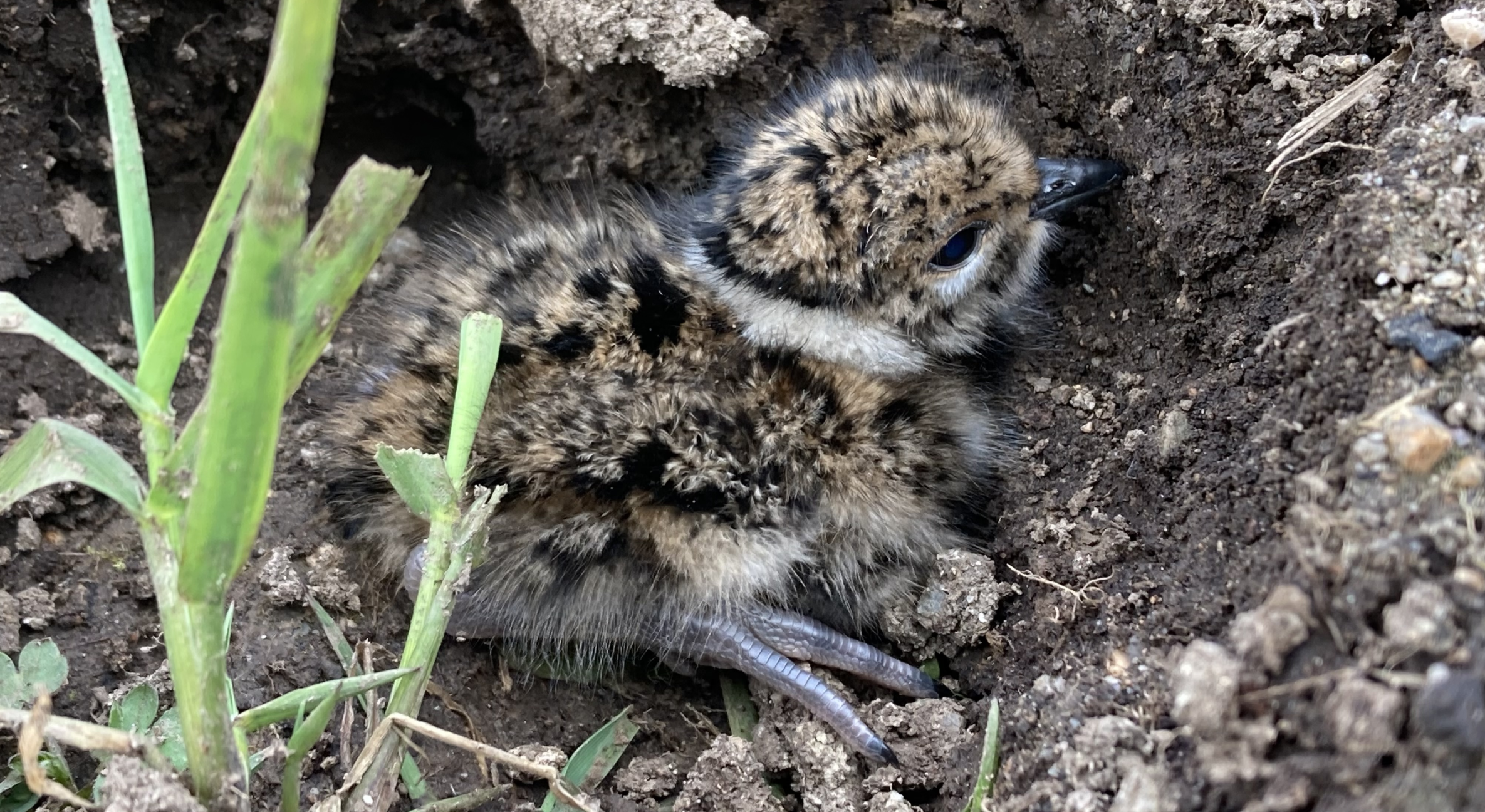
I spend a large part of each spring in pursuit of waders. It matters that we keep an eye on these birds, and it’s valuable to record their various success and failures during the course of the year, even though the information gleaned from these observations usually reinforces a sense of growing tragedy. After almost seventeen years, I certainly know more than I did about lapwings and curlews than I did – but I’m no closer to helping these birds or turning the ship around. I have only seen three pairs of curlews displaying in Galloway this year, and I can be confident that none of them have been successful. It’s still too soon to say for sure, but it does seem obvious that these birds have simply vanished from large areas of the southwest over the past five years. After two or three years of absence, we can be pretty sure that it’s no temporary muddle or delay in their movements – they have gone for good.
Local oystercatchers seem to have fared reasonably well in 2025, but only in urban and suburban habitats where eggs and chicks have been kept safe on the roofs of factories and supermarkets. Even in the heart of Dumfries, well-fledged youngsters are starting to appear in modest numbers – on their own, they can be told apart from their parents by the black tip on the ends of their otherwise orange beaks. When accompanied by their parents, it’s also obvious that they’re smaller, dowdier and more washed-out in appearance. In contrast to the busy enthusiasm of adult birds, youngsters spend most of their time slouching around as if they were sulking.
Without really looking for them, I’ve seen a dozen of these juveniles at the point of fledging this year in Dumfries, Kirkcudbright and Dalbeattie – but there has been no such luck in more rural areas. The oystercatchers which nested in a tree above my hayfield succeeded in hatching a full compliment of three eggs at the start of June – and in a sorry echo of last year’s disaster, the chicks were killed within a day of leaving their nest. As always, the lesson is that while eggs in trees or gateposts are safer until the point of hatching, chicks leave as soon as they’re hatched (either by choice or simply because they fall)… and they’re invariably killed soon afterwards.
The greater success in towns is perhaps due to a lack of predators (although foxes and badgers are amply replaced by gulls, cats and dogs), but also because roofs and industrial buildings are big enough that chicks can roam around and stretch their legs without feeling any real need to jump or fall to the ground. They can stay up there all summer until they’re ready to fly away – a marked contrast with chicks which often seem to fall out of trees in the same fluid movement with which they emerge from their eggs.
Lapwings have been much harder to find than normal this year. I hoped that an abundance of brassica stubbles in this parish would draw them in, but the birds showed very little interest in this kind of habitat here. One pair nested in a flooded patch of pasture near home, and they hatched three chicks which were predated during the drought. Two other pairs nested a mile away in a field of maize grown under plastic. I can understand why they chose this site, but maize grows like a rocket and perhaps they underestimated the sudden surge of vegetation which rose around them. A fortnight after laying their eggs on a wide expanse of bare soil, the maize stalks were a foot high. By the time they were due to hatch, that height had almost doubled – which didn’t bode well for birds which love extremely short vegetation.
The field beside that maize was cut for silage last week, and it was astonishing to find that those four lapwings were working together to protect a single youngster as the heavy mowers and harvesters roared around them. I’d guess that the maize nests hatched and the adults pulled their youngsters a hundred yards out into the newly cut silage field. Guessing that two nests might have yielded six chicks, the fact that only one survived the move is telling – but now there is slurry to spread and more work to do on the grass so that it can be mowed again in August. That single tiny chick looked pathetically weak and fragile on the yellow turf, and swarms of rooks and young carrion crows swirled around nearby, driving the adult lapwings into a defensive frenzy.
I don’t have high hopes for that chick, but after three days, it has already survived far longer than I thought it would – and it does show that while we’re used to feeling sorry for wading birds which always fail, there’s nothing wrong with their behaviour and enthusiasm. They’re tough and courageous creatures – they know what they’re doing and they do it well. We should change the way we sometimes think about these birds as damp and failing squibs – in truth, we have not just made some tiny adjustment to the system which only pathetic creatures can detect. It’s more useful to say that we have overturned our landscape to a point at which not even they can succeed.

 Bog Myrtle & Peat
Leave a comment