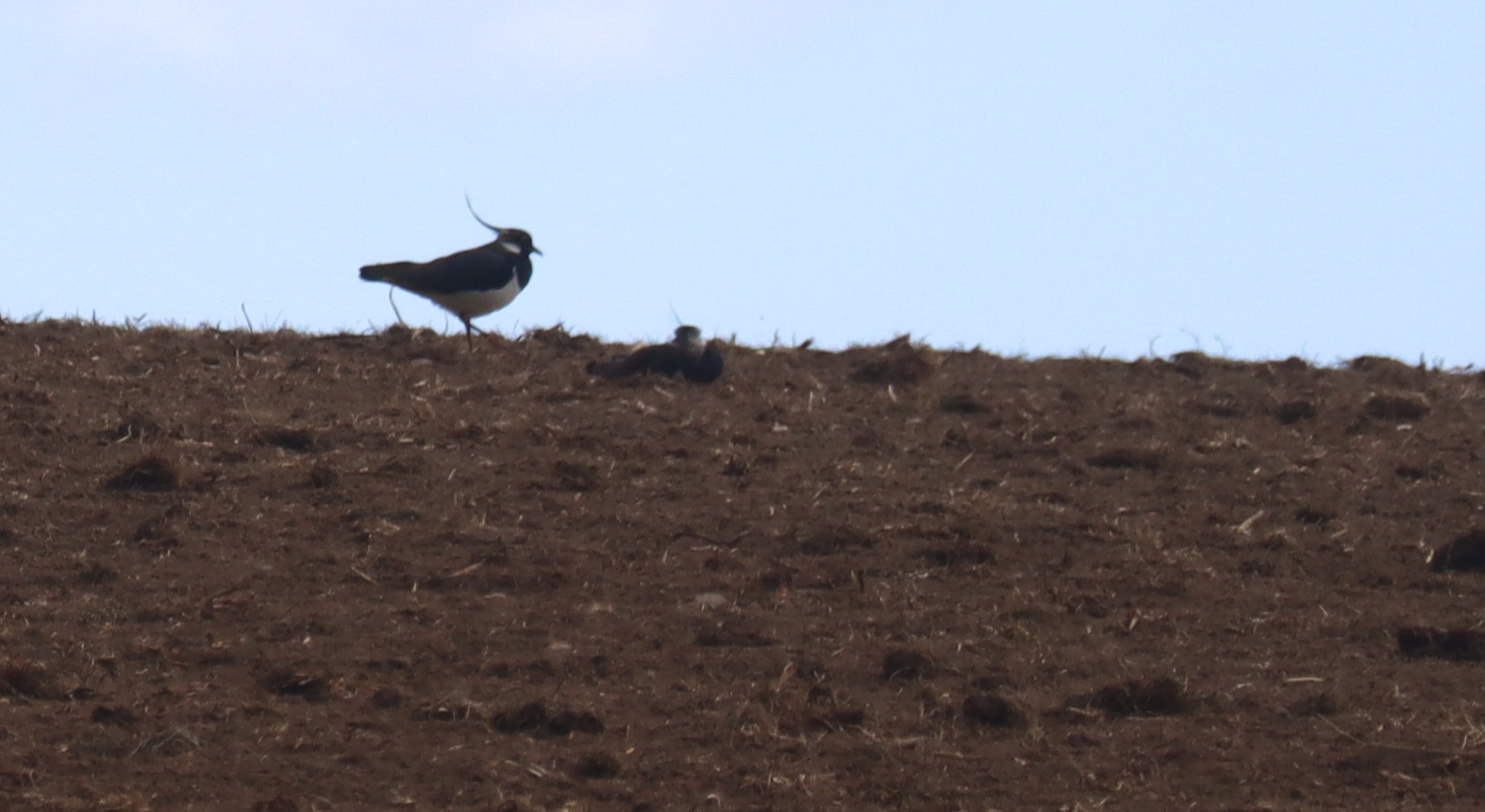
An impressive amount of energy and work has been focussed on lapwing conservation in Southern Scotland over the last few years. In many ways, lapwings are easier to protect and conserve than curlews in this part of the world, not least because the little birds are surprisingly flexible and curious. If a curlew’s habitat is crushed or destroyed by changes in land use, the birds will continue to return there as if they can’t understand what’s gone wrong – and in due course, they often die out altogether. By contrast, lapwings are able to capitalise on new opportunities when they arise – there are always a few birds exploring and prospecting for pastures new, and they can turn up in the most unexpected places.
Broadly speaking, a difference between curlews and lapwings is that the former need to be protected where they are – and the latter can be attracted into places where they could be. It’s a complex point, but it often means that lapwings respond more obviously and productively to human assistance.
Work by the Clyde Valley Wader Group in Lanarkshire has demonstrated the value of agricultural cropping for lapwings. In particular, this group has shown that lapwings love fields full of brassicas which have been eaten down by livestock over the winter and then left in a state of residual collapse and decay. They seem to swarm into these places, often after an absence of many years – and that’s great news not only for conservation-minded farmers, but also for the birds themselves. To some extent, it seems like this work has cracked part of the lapwing code – we know what they want and we know how to provide it. With time and continued support, growing crops like this could become a valuable agri-environment option – farmers in wader areas could be paid to manage their crops in this way… and after years of schemes which promised (and failed) to increase lapwing numbers, that’s a win:win.
By coincidence, several farmers in this parish have been growing kale and rape over the last few summers. They graze the crop down over the winter, then spray or disc the residues and reseed the fields with grass. They’re doing it for the sake of agricultural improvement, and this work has not always paid off for lapwings – but the important point is that the birds have been responding to their work. Since this trend began in 2022, I’ve seen more lapwings here than at any time in my life. Despite ongoing failures, the bigger point is that the brassica technique works in principle, and that success is simply a matter of refinement.
But it’s noticeable that local farmers planted more brassica crops than ever in 2024. It became extremely common to see cows strip-grazing the heavy old leaves during the winter, often supplemented by rows of silage bales and rounds of straw. I assumed that it was going to be a bumper year for waders here, so I went around a few of my neighbouring farmers and did the groundwork required to monitor birds and set up trail cameras at their nests. In general terms, everybody was on board and excited to see how the spring would pan out – but in recent weeks, it’s become clear that the lapwings simply haven’t turned up.
Nothing bred successfully here in 2024, but as many as twelve pairs made the attempt in the lower part of this glen. There’s far more “perfect brassica habitat” available this spring, but I’m only aware of a single pair which has tried here – and they have already failed and vanished. It seems clear that while there are amazing benefits to leaving brassica stubbles out into the spring, it’s not a guarantee of anything. Under normal circumstances, we can be pretty confident that leaving bare, loosely cultivated or residual cropping in place for the spring can be great for lapwings – but the lapwing’s ability to move around has a more frustrating side too. Sure – they’ll find you… but they’ll also leave you again.
Friends across Scotland do great things for lapwings and it sometimes seems like they’re building towards progress and productivity – only for the tap to turn off unexpectedly. They might have ten or twenty pairs breeding on farmland every year for ten years, then suddenly get nothing whatsoever. Lapwings seem more stable in some areas than others (particularly around moorland managed for grouse shooting), but we don’t really understand why they’re sometimes choosing to up-sticks and move around like this.
For the sake of farmers who want to cultivate land or leave late crop residues for lapwings, the financial hit is obvious and immediate. They have to pay for it, and they’re usually happy to do this because they’re invested in the birds… but it’s a bitter pill to swallow when the birds never materialise. Of course you can’t promise anything and nobody is pitching brassica cropping as the “silver bullet” of wader conservation, but maybe this quick blog will introduce a useful sense of instability to the narrative.
We can say that brassicas have helped lapwings in many parts of Scotland… but the Galloway example in spring 2025 suggests that you can create vast areas of perfect habitat – and it might not help at all, for reasons which remain a complete mystery.

 Bog Myrtle & Peat
Leave a comment