The Ayrshire village of Glenbuck was flattened to make way for a coalmine in the 1990s. Local mining enterprises had been failing for some time, and as the terraced cottages were demolished by Scottish Coal, the last few residents were folded into nearby Muirkirk. The result is not an abandoned village or a ghoulish row of skeletal gable-ends like you’d expect to see on St Kilda or in Sutherland. There’s nothing romantic at Glenbuck, because there is nothing there at all.
Or almost nothing – because this was the birthplace of Liverpool FC’s famous manager Bill Shankly; a man who found his heyday in the 1960s. It’s become a place of pilgrimage for Liverpool fans, even though the footprint of Shankly’s childhood home is little more than a gap in the rushes. Scattered through patches of heather, there are red scarves and banners declaring that “you’ll never walk alone” – these heartfelt tributes are blown slackly around in the wind because there’s not even anything to tie them to. Here is the heart of solitude – and if you aren’t alone here, you aren’t alone anywhere.
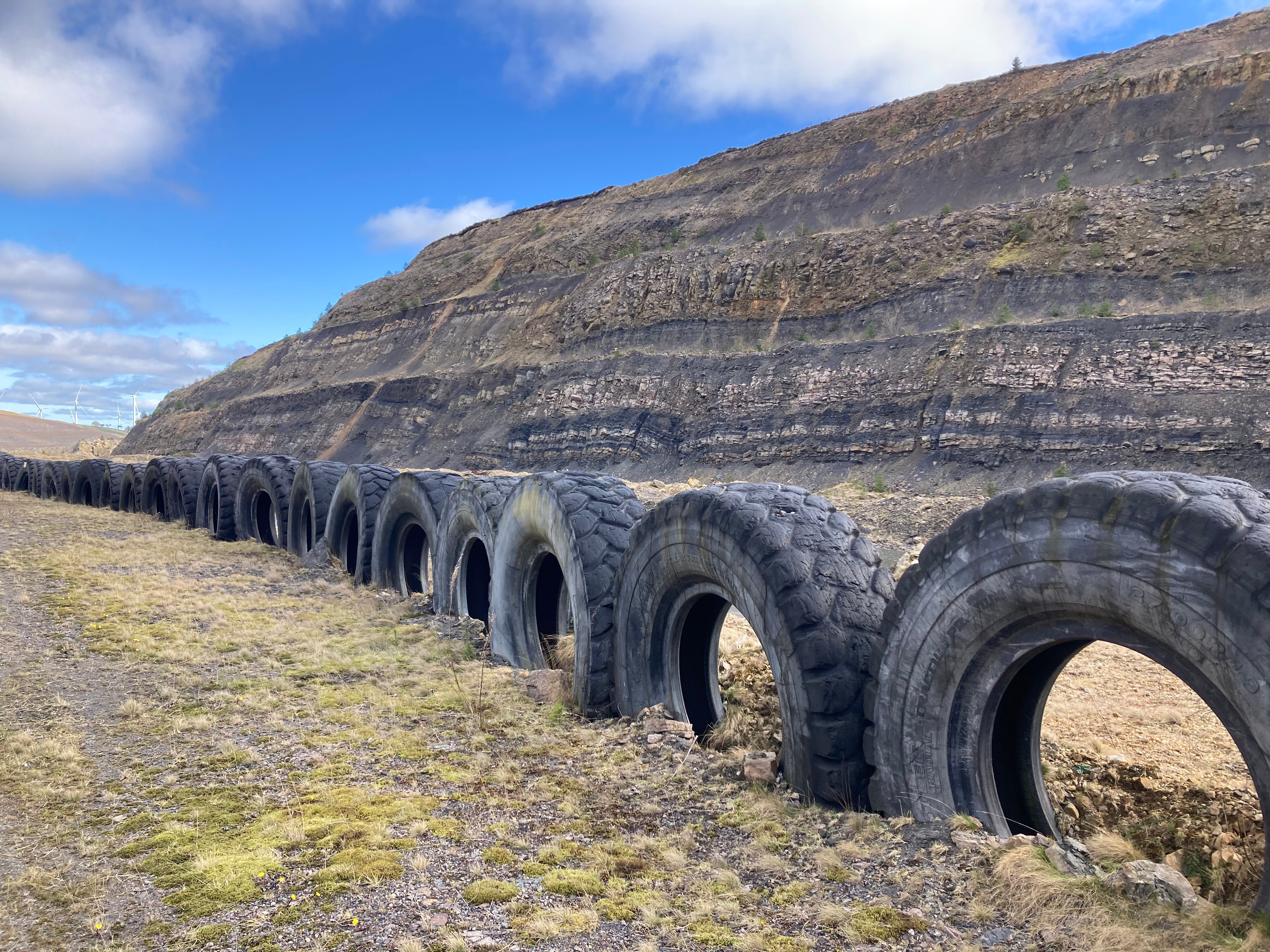
Above Glenbuck, the remains of an abandoned coalmine are described in industrial terms as a “Void”. This place is more than just a hole in the ground. It’s a monumental trench which runs one hundred and thirty metres deep from east to west for almost a mile. The bottom is laced with strings of pools and heaps of refuse; there’s a wall made from the recovered tyres of massive bulldozers. Perhaps inevitably, somebody has dumped a few fridges into the Void. They lie on their sides in a state of pathetic loneliness, as if there should either be a thousand fridges here – or none at all.
On the northern face, drab grey rock rears up in a smooth diagonal bank. It’s possible to make out a few scratches and mechanical scuff-marks in the living rock, but otherwise it’s a single, unsmiling sheet of stone. To the south, the opposing wall rises in alternating bands of black and white rock which have been opened up like a slice of cake in a pattern of giant steps. The black colour is coal and the white is limestone, here and there interrupted by volcanic intrusions and chimneys of cauterised rust. This is a complete geological record of Scotland’s coalfields – a back-catalogue of deep time which charts the progress of this place as it seesawed between inland seas, marshland and jungle for a period of around five million years. As I gaped at the scale of this place, a peregrine falcon circled against the cloud. Sandpipers called from the gaudy blue pools of water nearby, and the first wheatears of 2025 sang scratchy little songs from the cliffs overhead.
This southwest corner of Scotland is obsessed with Satan. The catchment of the River Ayr is littered with the remnants of battlefields and graves from the time of the Covenanters, and the Devil is said to be present in every geographical feature in this landscape. Seen a big pile of stones? That’s the devil’s bread. Found a split in the rock? That’s where the devil cracked his tail like a whip. If God created everything in this place, the Devil takes more than his fair share of credit for the interesting bits – and a lack of chronology in this folklore seems to suggest an ongoing experience of terror and unease. The Devil didn’t do this a long time ago – he might have done it yesterday – so be vigilant. It seems obvious that in the context of this landscape, The Void is unavoidably Satanic; if it’s hard to guess what the Devil did here, it’s obvious that he really went to town.
These coal-rich rocks are thirty five million years old – and in the wreckage of destruction, vast lumps of sandstone, mudstone and ironstone are heaped on the roadside verges like miniature mountains of their own. It’s such a jumble that every heap seems to have been brought from somewhere new, and while certain rocks are white or red or amber-grey, much of it is grey and flaky shale. Within these flakes, fossils wink at the daylight in complex patterns which suggest layers and heaps of mulched-up vegetation. Casually scattered within arm’s reach, there are cylindrical sections of cross-hatching which seem to have been printed from the bark of monkey-puzzle trees. Further on, there are bands of something like kelp and miniature stems of busy, woody shrubs; beds of rippled seabottom scattered with seeds and roots and puckered needles like penpoints.
My son is deeply immersed in an obsession with dinosaurs. When his class at nursery was asked to draw their favourite animals, his friends drew dogs and cats and horses. He drew a pachycephalosaurus, and I felt sorry for his teachers who had to show him how the word was spelled. I’ve taken him to look at the fossilised remains of lizards at museums in Newcastle and Glasgow, but I haven’t the heart to tell him that dinosaurs are a bridge too far for me. I can’t get my head around them – the only way I can think of a T-Rex is as part of a separate narrative on a different continuity. I am only just able to imagine mammoths and bog elk; species from ten or a hundred thousand years ago – and to do this, I require some kind of linkage or tangible connectivity. Perhaps it’s a failure of my own imagination, but I need common ground to get started.
When I got back from the Void, I used reference books to dig up a vision of Scotland thirty five million years ago. I discovered a landscape of tepid fens, fog and tropical vegetation which made little sense to me – but in geological time, this is relatively recent stuff, and many of the birds and animals which scampered through this landscape were on their way to becoming creatures we’d recognise today. Dinosaurs were long gone by then – at a time when this coal was being laid down, Scotland belonged to smaller and more manageable creatures; primitive dogs and cats; heavy proto-horses and elephants which browsed through the swamps in a multiplicity of upright and downcast postures. For the shadow of a moment, it became possible to imagine this place as it was – but trying to sketch out a map in which the decline and collapse of Glenbuck village could be overlaid upon the surge of a sodden tropical forest, the connection between two points in history became utterly impossible – snapshots from the start and the end of a coal story, uselessly dislocated.
Picture – The Spireslack Void – 25/3/25

 Bog Myrtle & Peat
Leave a comment