It’s only fifteen miles across the Solway to the Cumbrian coast. On certain summer nights as I fish for bass into the darkness, I can see car headlights bumbling around in England – and on New Year’s Eve, it’s fine to watch how they celebrate with fireworks on the stroke of midnight to a point at which you’d think that Hogmanay was their idea.
In every reasonable way, I should consider Maryport my local town – it’s closer than Dumfries or Kirkcudbright, and clever apps which are designed to sell me objects of interest on the basis of their proximity often draw my attention to furniture, hardware or pets from Silloth, Cockermouth and Workington. They haven’t factored in the broad expanse of terrifying mud which runs in the tide like a widening wedge towards Mann and the Irish Republic. In reality, it takes almost two hours to reach Maryport on an almost circular route of just under eighty miles. I have to drive east towards Carlisle, then turn back upon myself and head west in the direction of home on a slightly-more-southerly road which runs in a frustrating parallel to the one which took me away. And so it’s inevitable that I almost never go to the English Solway Coast, even though I see it every day.
But there is a vivid space for this place in fragments of passing through. I think of their sycamore trees and a glimpse of monstrous buildings on the sea’s edge – anciently empty farm buildings or monasteries made out of sandstone the colour of ox-blood and rust. On the coast itself, there are deep creeks full of curlews and samphire; saltings where the wrecks and ruins of rotten boats roll between bunkers and marine defences which were cast in concrete during the Second World War. It seems like every pub and hotel boasts of its association with Edward I, the Hammer of the Scots, who died at Burgh by Sands in 1307. Feted by these Cumbrian folk, it’s very noticeable that you won’t find a single pub dedicated to Edward’s name or legacy on the Solway’s northern shore.
Down the length of slightly threadbare streets, there are glimpses of grand mountains which at this time of year are slashed with wracks of snow. The Lake District Fells aren’t mine and they’re so heavily owned by others that I can’t imagine space for myself there. I was brought up on a farm from which Skiddaw was eternally visible from almost every field – but I have no real desire to climb that hill. And when it comes to Cumbria, I am far more drawn to these coastal fringes anyway – places which feel strangely continuous and available as the folded counterpart of my own dear place.
There used to be a woman in a nearby village with the surname of Sankey. It’s a funny word, so we played with it – and in a community in which everybody was called Johnstone, Glendinning or Kirk, it seemed to have come from somewhere far away. Building upon the exoticism of her name, Mrs Sankey spoke in a deep and extraordinary bubble, drawing on pronunciations which made us widen our eyes. She had originally come from Workington, and her accent never softened in all the forty years she stayed in Galloway. We mistook her for a stranger, but she ate flounders and cockles like we did – and she knew to be scared of the risen tide.
When I narrowed my eyes and tried to imagine what it was like to live on the far side of the Solway, I populated the streets and shops and houses of that bustling Llareggub with people who looked like Mrs Sankey; Mrs Sankey the postman in a blue uniform delivering post to Mrs Sankey the butcher who wiped her mincy hands on a striped apron; and maybe nearby places seem strange because far-off places are just too hard to imagine at all.
But the distance to Maryport is a consequence of our growing dependence upon cars and roads – and what I feel when I have driven around to the far side of the sea is a sense of connectedness, even across the strange or unexpected. Trying to fathom a sense of history in Galloway, I can see that these two coasts are intimately bound together, even when that intimacy is sometimes founded upon hostility and the definition of a frontier.
There’s a museum of Roman artefacts at Maryport. The town represents the furthest westerly reaches of Imperial consolidation, and while the world admires Hadrian’s Wall, it’s fair to say that this barrier would be meaningless if it only ran from Newcastle to Carlisle. Even the most passive and ignorant Celt would have been able to slip around the western flank of the wall by simple use of a boat. Recognising that the Solway is nothing like a barrier, the Romans extended the wall west from Carlisle into a network of coastal defences. These naval patrol stations and castles weren’t quite so glamorous or spectacular as the mighty wall itself, but they ensured that the wall actually stood for something… because even a shepherd knows that a wall is only as strong as its weakest point – and it doesn’t matter if the battlements were seventy three miles long and four metres tall if you could just walk around the edge when the tide went out.
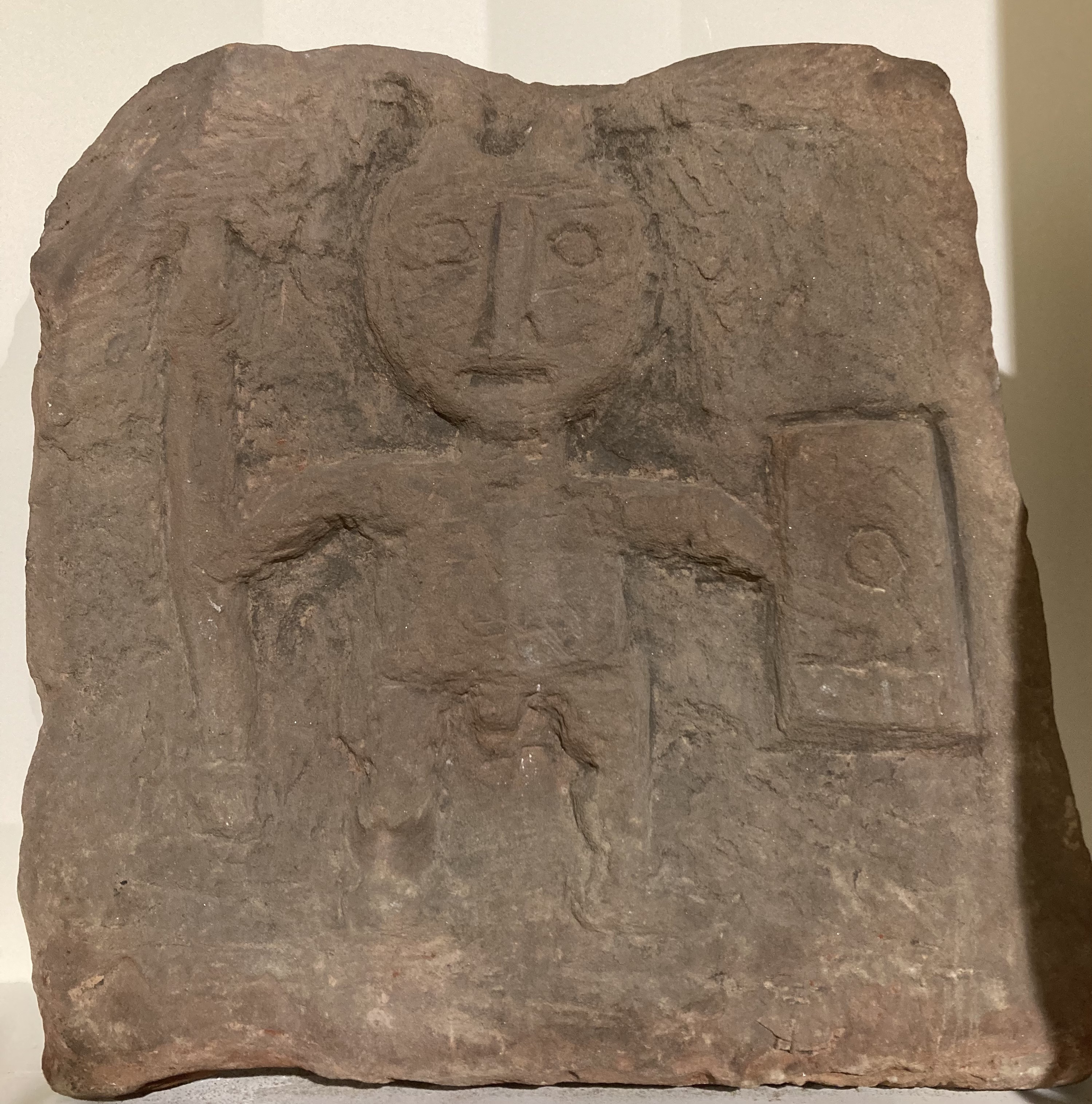
The Senhouse Museum is an understated little building without much in the way of airs and graces. Of course the brightest and most exciting Roman finds have generally been carried away to higher-profile museums in Carlisle or Newcastle or along the Wall itself, so it’s tempting to assume that smaller museums have to make do with the dregs of what’s left – but Senhouse contains a wealth of fascinating gravestones and altars, including a beautiful carving of the Roman goddess of horses Epona and a puzzlingly penis-themed “serpent stone” which is believed to hold Mithraic connections. Most strikingly of all, a small slab of sandstone reveals the carving of a short, bandy-legged little man holding a shield and sword. His willy dangles between his legs, and given a general theme of phallic inscriptions elsewhere in the museum, I can’t be alone in thinking that his nose looks a bit like a willy too.
Perhaps he’s a fertility idol – but importantly, this figure has horns. They’re only little stubs, but there’s no getting away from them – and as a consequence, he’s been identified as part of a pattern of “horned gods” which run all the way from the Celtic deity Cernunnos to the dangerously horned-up figures which were tapped into Bronze Age stelae unearthed in the mountains of Spain. This is a thrillingly rich connection, and while it’s hard to know whether horned gods represent a contiguous cult or tradition or just a loosely-related irruption of similarities, the idea clearly tumbles far out of sight into the whispers of prehistory.
Discovering that an ancient horned god was found alongside Roman remains within sight of my home and across the Solway in this almost-familiar Cumbrian hinterland, this mythic tradition has suddenly been grounded in strangely recognisable terms. An awful lot of my time and writing is devoted to trying to understand animals in relation to human beings – particularly in how that connection reverberates in a sense of belonging. This animal/human hybrid has turned up close to home, and he represents a trail of breadcrumbs I simply can’t ignore.

 Bog Myrtle & Peat
Leave a comment