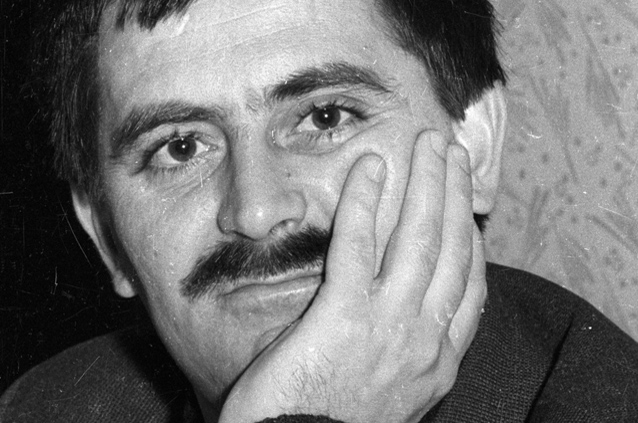
There are no small responses to the poetry of Ferenc Juhász. The man’s an explosion – a detonation of brightness, savagery and pressure which has no real parallel or reference point. Writing from the depths of rural Hungary during some of the most immense and disturbing tragedies of the Twentieth century, Juhász stands on the brink of terrifying change – and like so many poets of his era, he can’t help but keep a foot on both sides of a widening divide between past and future.
Born and brought up in a remote peasant village, Juhász’s language is scratched from the underside of an ancient folk culture of shamanism, moon-worship and the movement of horses across the great Hungarian Steppe – but he’s no archivist or librarian. In his poetry, these primal influences are made to swill against the sudden rise of modernity; his imagery is criss-crossed with pylons, concrete and the snarl of heavy new cities. It’s real and wild and frightening, blurring lines which go to the root of how we understand ourselves in relation to the world.
Juhász’s most famous poem “The Boy Turned into a Stag / Clamours at the Gate of Secrets” does what it says on the tin – a young man becomes a deer and roars accordingly. It’s a vividly expressed transformation, but the parallel shift which befalls the boy’s mother describes a far more imaginative experience of disintegration into nature. As the woman gets older, her dexterity and capacity fail. Driven outdoors and away from domestic routines, her body crumbles into a pulpy tangle of snail shells, slug horns and dragonfly eyes – she’s cracked apart like fallen leaves; the effect is hideous and luminescent… but these parallel transitions do not establish common ground between mother and son – it’s an allegory of separation; they’re actively diverging. She needs him, but he is departing for manhood – his return won’t prevent her disintegration, it will only accelerate it. It’s a profoundly tragic and disturbing poem, and it comes from a distinctly Hungarian tradition which belongs only to itself.
Elsewhere, Juhász is brightly, jaggedly observant in descriptions of horses and livestock; a blurring of Christian iconography and animism with its roots in an ancient steppe culture which runs far into Central Asia. His people become creatures and his creatures become people; all are expressed on a razor-wire of electricity and panic which cowers and cringes before the might of strange deities, then abruptly turns to attack the merest suggestion of a god (any god) with coruscating, bloodthirsty rage.
Juhász’s English-speaking contemporaries were writers like Seamus Heaney and Ted Hughes. These poets grow up in similar periods of transition from ancient rurality to modern city living – Heaney described it as a shift “from the sacred to the profane”. I’ve been preoccupied with similar shifts, but I am fifty years younger – and at first I was frustrated by writers of this generation who wrote to mark the end of old traditions. Finalities and retrospects were so important to their work that I felt baked out of an engagement with their words. They seemed to imply that I had missed the boat; that old jokes were in-jokes and I would never catch up. But the change is ongoing – I go looking for signs of the sacred in the year 2025 and find that the echoes are often more thrilling than the original draft itself.
At first I wondered if I was hunting these shreds as an act of defiance; as if I could somehow force a case to show that they were still relevant because they mattered so much to me. But I also apologised for writing in ways which seemed nostalgic; I trod cautiously around accusations that my approach belonged to traditions which had died before I was born. But I’m not frightened anymore. These writers were of their time and I am of mine – and we still haven’t struck the root of this seam yet. In that sense, Juhász is another exemplar for me and a freshly challenging elaboration of themes which never wear out.
Juhász is also different because but his specific power lies in an ability to blend nature, folklore and superstition into a singularly muscular and frightening aesthetic. He goes far beyond the sweet or saccharine recollection of a world which “used to be so lovely” and can only be recalled with misty eyes and sighs – his past is not something which we can put to bed and revisit at our leisure. I actually find it hard to hold my little book of his poetry – and there’s no safety to be found in closing it either. Once they’ve been unlocked, his ideas drip into your lap and spoil your clothing like ink or clots of blood.
I only found Ferenc Juhász in the most chancy and roundabout way. The poet Tom Pow suggested that I should read the Irish poet Maurice Riordan (and I think you should read him too). In Riordan’s 2000 collection Floods he responded to The Boy Turned into a Stag with something like an Irish translation – but even on this clearly floodlit path, Juhász is still hard to find in English. I pinned him down in a Penguin translation from the 1970s, but it’s a slender volume and half of it is devoted to another Hungarian poet called Sándor Weöres. Looking online, I see that there’s a more recent translation of Juhász’s work, but it’s quite expensive – and beyond it, almost nothing else.
I write this only as a tip-off and a tiny recommendation. You shouldn’t be put off by the fact that it’s not easy to find Juhász – I promise that he’s worth the hunt.

 Bog Myrtle & Peat
Leave a comment