It was clear and bright in Toledo, but the high-sided streets were chilly with shade. The city is famous for its Cathedral and the Alcazar which withstood an extended and disastrous Republican siege during the Spanish Civil War. There are famous photographs of Franco and Himmler striding through the busted wreckage of the old fortress in the aftermath of that battle; the place had been shelled into non-existence but it never fell to the surrounding forces. It became a symbol of resistance for the Nationalists – a show of defiance, even in its devastation.
Republican forces held the city during the siege, and to prove that the old ways could be shattered once and for all, they dug out the long-dead bodies of ancient bishops and holy men from their tombs, posing for photographs with their skeletons to demonstrate that death makes no exceptions for wealth and celebrity. These most recent and urgent chapters of history overlay thousands of others, from the nearby discovery of sixth century hoards of Visigoth jewellery to the high religious glamour of El Greco’s artwork which shines from the walls of the Cathedral’s interior.
To the north of the City above the fading grandeur of the Puerta del Sol, a network of steep-ascending roofs rise to the edge of a plain and unassuming brick-built booth. Shaded-out by overbearing homes and tenements, this is a tiny building, shrunk inside the socket of its own foundations. A few of the high windows are brightened with red and cream chequerboard decorations, but the effect is muted and subtle – it’s pretty, but only when you take a moment to pause and focus on it. A passer-by would find it easy to overlook this place altogether.
The only access to this building is via little stone bridges or modern steel ramps, and it’s tempting to guess at why this place should have been laid out with a moat in lines of such obscurity. It could just as easily have been a granary, an office block or a jailhouse – but this is the Mezquito de Christo de la Luz – an astonishing survival of Islamic architecture which was laid down under Moorish rule between 999 and 1000AD. Less than a century later, Toledo was recaptured by Christians and the building was repurposed as a Church.
It’s a Spanish habit to pinch and redesignate religious architecture, and there are countless examples of churches which became mosques and mosques which afterwards became churches when the Moors were driven out of Spain. Confusing the aesthetics still further, a hybrid “mudejar” culture blurred Christian and Islamic aesthetics and endured long into the Medieval period. It’s obviously fascinating, but while Christo de la Luz is far from the most famous example of a mosque which was later reinvented as a church, it’s a powerful building in its own right, not least because its essential smallness accentuates an impression of intimacy – there’s nowhere to hide or be distracted. Enter this building and it will become your entire world.
Inside, the floorspace is divided in two halves. The tiny nave is crowded with tall, narrow columns, their capitals bearing Visigothic carvings to show that the Moorish designers pillaged or rediscovered their materials from an even older tradition. These columns feel ancient and cold as soap; they rise towards a complex meshwork of vaulting in the shape of stars – and each one is different.
Towards the apse, the building opens into light and a high-plastered dome – but nothing here is more than a few feet away. The entire mezquito occupies an eight metre square; it’s a tight and personal space, dimly illuminated by shafts of cold, impassive light – and that light explodes on the fragments of ancient wall paintings, many of which have only recently been discovered beneath skins of flaking limewash. There are mottled views of saints and angels; an emphasis on seraphims with their four-crossed wings and their eyes which seem to stare from every angle; eyes on their hands and on their forearms; eyes, even when they’re just a pupil surrounded by the brackets of lids. But more prominent are the winding foliate amazements of vine leaves, geometric patterns, sprawls of ivy and ribbons – in its heyday, this would have been richness to the point of overload. The fact that so much has been lost has meant that these patchy, leprous survivals are more comprehensible; they invite much closer scrutiny because the full effect would have left us wondering where to begin.
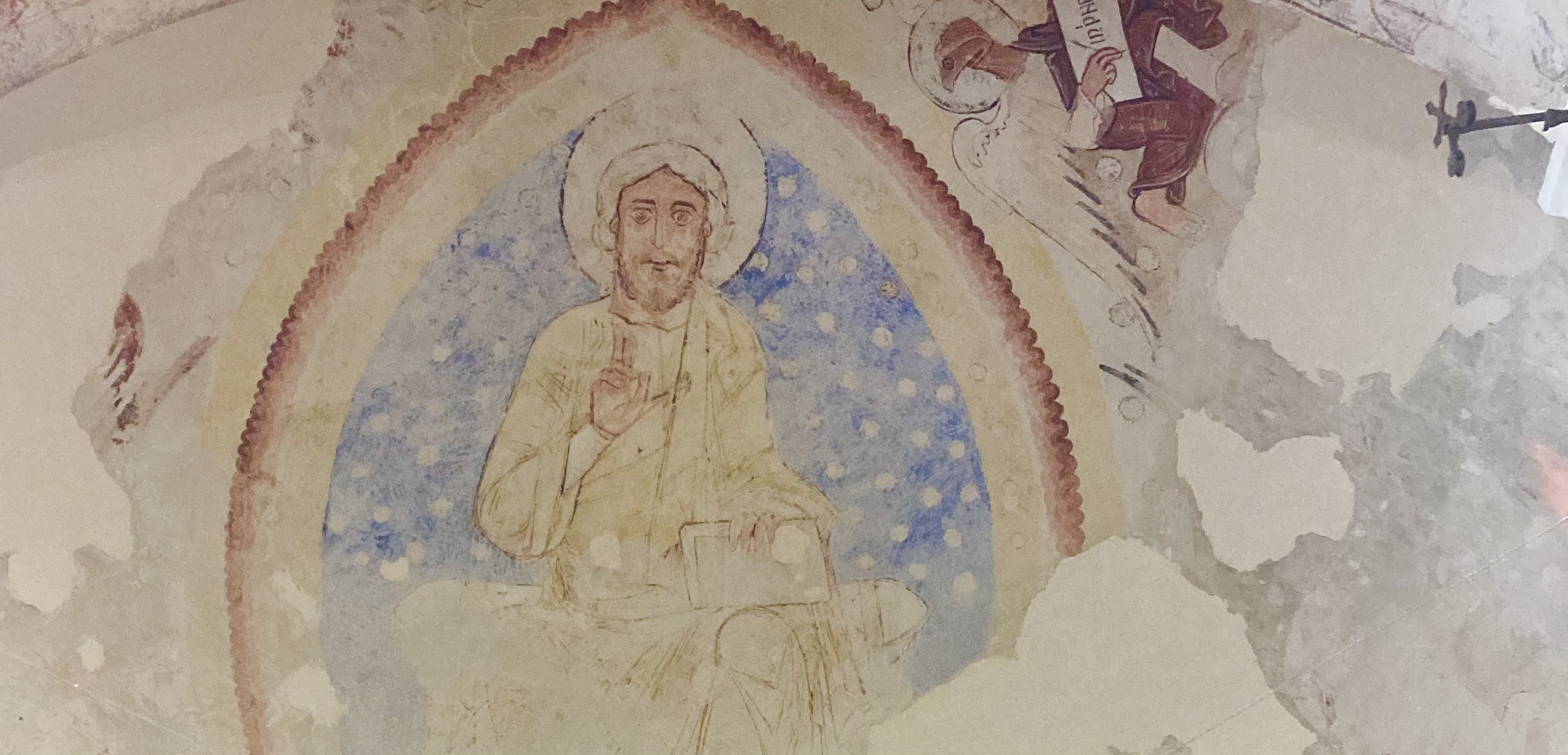
Across the ceiling of the half-dome, the figure of Christ is painted in the fullest pitch of his empty-eyed, Romanesque grandeur. He’s not a man at all; he’s an icon of himself – calm and passive and superhuman in his humanity. He burns brightly against a faded blue night sky, littered with stars and wreathed with billows of purple smoke. From a small sign on the wall, I learnt the word to describe this scene – in Byzantine tradition, it’s called a Christ Pantocrator, and it roots this place in the same famous continuity which thrilled me in Istanbul – but just as the Hagia Sophia baffled me with its gestures of conflicted faiths, the flagrancy of Christian tradition is offset here by fragments of much older Arabic script which runs around the chancel arch in a patchwork of soot black lettering. Accompanying decorations and intricacies are rendered in ox-blood red, and the two overlap until it’s hard to tell which is more recent. One can’t be seen without the other – it’s a three-dimensional scrapbook of overlapping intensities, and like the oppressive stuffiness which precedes a heavy storm, a moment of resolution seems to hang in the balance.
I had the entire place to myself for an hour, waiting for the atmosphere to crackle into life. I watched my warm breath palling like smoke in the cold; cats were fighting on the roof outside; pigeons clattered in the ivy – but the world itself was held at cold arm’s length. At last I had to leave this place and plunge back into normality, but before I stood and walked three paces to the door, I made several dummy departures as if to tease out a solution – as if I was waiting to see whether I or the building would blink first. But it refused my games and hung on to its imminence – and if what happens next is on the tip of the tongue of this place, it could easily stay there for another thousand years.

 Bog Myrtle & Peat
Leave a comment