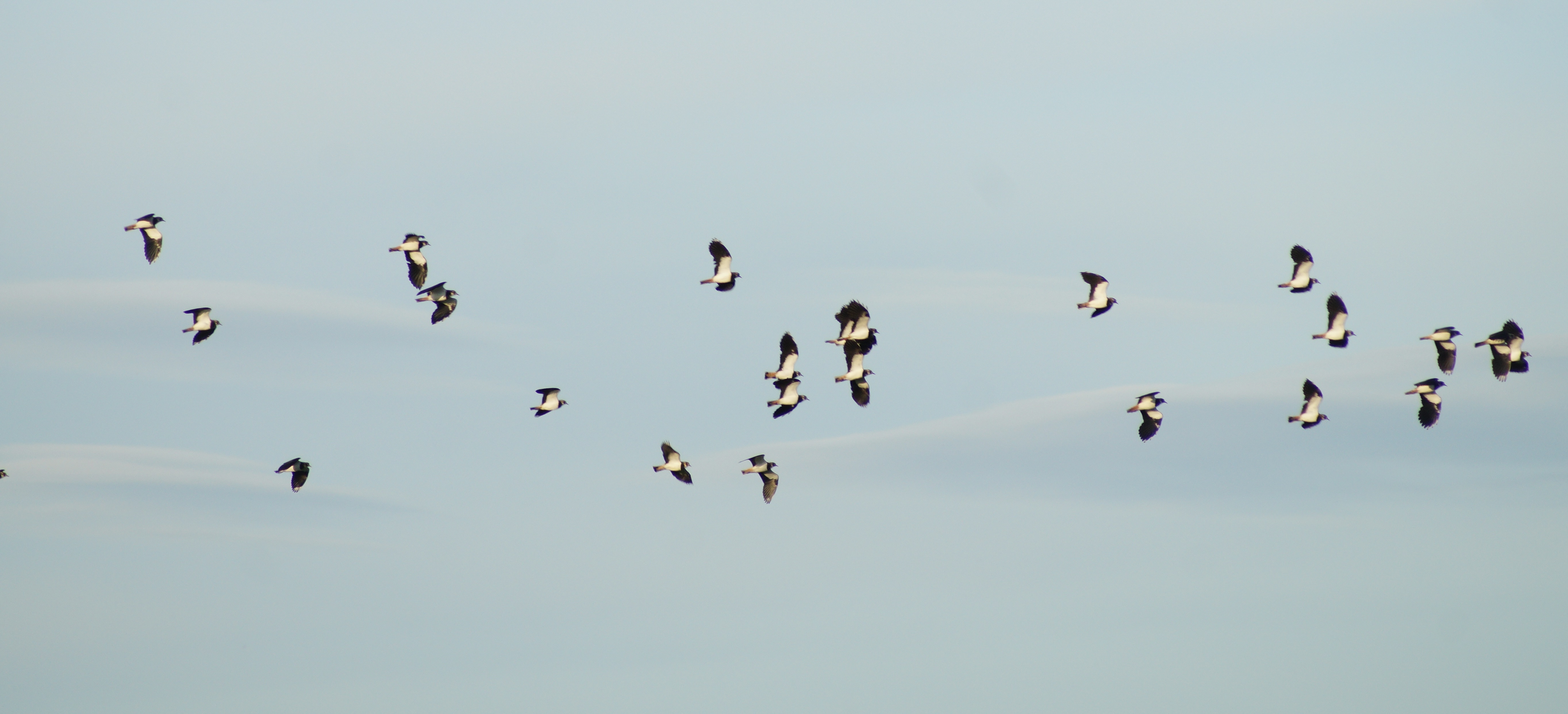
Big flocks of lapwings have spent the winter down on the wetlands, but individual pairs are now breaking off to speculate inland as the days lengthen and thrushes sing for the twilight. Lapwings are unusual waders for the sake of their curiosity and flexibility. Birds like curlews are duty-bound to return to the same places every year, and even the raucous oystercatcher is oddly conservative in his innovation – but lapwings come and go according to patterns of whim and excitement. They might stay and breed in one field for several years and then never return again – and not for the sake of failure or decline. Something might change which we humans can’t detect, and they’re simply off.
We know that lapwings can move across long distances during the course of their year, but we don’t have much idea of more local movements during their breeding season. If birds bred successfully in your fields last year and they don’t return this spring, it’s hard to know if they’re just a mile or two across the hill or whether they’re attempting to breed in France. Whatever the answer is, lapwings actively seek out new and promising opportunities to reproduce, and they’ll often turn up in unexpected places at this time of year.
In fields on the way to Dalbeattie, a ditch burst in the storms which came in November. Fifteen acres have remained partially flooded ever since, and it looks like good lapwing habitat. It’s therefore no surprise that lapwings have turned up there, and at least four pairs have been watching the diggers repairing the ditches so the water can drain away again. Those birds will move elsewhere when the habitat’s lost, perhaps to a nearby hill where cattle have been grazing rape or kale over the last few weeks. Lapwings love this kind of muddy mess, and it’s likely that they’ll set up there to breed in eight weeks time when the first eggs appear. The trouble is that lapwings can’t tell the difference between habitats which have been created to draw them in and the accidental mess caused by floods and mistakes. The former is a safe and stable environment; the latter is often worse than nothing at all because it encourages birds to make commitments which are later betrayed. What looks like good habitat is never more than a roll of the dice away from disaster.
To some extent, you could say that lapwings are spoiled for choice when it comes to suitable breeding habitat right now. There are floods and puddles and mushed-up field corners everywhere you turn – even though many are in the process of being snatched back into agricultural productivity. But it’s far too tempting to assume that we’d have many more lapwings in Galloway if only farmers could be persuaded to leave these wetter, scruffier corners as they are. For a start, farmers can’t leave them alone. Quite apart from the cultural urge to tidy things up (which is deeply engrained in its own right), farmers are being paid to produce food from productive land. If they’re not in specific wader-friendly schemes, they’ll be actively penalised for allowing land to fall out of production. As it stands, the system supports people who want to do good for waders (with varied and indifferent results) and it actively punishes those who accidentally do good for waders.
It’s not simply a case of making space for lapwings – that’s both easier and harder than it looks. It’s also understanding that no sooner have they laid their eggs and rooted themselves in a particular spot, they’re under threat from a host of new problems, from badgers and foxes to crows and errant livestock. Trying to support an ephemeral population of lapwings on my neighbour’s farm last year, I spent hours protecting the birds from predators and managing agricultural operations to ensure that nothing would be disturbed by the reality of modern farming. I did everything I could – I’d go so far as to say that I did everything that could be done – but that work yielded precisely nothing whatsoever. The birds hatched several chicks, but they were all eaten. This is not to say that we shouldn’t bother with habitat creation – we just need to be realistic about the significance of habitat creation which is not supported by any other action.
There’s promise and the scent of opportunity in the air at this time of year. Smashed, soaked and washed-out by winter, the landscape is closer to its natural-self in January than in any other month – but progress is far harder to realise than it seems. Encouraging farmers to hold on to this wreckage feels like a passive “win” for the birds, but successful wader conservation is based on active intervention. In most situations, there’s no solution big or comprehensive enough to mean that we can do it once and things will all be fine thereafter. Success depends upon dozens of carefully-timed tweaks and interventions which have to take place every year – it’s why waders are some of the species most threatened by the progress of rewilding.
Even rewilders concede that a completely hands-off approach to wader conservation will doom the birds to failure – they justify it by saying that any change results in winners and losers, and that rewilding provides a net benefit to a wider variety of other species. Some even go so far as to say that we have too many waders at the moment anyway – there are even claims that the kind of people who like waders are farmers and gamekeepers; so if the birds fail, it’s a neat rebuke to “the bad guys”. I believe that there are some excellent reasons to prioritise wader conservation, but the reality is that we’re actively moving away from progress for birds like lapwings and curlews.
It’s also hard to ignore the fact that each year brings fewer lapwings back to Galloway. The big flocks of my childhood don’t exist anymore. What I call “big” nowadays is only sixty birds; when I was a child, it was six hundred. Here’s how it goes, and there are no easy answers.

 Bog Myrtle & Peat
Leave a comment