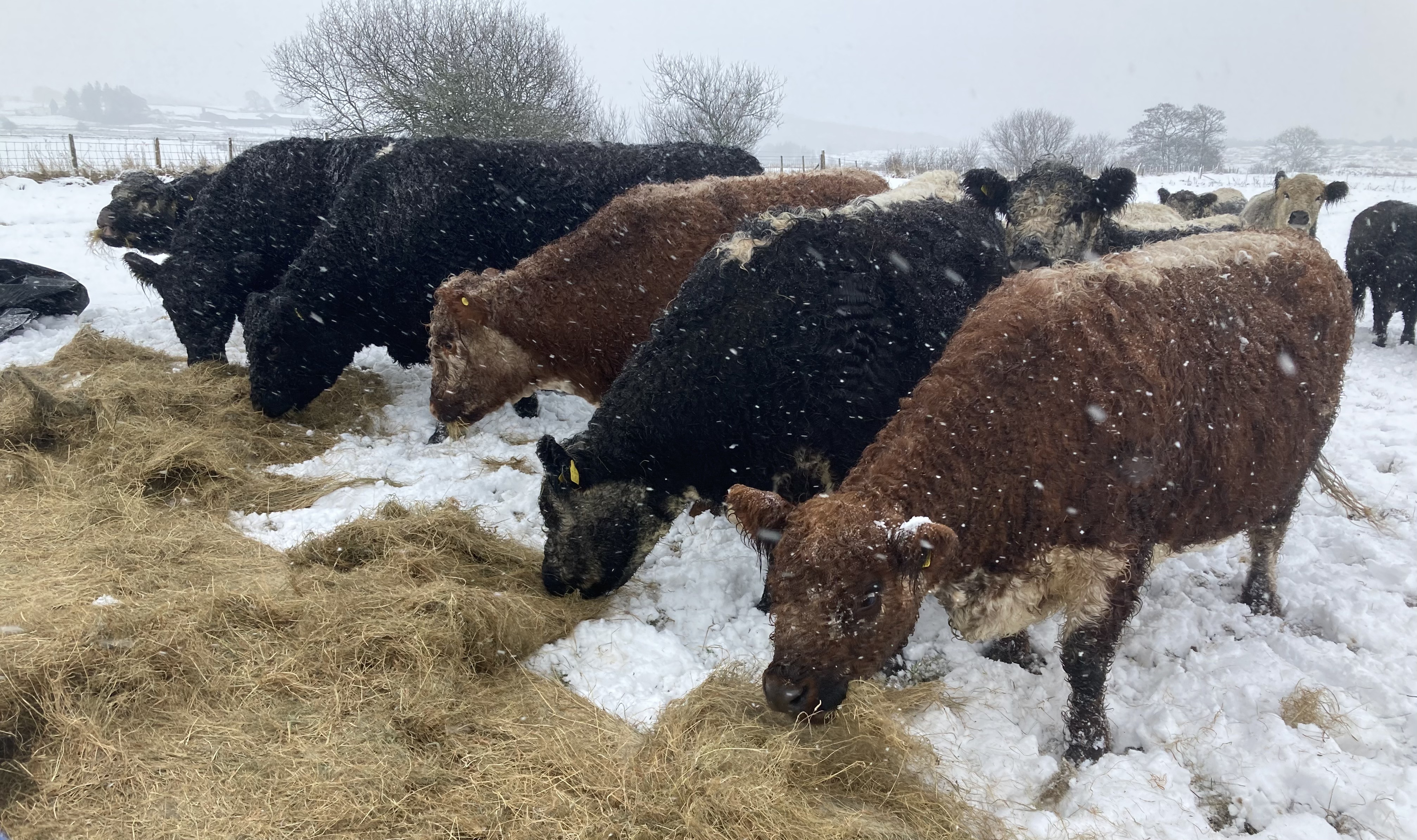
The bale-grazing experiment continues – and taking such a focussed look at how and where my cows are feeding, it’s possible to tighten up on aspects of their overwintered behaviour. I worried that I was wasting silage by unrolling the bales and driving cattle out to graze upon it. It’s certainly true that they don’t eat nearly so much of the stuff as they would if it was placed neatly in a ring – but they are eating far more winter grass on the rougher parts of the hill. What I lose in silage is more than made up for by natural forage, and the cows have never looked in better nick as we coast towards Candlemas and the prospect of the year’s first larksong.
But it has to be said that while the cows are hale and hearty, they dislike this regime. They can prosper under the new management, but they’d prefer not to. My silage bales are stacked in an area of rough, dry ground towards the highest part of the property. The cows have been up there to raid it, and the leading matriarchs have learned how to tear open the plastic wrap to pull out the silage inside. I often have to fence the silage off so that cows don’t peck at it, but I normally wait until I get a problem before I act. During most winters, the cows are so full of silage at their ring that they’re never tempted to steal at all – and I can save myself a job – but in forcing them to graze rough grass, it’s no surprise that they’ve turned to a life of crime. I put an electric wire around the silage, and that’s holding them back from further pillage, but this has been another useful reminder of the wide margin between what these animals need… and how that lies in contrast to what they want.
I had some interesting feedback from an article on Scribehound (behind a paywall, sadly) about the traditional use of native breeds of cattle. I argued that native breeds were no more or less sustainable or environmentally friendly than any other kind of cow – that it was quite possible to have traditional breeds and do no good whatsoever for wildlife. The issue is not so much the specific breed of cow but rather how it’s managed and deployed as part of a system. I was being deliberately provocative in parts of that article, particularly in my attempt to tweak the tail of belted galloways, which are so universally admired and adored.
I have no axe to grind with belties – they’re fine by me – but in my role as a land management and conservation advisor, I am often surprised by a general perception that belties are somehow better and more worthy than other kinds of cattle, and that it’s not really possible to do good things for nature without them. But just as you can’t control how and where your words will travel, the article was picked up by some people who interpreted my comments as a criticism of native cattle.
I’d be the last person on earth to criticise British beasts – but this pushback was a useful reminder that native breeds are still on the back foot in this country. In attacking my article, critics were keen to reinforce the idea that cattle are financially viable – probably because they’re used to being told that they’re not. I hadn’t made any real mention of financial viability in my article, but if you’re in the habit of being criticised along a certain line, it’s easy to imagine that it’s the only line – and other arguments get lost. Until we can shift the dial on acceptance for native breeds, it’s sometimes tricky to explore issues which look at other areas of the conversation.
I was being cheeky, but I do believe my point still stands. Even here in Galloway, some of the highest profile producers of galloway beef have almost nothing to differentiate their environmental credentials from a standard model based on continental charolais x calves. The biggest local processors buy galloway calves at eighteen months old and run them through sheds full of maize wholecrop sileage to get them finished according to commercial deadlines. That meat is marketed for a premium because it’s “galloway beef from Galloway”, but the elevated retail price seems to assume that that’s all there is to it; quality is therefore self-evident. It seems obvious that unless we can get a clear view on how this beef is being produced, the story is far from simple. In our progress towards the ultimate Sunday roast, a native breed is a certainly a good start… but it’s definitely not the end of the story. Nobody’s being cynical here – it’s just more complicated than it’s made to seem.
Back out in the field, it’s certainly true that galloway cattle can do things that other breeds can’t do – but these special powers are pointless if they’re not being used. It turns out that my galloways are thriving on bale grazing, not least because they’re extremely well adapted to outwinter on rough grass. I didn’t know how well adapted they were until I started to make them work a little harder… and it’s revealing that the beasts themselves didn’t know how good they were either. Given the choice, they’d plump for an uninterrupted stream of the best silage from October to April – but the current state of their fat bellies and wobbling briskets show that they really don’t need it.
The impact on of all this bale grazing on local vegetation will show over the coming months, and hopefully the birds will appreciate the change as an improvement when the time comes to start nesting. I’m certainly not an ecological angel here, and everything I’ve done so far this winter has been a matter of experiment and hope – but even after almost ten years trying to strike a balance between farming and nature with these cows, it seems like there’s always more to learn.

 Bog Myrtle & Peat
Leave a comment