I’ll never see inside the caves at Altamira, just as there’s no chance they’ll ever let me climb down into the gloomy reaches of Lascaux. Europe’s brightest and most extraordinary cave art is too precious to share with rubber-neckers like me; those paintings are so fragile that even my associated humidities would be intolerably corrosive. It’s not that I can’t look into these places – I can’t even risk being near them.
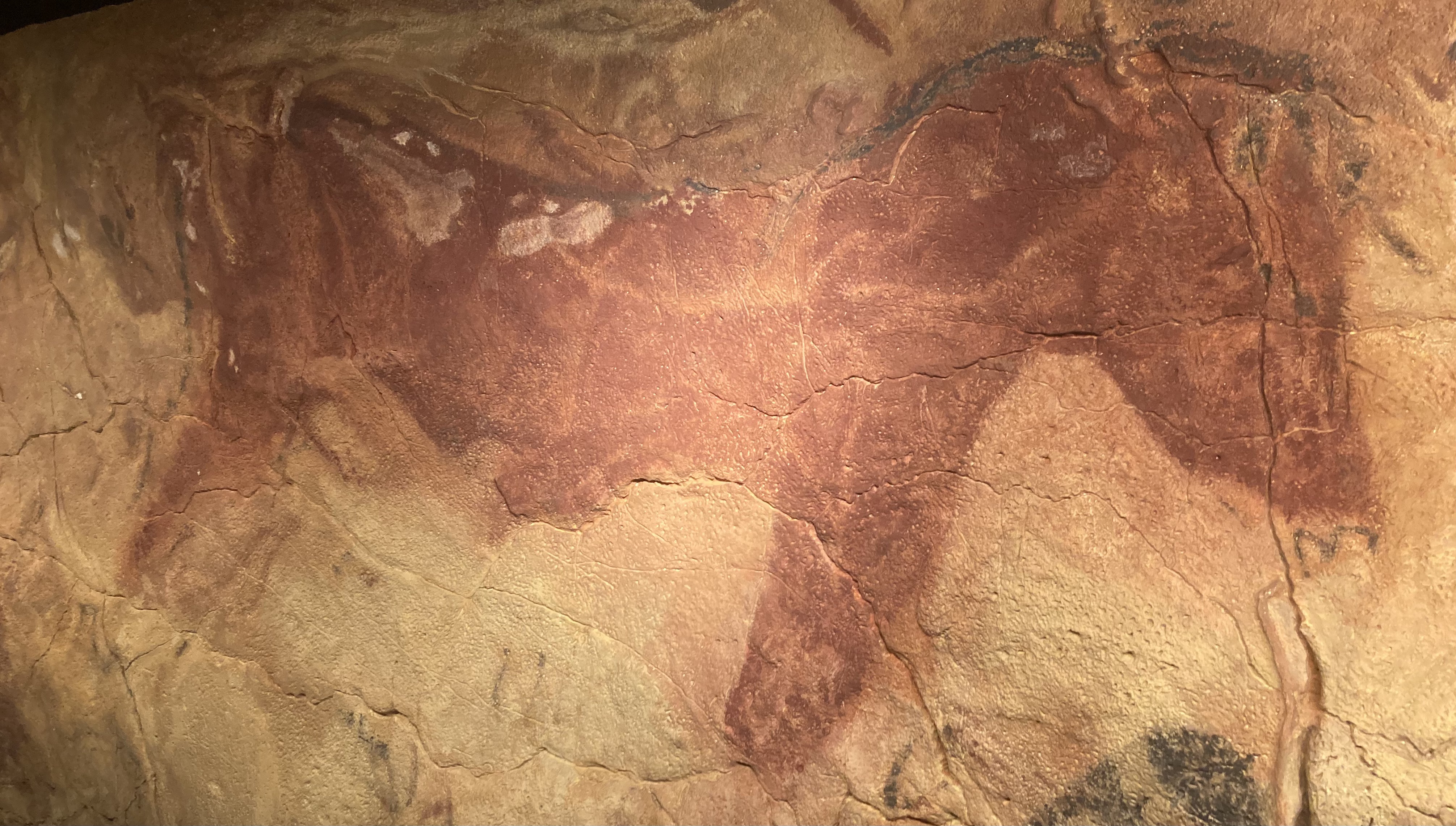
As an alternative, they’ve made a copy of the caves at Altamira in the grounds of the Museo Archaeológico Nacional in Madrid. Measured steps lead down into a concrete grotto beneath the streets where doors slide on glossy runners and the rooms are buried in coats of black emulsion. At the far end of a short passageway, a neatly trimmed-off ceiling reveals the heart of these 36,000 year old designs which are famously familiar as bison and the long-lost silhouettes of wild horses. But what seem to be obvious lines and embellishments are actually not that obvious in person. The hulk of a bison’s hump stares directly into your face on a sheet of A4 paper, but the reality of these paintings is far more ephemeral and three-dimensional, even on the roof of this imitation cave.
The Altamira paintings are clustered around a pattern of low-hanging bumps in the rock – each bump has been reimagined as an animal, and this approach runs so deeply against the grain of modern representation that it seems to make no sense at first. You or I might have looked for a smooth surface upon which to express ourselves, but this artist(s) actively incorporated these uneven wobbles to augment their design. Perhaps they would have looked upon a smooth surface as lacking in essential character – maybe they wanted this reckless surge of texture to form an intrinsic part of their work.
In other cave paintings elsewhere, figures and shapes have been overlaid upon one another in patterns to signify trembling movements – certain lines are echoed and replayed to draw specific emphasis to the action of running or feeding. It looks chaotic, and in order to interpret these figures, we need to abandon our usual creative vocabularies and go back to basics; in that sense, they remind us how much we take for granted as “normal” in western art.
I know these figures back-to-front from books I’ve been reading since I was twelve years old – and it turns out that if you want to see what the cave paintings at Altamira are all about, you’re better off looking at photographs. Cameras and artists’ impressions translate this wrinkled smear of artwork into flattened images which are much easier to interrogate and explore. This replica version doesn’t improve upon the forensic acuity of photographs any more than it can provide a meaningful alternative to Altamira itself. It’s simply one of several tools which assist our progress towards understanding what the real thing is like.
Of course it’s daft to say that this replica is not as good as reality – it’s not trying to match the original, and nothing could ever replace the truth of ancient darkness. But it turns out that I’m a sucker for replicas anyway; I’ve often been thrilled to spend meaningful time with fakes or replica items. At first this was in error; at the Ulster Museum, I spent twenty minutes sketching the famous medieval Cross of Cong, only to realise that it was a Twentieth century copy. Until I read the little disclaimer, I was thrilled. After I had read it, I was disappointed. But reflecting on that disappointment, the shift seemed so arbitrary; nothing had changed – I was standing exactly where I had been standing, staring at precisely the same object. If I hadn’t noticed my error, I would have gone home feeling happy as a clam. Perhaps I felt silly or embarrassed for having made such a mistake, but it wasn’t as if the entire museum was giggling at me. The disappointment only existed in my own head.
Sometimes I have wished that museums hadn’t told me that I was looking at copies or imitation objects – the emotional glow and the swell of excitement is true to itself, and there are many things I’d love to see but never will – so why shouldn’t I be happy in my error? The replicated cave of Altamira is obviously different because it’s far more dependent upon context. It’s not some dislocated brooch or gilded ornament which has been passed through many hands and may or may not be real. There’s no suspension of disbelief at the Museo Archaeológico – it’s simply an experience of its own, complete with its own caveats and conditions.
And I have to say that it does add value. I had not thought to consider the illusions of curvature, light and bulk in this way. I had imagined that they were drawn on a chalkboard surface because all I’d ever seen were images printed on paper – but in its use of natural contours and materials, this painting is closer to a kind of sculpture. Taking this impression from a replica has helped me bite more deeply into real things I’ll never see with my own two eyes. I can picture it now; I feel closer to knowing what it’s about – particularly in how it offers a sense of unfathomable distance from modernity.
In its wider context, the Museo Archaeológico Nacional itself is bulging with vital, ecstatic riches from ancient Iberian civilisations – the Altamira section is nothing like main event and I probably wouldn’t have gone down those steps for a look if I hadn’t been passing anyway. But it helped, and the bridge I’m trying to cross by accessing these paintings is too large for a single leap anyway – it’s not so bad to inch a little closer.
Picture: Part of the copied Altamira cave paintings which show a wild horse.

 Bog Myrtle & Peat
Leave a comment