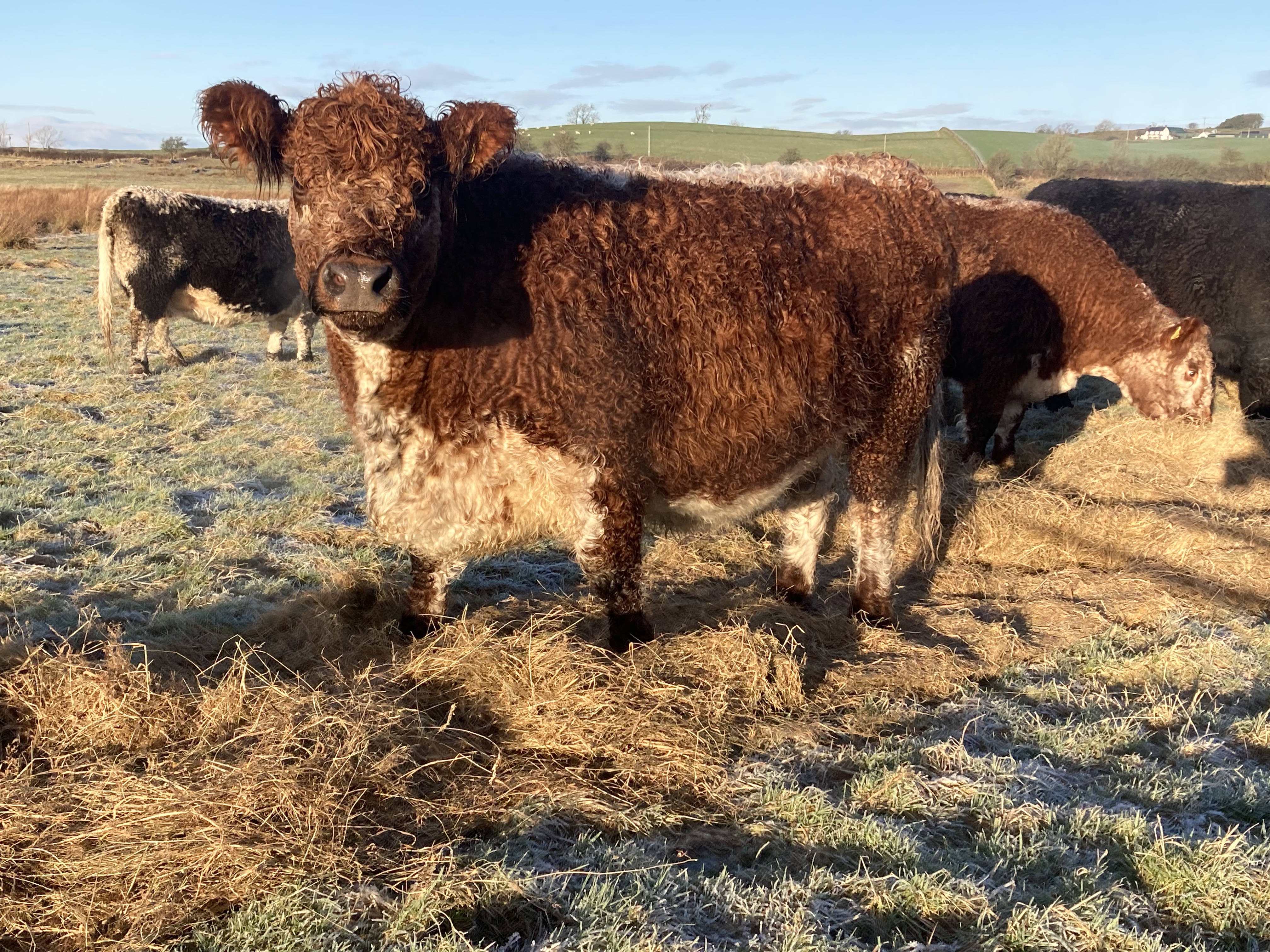
It’s hard work rolling out bales for the beasts. I’m glad I only have to do one at a time – if I was feeding eight or ten bales in a morning, I’d be getting sick of it. That’s an issue of scale, and what seems to be working for me is not an automatic hit for bigger farmers. But it’s not all plain sailing…
As a rule, it makes good sense to roll bales down a hill so that gravity does most of the work. That’s how I’ve seen bales being unrolled in videos on social media, pursued by a trail of bucking, bellowing beasts in a pitch of delighted excitement. But it doesn’t help that almost of all my grazing is largely flat. Where there is a hill, the slope is rarely long enough for a bale to gather speed or momentum of its own. So I’m forced to push them by hand along flat ground, and the amount of patience I have for this work varies enormously.
At the same time, level ground is likely to hold water after rain. These are all peat soils – they drain slowly and they’re inclined to hold a grudge. Old footprints die hard, and even the wheelmarks from last summer’s tractorwork are still visible in the morning frost. I have to be very careful that I’m not doing harm by moving bales around and spreading the damage of cattle-hooves across the better ground.
I’m quite new to this place, and I’m still learning the bits that get wet and stay wet for longest – and I must confess that I have made a bit of a mess in certain places. Some areas are getting muddy, and that’s more than just an aesthetic worry – broken turf is a toehold for weeds, compacted ground spoils good grass and ripples of soil get stuck in the mower and spoil the silage. “Scruffy” is good for nature – but there’s a balance to strike between “scruffy” and “damaged”.
I knew this would happen, but it was always my aim to contain it – and I’m starting to struggle. In weighing up the pros and cons of bale grazing or dumping it all in a ring-feeder, the balance is always shifting. And I can’t ignore the fact that over the road, cattle are grazing kale and straw across a wide, angular hill. They’ve completely destroyed the field and the soil runs off black and muddy every time there’s a rain. It’s a different approach, and while I’m quibbling over a misplaced hoofprint, I can’t ignore the fact that certain strands of commercial beef production are pushing “full steam ahead”.
It also matters that since I have been feeding cattle across a flat, wet field since November, two animals have gone lame. One cow has begun to stand on the heel of her back off-side leg and her hooves are sitting unevenly on the ground. It means that she’s started to limp, and another cow has stood back altogether and released pressure on a hoof which has suddenly grown up and over itself like aladdin’s slipper. These animals are both more than ten years old and it will be quite easy to sort them out by trimming the hooves and restoring the original shape – but it does bother me, because galloways should not have foot problems.
Old wisdom dictates that problems in galloways should be weeded out for the benefit of the breed. These beasts are famous for being self-reliant, and while it’s common for commercial breeds to have their feet trimmed, there should never be a need to touch a galloway’s feet – if there is, many would argue that the animal itself should be condemned – as the saying goes “Cut their feet- cut their throat”. This is the first time I’ve ever had problems with feet in almost ten years of working with these animals, but it’s possible that these problems have arisen (or been exacerbated) by the fact that I’m feeding cows on wet ground this winter.
In a normal year, they’d be scrambling all over rough knowes and hilltops to stand in the shelter of a granite quarry. Like a dog’s toenails, that friction and movement would keep their feet in check by naturally wearing the excess hoof away. Galloways do fine on wet ground, but they do like dry land to lie on. I’ve been feeding them away from their usual dry-lies, and maybe this has combined with other factors to create problems. It’s one to watch.
On the plus side, feeding in new places continues to be interesting and revealing. From my office window, I can see when and how the beasts choose to eat. I can observe how the pecking order changes between them, and I watch as they adapt and shift according to the wind and weather. Plus when I got to them, they’re clean and satisfied – gone are the days when they stood to their bellies in muck around a feeder. Making them more interactive adds another level of fun to the work, and now I look back on the old technique of dumping feed in the same place every day as if nothing could have been more boring.

 Bog Myrtle & Peat
Leave a comment