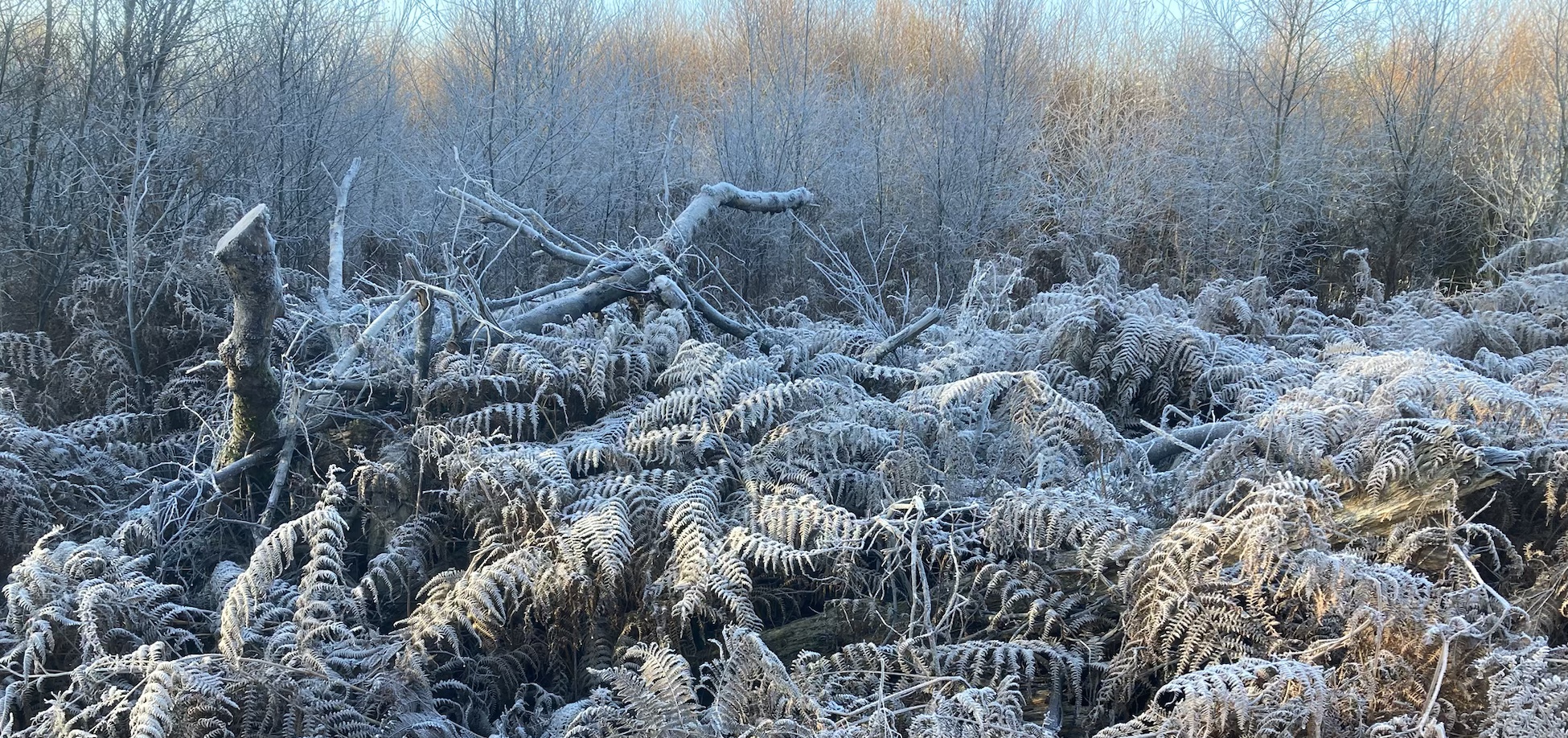
The sun rose slow on a cold morning’s run through the forest. It’s a route I follow almost every day, and after the overnight hardness of stars it’s liable to come up icy in the morning. As I came around a distant corner, golden backlit breath rose through a stickle of birch trees. It was the kind of breath you’d expect to see from cattle in the dusk, and I almost thought nothing of it. But there are no cattle that way, and there’s no such thing as breath without lungs. I stopped and stared, but there was nothing beyond the shattered black shape of an upturned root in the trees. I took a few steps off the track and that breath continued to stream into the morning like steam from a Yellowstone geyser. Then it struck me that for all I was watching, something watched me back. And in a sudden bounding turn, the black root materialised into a heavy boar which recoiled and ran deeper into the trees; daft as a minibus; silent as the breath which had first drawn my eye to scene – and without which I’d never have paused to look harder.
This is only the fourth or fifth time I’ve seen these wild boar in the forest above my house, but I know they’re there in good numbers. You can’t count boar on the basis of what you’ve seen, otherwise they simply wouldn’t exist. It seems that even in the time I’ve been aware of these animals in Galloway, they’ve been leavening themselves like dough. Catching a friend by accident in the street last week, he told me that boar are now being seen and shot fifteen miles further west than I thought they’d ever gone. They’ve crossed the Urr, the Fleet and the Dee, and they’re well on their way to the Cree. Asking around, it seems like the population at Beeswing and Kinharvie now runs a full thirty miles to Creetown – an entire span of Kirkcudbrightshire, although principally in the south and along the coast. I’m not aware of any boar found north of the old railway line, although others have expanded southwards from a different escape or release site in the Glenkens.
What I’ve just written here is probably the most detailed and extensive survey of wild boar distribution in this part of Galloway… by which I mean that we have no idea what’s happening. And there are still many people who flatly deny the existence of wild boar here. Ironically, some of the most ardent (and amateurish) rewilding landowners dream of a day when wild boar are allowed to roam again in Scotland… while snuffling outdoors in the darkness, their dream is manifestly true.
Wild boar are getting some degree of official recognition in government management guidance, but the work is generally directed towards squeakier wheels further north. Stalkers and land managers in the Highlands are locking horns with boar and attracting attention and support from official bodies – but aside from a vague and airily ambitious gesture that “boar in Galloway should be eradicated”, the fact remains that these animals don’t pose much of a problem here. When you speak to people in NatureSCOT, they have no specific desire to eliminate boar (which they doggedly call feral pigs) – at the very most, they’re simply providing landowners who want to kill boar with a degree of guidance on how best to do it. Stories of state-mandated extirpation have either gone quiet or never existed.
The boar in Galloway are living in massive areas of commercial forestry and rooting around in upland bogs. It’s no skin off anybody’s nose to have them around, and if they ever did pose a problem, it would be very easy to shoot one or two individuals and afterwards shy the rest to the forest again. In so many ways, this is a superb wildlife story which Galloway should trumpet with pride – we’ve lost almost everything else since the forestry came and the slurry spreaders belched into life, so why not enjoy something we’ve gained? But this story also depends for its success on the fact that nobody knows it’s happening – these animals owe their expansion to the fact that it’s taken place in silence.
There are no official bodies or organisations publicising or celebrating the status of boar in Galloway. A blog article like this one is as close as you’ll get to a press release, and maybe that’s a pleasingly porcine folk revival to offset against the grim commercial shininess of the conservation industry. It also means that we have nobody to thank for these animals – although that’s not to say that somebody won’t try and take the credit someday. For now, there’s still enough doubt in the public sphere as to whether or not wild boar are good things, and maybe it’s a bad idea to stamp your name on something which could later become a problem.
Maybe this explains why foresters are so tight-lipped about the success of boar – the animals have built their heartland in public-owned spruce crops near Dumfries, but there’s little formal recognition of their existence from the foresters who manage this land on our behalf. We’re definitely not being encouraged to “come and see”, so the animals remain under the radar, thrilling us in momentary encounters and consolidating their hold, far beyond the point at which it doesn’t matter what we think – they’re definitely here for good.


 Bog Myrtle & Peat
Leave a comment