The National Park consultation is “underway”, but it’s hard to make sense of the process when so much depends upon whether or not we actually want to be having this conversation.
A questionnaire which recently fell through my letterbox not only asked if I was keen for designation, but also sought my views on how board members should be elected as part of the proposed National Park’s multi-tiered management structure. So many issues are rushing through a narrow gap at the same time, and it’s all a bit overwhelming if you’re unhappy with the entire concept. If you don’t want a park, it’s tempting to write NO and then leave the rest of these questions unanswered, but in a meeting with NatureSCOT staff at the Mart in Castle Douglas last month, it became clear that reasoned engagement carries more clout than yes or no answers. As a result, it’s easy to feel pulled into this debate against your will.
On the basis of an assessment that we don’t quite understand, saying “NO” doesn’t count as much as saying “no thank you” and then explaining precisely why… but it’s hard to measure quantitative and qualitative data against each other, and if I wrote a comprehensive, social-science-backed 30,000 word pamphlet about why I think a National Park is a bad idea, should that really have more weight than another person who has less time on their hands and simply says “no thanks”? What’s more, if I extended my treatise to 60,000 words, would that be even better or more impactful? When the decision comes, are we going to be left wondering if there was more or less we could have done to make our point? Or was it never really up for discussion anyway.
It seems obvious that this should be a two-part process – the first to establish if we want a Park or not, the second to discuss the cascade of subsidiary fall-out questions which accompany a YES.
If this was a genuine conversation which attempted to work out how people feel about a National Park, we could engage with it however we chose – but for as long as the questionnaire also includes “do you support a National Park?”, it feels like a referendum in all but name. We can’t help but assume that it’s the only real question worth answering, but if you want your NO to ring loud and clear, you have to engage with the consultation document in full… and does that mean you actually end up sounding softer and more open to negotiation? In any other circumstances, the ultimate NO would be a refusal to engage with the consultation at all, but we’re told that this not the best way to kill the plan – so if we do want to kill it, what’s the best way to go about it? In its current form, it’s neither referendum nor consultation, and none of the normal rules apply.
I am trying to resist my impulse to oppose the National Park, but it’s very hard when the consultation process is being so consistently crap, opaque and muddled.
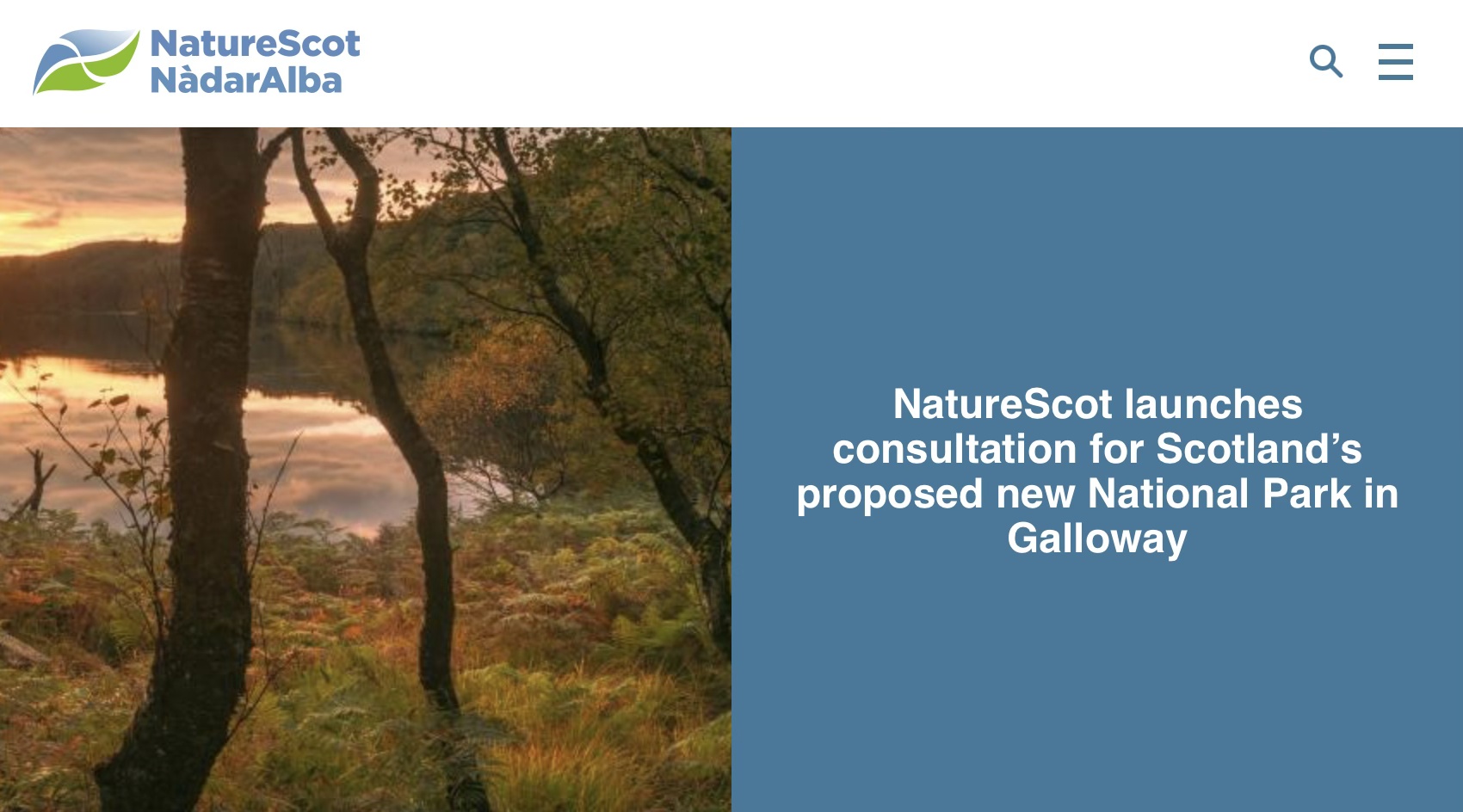
As the Nature Scot communications machine has swung into action, it’s even been disheartening to see how this conversation is being presented and explained. Paperwork circulated by the consultation is festooned with the blandest and most generic photographs which seem to have been derived from a stock image library in which the search terms are “Scotland”, “tourism” and “outdoors”. Some of the photographs of scenery have been manipulated to suit the design and layout, and it all feels disturbingly unlike the place I know – as if the authors once overheard a joke called Galloway at a party and are now making multiple unfunny attempts to retell it to their own friends at home.
I can see all kinds of benefits to a National Park in Galloway, but only if it really understands what Galloway is. The very nature of National Parks means that they’re pulled in all kinds of different directions from the outset; designated landscapes are held to different standards, and it’s not unusual to hear people call for certain actions or restrictions “because it’s a National Park”, even when the point they’re making has nothing to do with park status. Where there’s funding available to do cool new stuff in National Parks, targets are set and changes implemented according to national and international inspirations – but unless a National Park has a clear understanding of where it came from, these pressures and expectations simply rewrite the entire rulebook, and what’s genuinely precious is lost.
In their use of language and presentation, it’s clear that NatureSCOT and the Government don’t really know what Galloway is. To be fair, it’s hard to articulate a sense of this place, but we can’t protect it if we can’t define it. Pictures of texel lambs and laughing tourists are being included for decoration in the consultation documents in order to break up larger blocks of text – but they’re weirdly off-key, and this is too important to fluff with a strangely unrecognisable aesthetic which has very clearly been pulled together somewhere else.
When you look at old maps of Dalbeattie, it’s astonishing how this place was able to look after itself. In 1908, the town had [in no particular order] an abattoir, an infirmary, a feed mill, a grain store, a livestock market, a train station, a curling rink, three schools, a timber yard, an international harbour and a series of globally significant granite quarries. Dalbeattie was ready for anything – you could be born, educated, work a full life, retire and die without ever leaving the town. As part of a pattern of completely self-contained towns, Galloway had a specific character which was entirely of its place. And we weren’t unique in that – it was the norm in a nation of largely autonomous counties and regions at a time when the train journey from Dalbeattie to London (ha ha, can you imagine?) would take you through a galaxy of clearly defined communities, each one with a sharply defined sense of itself.
Nowadays, Dalbeattie is utterly dependent upon centralised government. It’s no wonder that Galloway is hard to define because everything from the food we eat to the places where we’re born and buried are completely homogenous. Generations of governments and global corporations have stripped the guts out of regionalism – devolution just changed the people who don’t understand us. It’s ironic that the government is designating National Parks to protect valuable places in a country where local variations have probably never been weaker or meant less. If I had a quid for every time I’ve seen policy and strategy documents which lump Galloway into the Borders, I’d be a rich man. There was a time when only English people made that generalisation – now it’s a Scottish norm.
I grew up around people who remember Dalbeattie in its independent heyday. They had a clear sense of this place and themselves, even down to the words and the language they used to describe it. Galloway really meant something to them, and those people are what Galloway means to me – but as that generation has faded, it’s no surprise that people from outside Galloway look at this place and see a blank canvas. For them, we’re just a big blob of “countryside” – another chance to do the kinds of things you can do anywhere; like setting up a mountain bike track, reintroducing red kites or spending the weekend in a glamping pod. That’s not to say that these aren’t valuable things, but they are certainly generic and they have almost nothing to say about the specifics of this place – or any place. They’re just “things you can do at weekends”. But what if your whole life is Galloway? Even if I could pin what this place means, my experience is not yours and others will certainly take a different view.
Unless there’s a genuine attempt to engage with this place on its own terms, the real value of Galloway will simply ebb away in a National Park. It’ll be called “the next step” or “a future for the region”, but it’ll start with the finish.

 Bog Myrtle & Peat
Leave a comment