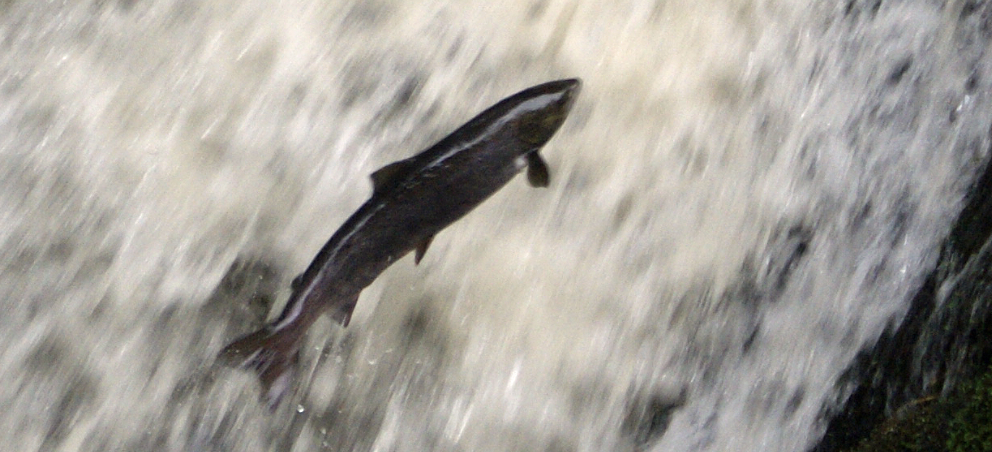
A salmon rose and sank again in a pool at the old Urr weir. Fallen ash leaves billowed in gales around her body, and the moment passed to the tune of the water’s growling. I was desperate to be sure that my son had seen him too, but he was looking somewhere else – and it’s hard to balance his own flow against my sudden urgencies. I shout “look!”, but he’s already looking; it’s just never at what I would have chosen. And it turns out that you can’t show a four-year-old boy anything. You simply have to hope you’ll be there when he sees it for himself.
I wanted him to see that fish because it thrilled me – but also because each time a salmon shows itself, it might be our last chance to see it together. Of all the things that I would like to pass onto my son, salmon feel important. We’ve often sat to watch for jumping at the Cluden and the Minnoch falls. Unfairly, I press him to focus on my priorities, and he frowns obligingly at the spume as if that’s what I wanted. But then he gets bored or cold and my own memories of plenty are strangely overlaid by these disparate experiences. It’s hardly about the fish these days. We look for things like otter spraint or twigs to toss for the current. Last week we sat for an hour and saw nothing like a salmon. Instead we talked about the changing leaves and an unexpected view to Hamish’s new shed.
As wild fish stocks decline, salmon have passed into the realms of special interest. They’re probably most often seen by ecologists these days; in the context of angling, they belong to a cadre of persistent old men with startlingly florid faces. My son saw such a man treading into the river in a pair of crinkled chest-waders. He said it was like seeing “a grey mermaid”. Of course my heart goes out to these devoted few who simply cannot quit, but they’re often tetchy in their failure. Like any brotherhood marginalised by change and frustration, they remember the good old days and they’re not sure where to place the pain of bereavement. Like aimless sexual energy, it’s sublimated into ever-greater fascination for precision and presentation – for officiousness and pedantry which further narrows options.
It’s fair to imagine that fewer people take up fishing these days because they don’t know where to start. Formerly, they could have been told to have a crack and see what happens. Now it’s no laughing matter on the riverbank, and silliness is nipped in the bud. When you meet an old campaigner, the advice is outweighed by tutted warnings and the suggestion that you’re out of your depth. The stakes are too high; kill a salmon even by accident and you’ll have your collar felt by the police – but the law which protects an almost-extinct species of fish is largely decorative, like legislation to restrict wild camping on the moon – the chance would be a fine thing.
And all this at odds with stories of men in Dalbeattie who’d drunk their wallets dry on summer nights and resorted to pulling salmon from the burn which runs beside the pub. Caught by a violent miscellany of pitchforks and wrecking bars, the fish could be passed across the bar to the kitchen and paid for in yet more pints. As time went by, the fishmonger learned to stay open late and swapped cash for the salmon killed by pissed-up town folk. You get a skinfull and still come out on top. It’s like a vision of Chaucerian England or the glimpse of a Bruegel fair, but this was the late 1970s.
People still run nets in the lagging bays and bends of the merse. They’re breaking the law, but heavy steaks of wild-caught fish are often in circulation under-the-counter. I don’t blame them for it. In fact, I admire the stubborn middle-fingeredness of resistance, particularly against a system which elsewhere endorses a form of industrial salmon production that would make Satan shudder.
These little nets aren’t decimating stocks or taking anything which can’t be replaced; there’s no devious commercial operation at work on the Solway rivers – just old men who’ve always done it. Their skills will die with them; they’ll stop when they’re gathered and I wish them luck in the meantime because poachers are endangered too. Besides, when you remember that salmon are a cipher for the vast incomprehensible enormity of the world itself, it seems obvious to rise and meet them in ancient ways which far exceed fretful protectionism. They’re meant to be killed – and since the greatest wonders of the world have been neutered by fussiness and bureaucracy, it’s become obvious that many were sanctified by profanity in the first place.
We’re told that the best way to protect these fish is to delete them from popular consciousness – to remove them from the day-to-day familiarity of food or currency. But the real point is not whether these species exist, but whether they’re able to suffer our attention. For human beings, the real pain is to find that we now have to occupy the world in a state of anxious best behaviour; newspapers frighten us, posters threaten fines, surveillance cameras watch for infringements and disturbance… and isn’t it startling to realise that my son belongs to the first generation in the history of mankind who can’t just dunt a fish on its head for his dinner? There are still salmon in the river Urr – but like everything that’s in decline, we lost it long before it finally failed.

 Bog Myrtle & Peat
Leave a comment