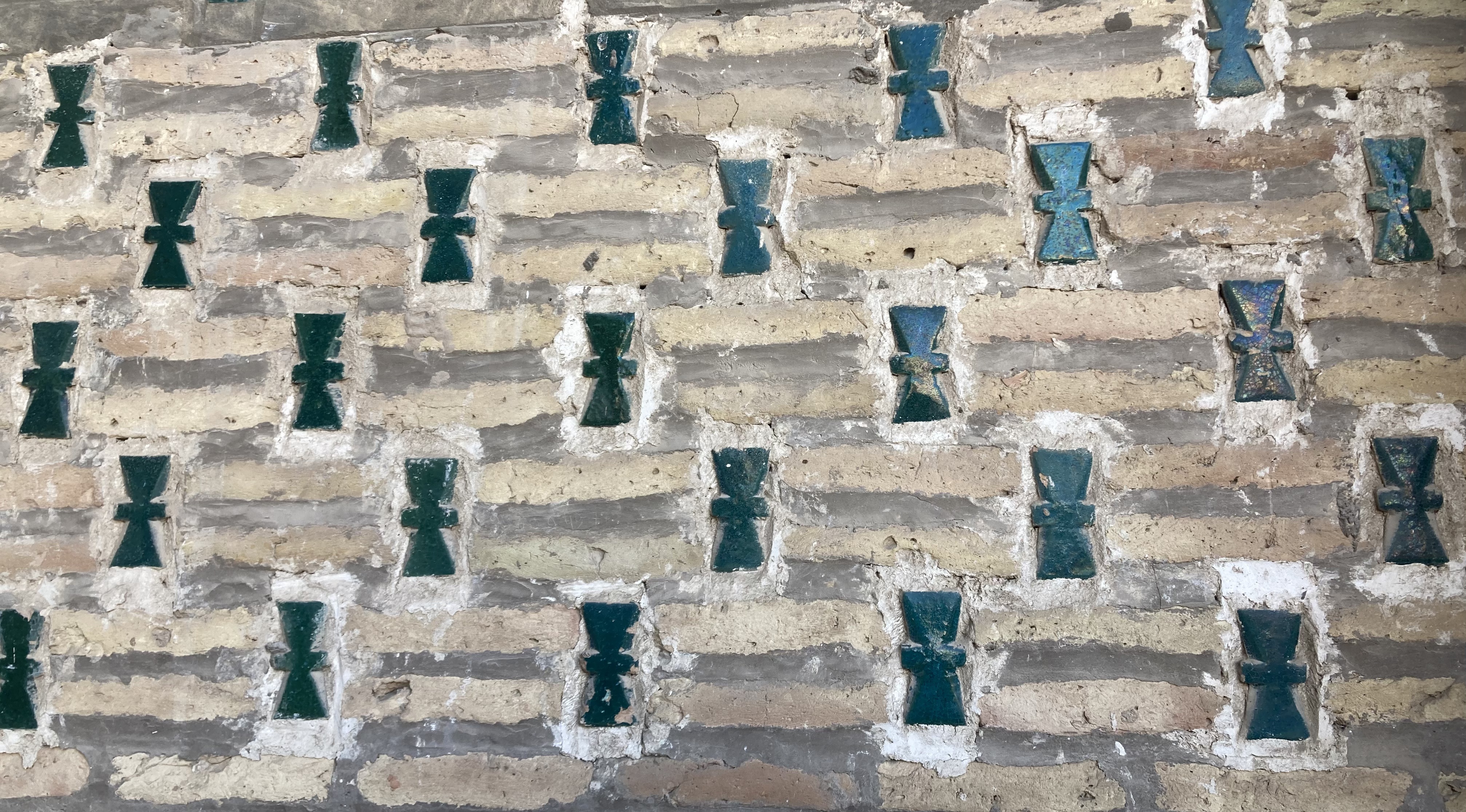
Everywhere you look in Khiva, there’s a four-pointed cross like the shape of a bowtie on its side. It seems to crop up on every level surface – the motif is woven into the complex design of madrasahs and boldly embedded in the stonework of mosques and minarets. No opportunity is missed to incorporate this cross, which is usually rendered in a pleasing bottle-green glaze. As a symbol, it’s such a repetitive and distinctive feature of the place that some of the hawkers sell it in pocket-sized imitations from carpets spread out in the neatly swept streets. There’s no engraving or explanation on these ceramic souvenirs – nothing to say “Khiva” aside from the obvious fact that they can’t have come from anywhere else.
In a country of complex and wonderful Islamic design, “the Khiva cross” feels like a variation on a strictly mathematical theme, but it actually speaks of a much older tradition here. This cross is a vestigial remnant of ancient Zoroastrianism – it represents a meeting point between the four essential elements of life. Importantly, it hasn’t survived here as a symbol of resistance against a tidal wave of Islamic culture which arrived twelve centuries ago. There are some far more proactive and self-aware vestiges of Zoroastrianism and pre-Islamic shamanism in Khiva, but the crosses have been completely wiped clean and repurposed as nothing more than a pleasing symmetrical shape. There are echoes here with in the way in which pagan oestre was subsumed into the Christian Easter – and you could go further to wonder how our modern chocolate festival used to have some relevance to Jesus. Meanings move, and heated symbolisms can soon become decorative pleasantries.
Similar processes are at work in Bukhara, where a tide of seventeenth century Turkic nationalism collided with standardised Islamic design. Nadir Divan-begi Madrasah is dazzlingly beautiful not only because it’s a vision of blue and turquoise tilework, but also because it depicts the huma bird of ancient folklore fame. The motif is repeated twice in glorious mosaics, and the birds (which are something like a cross between peacocks and phoenixes) are carrying matching cows in their jewelled talons. They’re exceptionally vivid and exciting, particularly for those of us who love representations of nature and wildlife in art. But Islamic design is famously focussed on mathematical precision and a deliberate avoidance of earthly creation.
The huma birds are very irregular, but the crowning curve-ball is the representation of a human face – a sun god with kiss-curls and a chubby, smirking grin. Surely he is an unacceptable affront to Islamic design? But this building is driven by a number of conflicted, competing interests; it’s linked by a surge in Turkic nationalism and reverence to tribal history in a landscape dominated by nomadic culture. The people who designed this Madrasah were devout muslims; they were simply able to balance their faith alongside ideas of regionalism and ethnic diversity. Besides, Bukhara is also pretty far from centres of Islamic authority. It must have been hard to police coherence and conformity in distant corners of the Islamic world, just as Roman Catholicism found it difficult to iron out local variety in medieval stonework in western Ireland. The Christian iconography at Sligo Abbey is clunky and bizarre; centralised authorities hated this kind of vernacular ham-fistedness, but it was too difficult to get rid of it.
in Amir Temur’s mausoleum at Samarkand, the grave markers are simply stone oblongs, carved with austere passages and reflections from the Qur’an. Overhead, every surface of this building’s interior is crusted with stars, lozenges and interlocking networks of immaculate gold filigree. It’s a mathematician’s wonderland; an extraordinary expression of Islamic intricacy – but above the grave of Sayyid Baraka, there is a tall wooden pole which reaches high up into the resplendent decorated dome. It’s black and twisted, and a tuft of scraggy material hangs limply from the peak in the stillness. It looks dreadful and discordant, but here’s the same tension at work again, because this is a symbol borrowed from ancient Turkic nomad custom which required the headman’s yurt to be marked by a horsehair banner. This pole looks scruffy, but it’s a clear gesture of respect to the dead man; that while his tomb is overlaid with the most glorious decorative architecture in the world, the most obvious symbolism is borrowed from horse-cultures of the endless steppe. In that sense, this grave is oddly moving – “here lies the chief” expressed in languages which sometimes feel mutually exclusive.
Where religious symbolisms are mixed and muddled by overlap, there’s a risk that they could become meaningless. After all, what is religion without rules and conformity? If you just do what you want, it’s a slippery slope towards chaos and meaninglessness. But there’s a striking degree of humanity in these little overlapping gestures; “the Khiva cross”, the huma bird and the horse-hair flag. They highlight some deeply recognisably human tendencies, not least in our endless ability to reinvent the rules and bend them to fit irregular feelings.
It’s sometimes difficult to invest in faith which feels frowningly inflexible. We don’t like to feel as if we’re being passed through a machine or a production-line which makes no allowance for ourselves. There’s always a tension between communities and the individuals, and that’s not to argue that every person should navigate faith as a kind of personal pick-n-mix scenario – particularly because the most comforting faith provides a reassurance that as individuals, we’re only a little piece of something bigger. But where collective consciousness is dissatisfied by control and conformity, faith can feel even more vital and human when it’s bent or twisted or shaped to fit. In an academic sense, dry classifications of religion often seem hollow until they’re grounded in the reality of actual people and genuine lives. We can feel closer to ideas around Islam, Zoroastrianism and Turkic culture when we see them being squeezed and smudged up together.

 Bog Myrtle & Peat
Leave a comment