A mile or so below Kirkcudbright, the Dee slops back upon itself to the pouch of a bay. It’s a great spot for curlews and shelducks, and from certain angles, it looks just as it would have done twelve hundred years ago when the Haliwerfolc nosed their way into Galloway. Fleeing from Viking raids on the east coast, this itinerant gang of monks and pilgrims had pulled their most treasured relic from the earth and vanished inland on a weary, winding journey across the Old North.
Before he died in 687AD, Saint Cuthbert told his community at Lindisfarne that if they should ever have to leave that place, they should take him with them. So in the face of an impending apocalypse during which dragons were seen flying in full fury above the coast of Northumberland, Cuthbert was exhumed and returned to the world. When his coffin was pried open, the monks discovered that the Saint was unfazed by death. Despite having been buried for years, the man lay neatly in the grave as if he was only asleep. Cuthbert was outlandishly devout in life; a friend to the eider duck and the curlew, he courted the gentle embrace of otters and crabs on the shit-stained Farne Islands. But the preservation of his body seemed to prove the point beyond any shadow of doubt. The Holy Spirit was clearly at work in this man; his body called for the most urgent and sacred protection.
For seven years, the Haliwerfolc carried the remains of St Cuthbert on their shoulders. Viking raids had turned the east of England into a nightmare of danger and persecution, so they walked and moved endlessly in that time, mobile and terrified as birds. Haliwerfolc was the name given to these “folk of the holy man” – their company grew and diminished on the fretful journey. Perhaps at times there were hundreds of people in close procession behind the restless coffin and the only-slightly-sleeping man inside. More likely there were only ten or twenty of these Haliwerfolc, and their movements through the north country were anxious and fussy as a breeze. There is no formal record of the journey taken by St Cuthbert’s corpse; he moved throughout the land now marked as Northumberland, County Durham, The Scottish Borders and Cumbria, first in the east and then in a growing spiral of snakework and ribbonism. It’s reasonable to imagine that he travelled everywhere, but even the clearest evidence is oddly gap-toothed and vague. We can piece it together in pursuit, but we’ll never get ahead of the truth.
One account suggests that the Haliwerfolc attempted a crossing to Ireland, but perhaps the weather was wrong or they changed their minds. Having made the decision to think boat-mindedly, it’s possible that Scotland offered a sensible alternative, and it’s no bother to cross the Solway when you have God’s will behind you. In a bend of the coast that is sheltered from the cool southwesterly, a small shack was built to house the coffin for several months in some unnumbered year towards the end of the ninth century. It became the kirk of Cuthbert – in time it would be called Kirkcudbright, famous not for any connection to the Saint’s life or works, but on account of his presence there in death – which is fitting, because most of St Cuthbert’s greatest deeds were transacted once the last breath of North Sea air had blown out of him.
In time, the Haliwerfolc were called to leave Kirkcudbright. What began as a panicked evasion had fallen into the steady pursuit of a sign. As they left Galloway, they didn’t know where they were going – they only knew that it would be obvious when they had arrived. They headed east until a shock of inspiration finally struck in a bend of the Wear and the sight of a milking cow, twelve miles southwest of a point where the river meets the sea – Durham. Over the ensuing centuries, a series of fine, upstanding churches would be thrown up on the site of Cuthbert’s final grave, the last and most impressive being the current might of Durham Cathedral.
But I just can’t let St Cuthbert slip away from Galloway. He was here, and his cross is featured on the recently revamped flag of the Stewartry of Kirkcudbright. We’ve made mincemeat of pronouncing his name, but it feels unfair that while his story rose and grew fat like a storm cloud across such a fine, enthralling sweep of land, we only remember the point at which the lightning finally struck. Even if I force myself to concede that Cuthbert doesn’t belong in Galloway, it doesn’t diminish a sense that he might have done – and that Durham could easily have been thrown up in south west Scotland.
I shouldn’t grasp for these ownerships, but Galloway is always part of other stories; a supporting role and one of many strands which run beside or fractionally beneath the brightest one. Twenty years after Cuthbert’s body passed through this place, the famous Galloway Hoard was buried at Balmaghie. When it was discovered in 2014, this treasure trove made national news – but it’s only a “Galloway Hoard” because as it was discovered here. Archeaologists are fascinated by the strange, exotic design of the artefacts, some of which may have come from Zoroastrian Persia. There are Saxon brooches, Viking silver and fragments of silk from Byzantium… but nothing which originally came from Galloway. We’re always for the borrowing and the passing through – it’s the same for our stories; we have part of Robert the Bruce, a chapter of St Ninian and a visit from Bonnie Prince Charlie. Like Robert Burns, the best of the Covenanting ministers came into Galloway from Ayrshire – they’re linked to this place only because they died here. We gave inspiration to John Buchan and Robert Louis Stevenson who came to see and then left again. Struck with an endless list of glancing blows and lacking tales to call our own, it’s surprising that we’ve been able to retain such a clear sense of ourselves.
If history recognises Galloway for anything at all, it’s only for a kind of reckless extremity which amounts to self-destruction in matters of generosity and dourness. We know ourselves, but we often lack the words to make this place understood. Galloway is loud with an inarticulate urgency, like a stage without actors; there is a great simplicity of truth which lurks forever on the tip of Galloway’s tongue, and the muffled words are maddening because something is being said at the mouth of the Dee below Kirkcudbright. St Cuthbert can help to make elements of it clear, and even in his passing through, the ancient Saint has bound himself into our Dream-Time, lending an almost-mythological vocabulary to this landscape as Oisin or Fergus did for WB Yeats’ conception of Ireland.
Of course there are more sensible, historical ways to think about Cuthbert, but if this legend brightens certain strands of this place, it darkens and confuses others. He’s only part of a wider explanation here, and it makes no sense to claim exclusive rights to his story when the very essence of our place is borrowing, connection and the stirring, tidal swell of stories. If Cuthbert is incontrovertibly bound to the North of England, it seems obvious that we are too – but in trying to define Galloway for the sake of itself, I underestimate the scope of the stories we tell about ourselves.
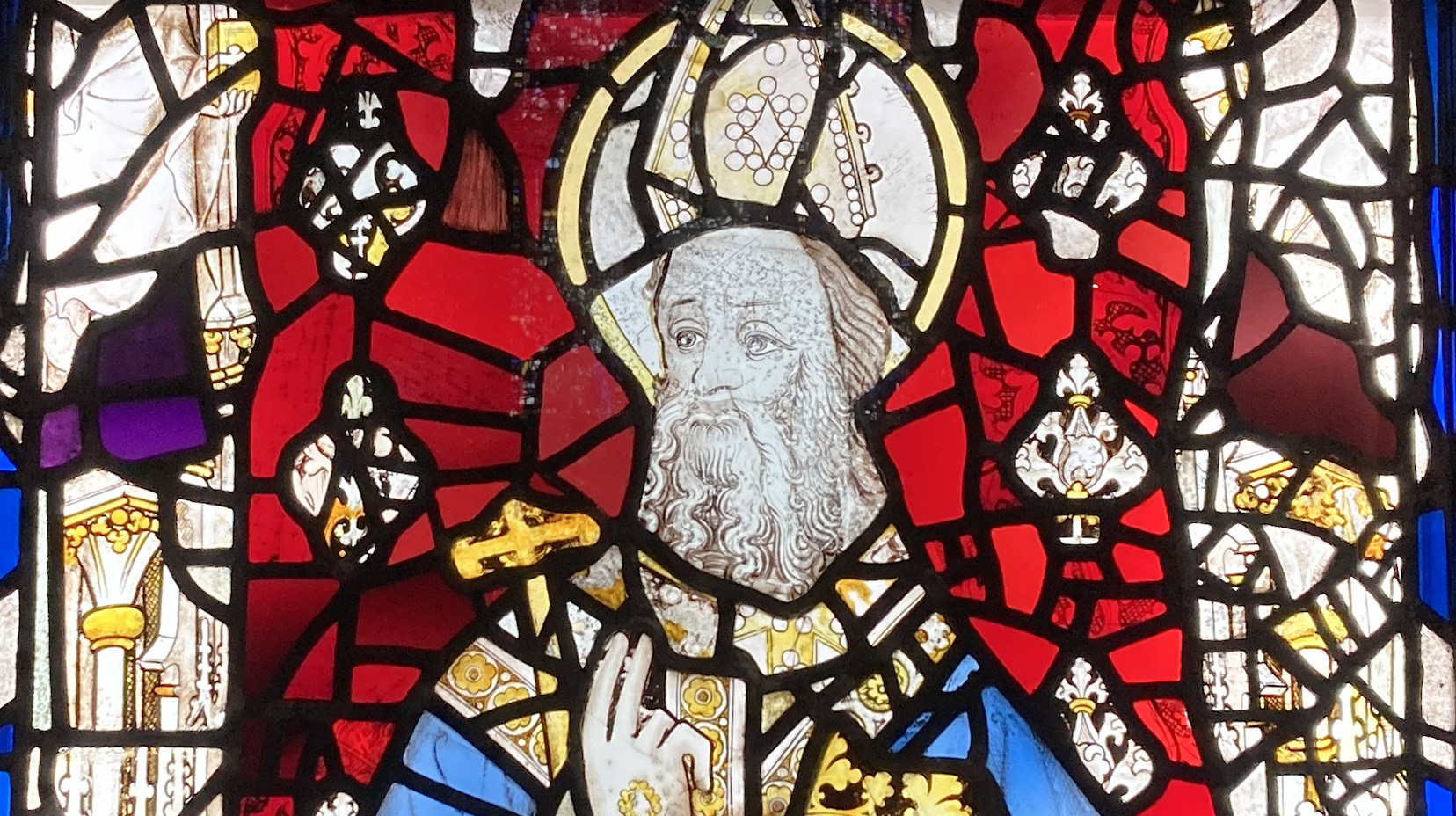
Picture: St Cuthbert as shown in the St Cuthbert Window, York Minster

 Bog Myrtle & Peat
Leave a comment