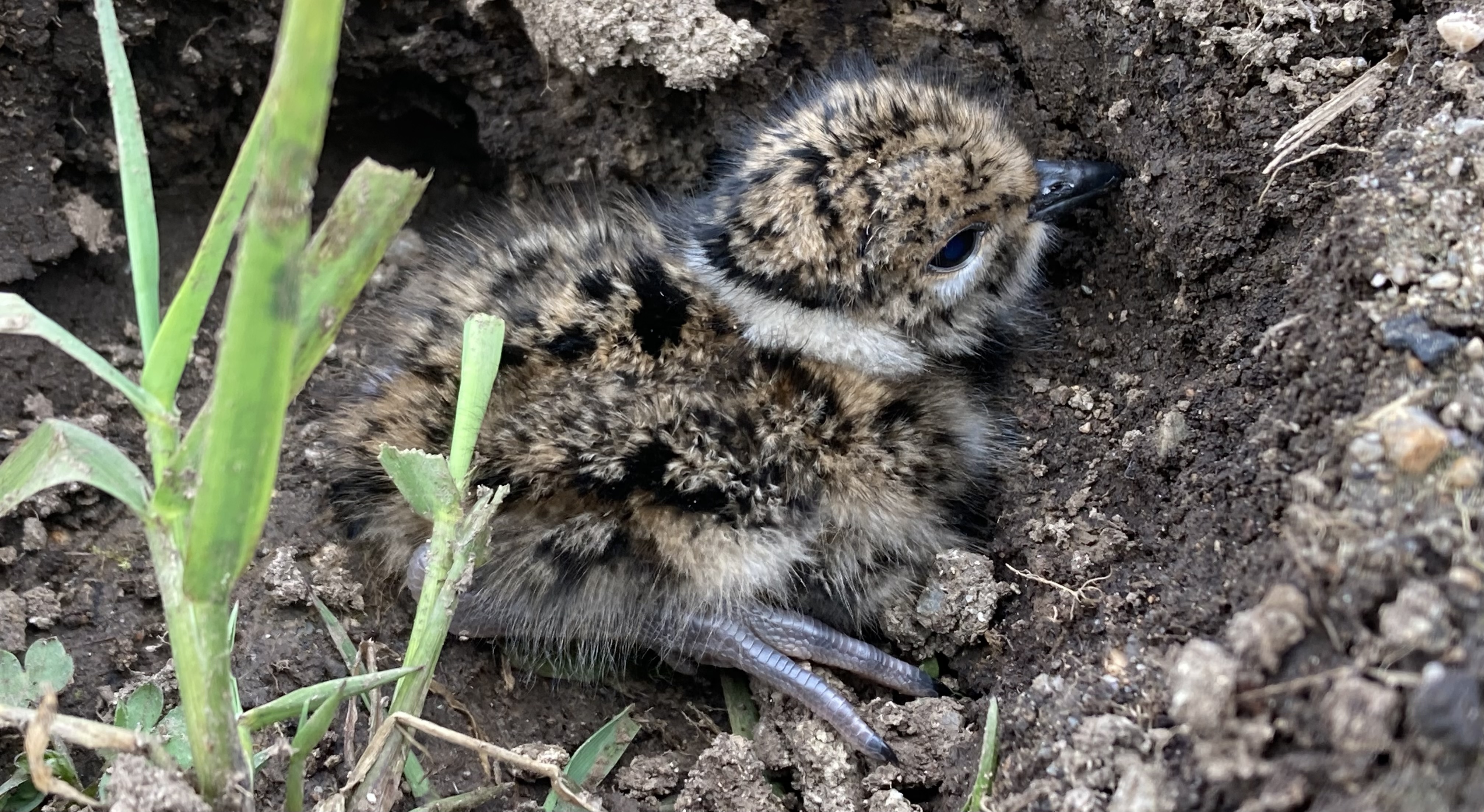
The lapwing eggs hatched into soft and comfortable rain. After several days of north, persistent wind, clouds rose up from the sea and smirred between the trees and the hilltops. It was warm, and the cuckoo called from every wood and spur of birch in the parish. The marigolds were full of leverets, and the cottongrass thickened to busbies by the labour of larks – you could not have planned a better day for young chicks to emerge, and now that I have photographs of the first egg’s hatching, I can backdate the process to its beginning on April 3rd; a long and changeable twenty eight days of incubation and worry.
I felt certain that this nest would fail for a hundred surefire reasons, and it made me catch my breath to find a cow footprint punched into the soil less than twelve inches away from the eggs – but they succeeded, and perhaps that’s a useful corrective against the assumption that livestock are a guarantee of wader-failure. Heavy numbers don’t help, and I would never recommend this kind of “come one, come all” grazing management at the height of the nesting season; but these birds are not inherently pathetic or vulnerable. With luck and momentum, they can work wonders.
The hatch itself was staggered over twenty four hours, and there are old sayings about the forwardness of lapwing chicks which seemed to depart the nest within seconds of hatching. In truth, while the chicks are bold and independent from the start – they are kept under control by their parents. I had set a camera at the nest which recorded detailed conversations between the mother and her first chick, and sounds which can certainly be understood as “be careful” and “come back” as the youngster went out to explore.
As soon as the first egg hatched, the behaviour of adult lapwings changes dramatically. The male’s flambuoyant displays come to an end, and their work is entirely focussed on protection and care. I’ll miss those displays, which have sometimes made me grudge the ludicrous hyperbole of raptor enthusiasts who attempted to rename the hen harrier as “skydancer”. Harriers are fine, but they’re a distant understudy to the male lapwing in the peak of his upside-down powers. The pair’s activity now is confined to vigilance and warning calls – the grumbling peeWIT which forces the bumbling chicks into hiding. After thirty six hours, three chicks left the nest and began to explore their surroundings in a loose group. A single egg was left unhatched in the nest. This warrants further exploration in a note to follow.
I have spent a lot of time watching these birds over the last few days. From a safe distance of two hundred yards, it’s more-or-less impossible to see the chicks – I can only infer what they’re doing from the behaviour of the parents. Sometimes both adults are brooding chicks, but more often they’re all gathered beneath the female. The male generally stands nearby, making busy little forays around the brood and returning to keep watch.
Hard rain kills chicks in no time at all, but this soft stuff was active boon – it kickstarted a whole new blizzard of insect life for the youngsters, precisely when they needed it most. However, it turned out this blizzard was indiscriminate in its bounty – the muddy kale field was suddenly filled with rooks and jackdaws which came to enjoy rich pickings of insect-life. Many of these came threateningly close to the lapwing and her chicks, and that was a cause for concern. Carrion crows are by far the most active and predatory corvids in this area, but I’ve been running traps to catch them for the last fortnight. They’re few and far between now, and that’s only to the good. But while jackdaws and rooks are less deliberate and calculating in their pursuit of chicks and eggs, they’re not going to ignore an opportunity when it’s presented.
As a big flock of jackdaws came near the chicks, the male lapwing spent considerable time “shooing” them away. I counted him making seventeen flights to attack and see off jackdaws in ten minutes, and the effect was generally quite positive in his favour. The rooks just flew away, and the jackdaws were quite shy of the attacks. But two or three seemed to think it was all just a game – they came back again and again, and once when the lapwing was chasing them off, they turned and chased him back. Three of them forced him down to the ground and one pulled a gout of white feathers from his belly. He quickly recovered and he soon won the upper hand – but in the confusion, three other jackdaws had found the female bird and were trying to pull her over. I presume that the chicks were underneath her at the time, so she was trying to keep them covered in the face of some difficult rough-and-tumble.
None of this had the feel of predation or direct attack. The jackdaws were being a menace, but there was nothing like strategic cold-bloodedness here. They were in the field because they were searching for insects, and it’s in their nature to be irritating. But I was very struck by the toll this must exert on the lapwings; and how direct predation is only part of the problem against a steady, persistent erosion of energy and willpower. Even when jackdaws don’t eat lapwing chicks, the fox which comes at the end of the day is more likely to take the young from adults which are worn-out and battered by troublemakers.
Breeding behaviour is complex and confusing, but it’s fascinating to learn that in County Antrim where fox and crow numbers are managed and curlew nests are fenced against badgers, adult birds are reckoned to be fitter, stronger and more energetic than birds which face a constant threat of predation. There’s no hard evidence to prove this yet, but it makes sense to assume that when curlews are disturbed by predators once or twice in a week, they’re more settled and better able to deal with problems than those poor, unfortunate birds which are disturbed once or twice every hour. There’s even a theory that curlews are so boosted by a reduction in predation pressure during the breeding season that the benefits roll over to next year – they come back in better condition and will do a better job next time too.
On the other side of the coin, if these lapwings manage to fledge any youngsters this year, they will be crushed by it. It will take everything they have to sustain this output for a month – and perhaps they’ll envy the birds which lost their eggs in incubation and were able to fly away without a backward glance. But if curlews can carry good condition over between years, it follows that lapwings can carry exhaustion into future years as well. And at this level of stress and pressure, might this year’s success come at the cost of next year’s attempt?


 Bog Myrtle & Peat
Leave a comment