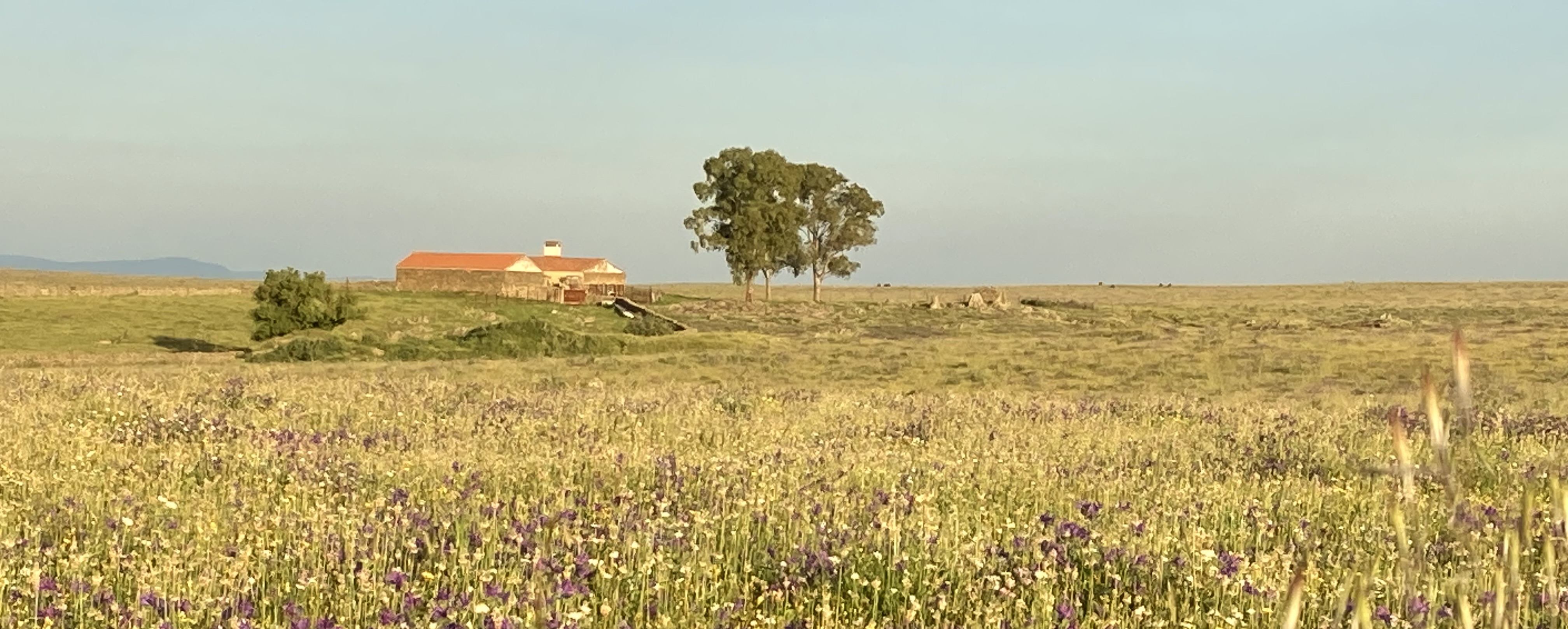
The prevailing scent is sap and sand at dusk on the Spanish plain. The endless span of grassland which pours away to Cácares and Badajoz is steeped in dust from the Sahara desert, and while this isn’t Africa, it shares a room with the place. The overlaps tell most at dawn and in the evening when the blinds are up back and the settlings stirred in motes which turn in the sun.
From high ground above Santa Marta de Magasca, the view is interrupted only briefly by snow-capped mountains in the distant north. They’re violet and they come and go according to the evening’s atmospherics, but otherwise it’s only blank horizon and the almost-invisible line between land and the sky. This is the kind of steppe where a man can see further than he’s able to walk in a day, and travel is simply a matter of waiting for the distance to pass. I have no problem with the open sky, but the price of being able to see where you’re going is a heavy awareness of how slowly you move.
Sometimes there are cows in the tall grass. Many are like fleets of far-flung ships in full sail, and it’s fun to work up whimsical ways to describe the distortions of distance. But they’re more likely to be found in threes and fours by the roadside, stripped of their wonder and farting without any expression of curiosity or desire. There are also sheep being driven through the hip-high grass, and occasionally the mark of a farm with its trees and the movement of storks from its chimneys. Away from these flags and putting greens, it’s just a grand fairway of freshness and larksong; a jingle of buntings from the roadside wires and the crunch of grit beneath tyres.
We drove in the rut of a road as the sun sank and cast the grass in a worn-out, dusted light. There was a hare ahead, and the barcode shadows of short scrubby trees which grew from the verges. We could easily have been in Africa then, somewhere on the veldt above Sun City, or the hammocked roll of Natal towards Pietermaritzburg. In a sudden burst of movement, birds rose from a roadside field and looped overhead in a single, driven rush. There might have been fifteen or twenty of them, flush and giddy as gnats in the sunset. They landed and vanished at once in the grass between the knees of several ponderous sheep, then they rose again from standing and turned several times overhead in an escalating spiral which finally took them out of sight to the west.
To the naked eye, they were never more than silhouettes and a silly, growling call – but afterwards they were identified from photographs as sandgrouse, and so little like our own red grouse that the shared name seemed downright silly. In truth, they’re hardly related to grouse in any way at all. The name is only relevant for a shadow of reasons – perhaps for the sake of the shape of a beak or a simple, dove-like vulnerability. They’re beautiful in a zigzag of gold and caramel, but perhaps that’s just the novelty – because red grouse are also beautiful, and would strike a stranger squarely between the eyes.
Even from the first beats of flight they’re something different in attitude and poise; the decision to go is taken in the context of “up and away”, like plovers or snipe which never grudge wingwork. Measure this against the irritable resignation of a red grouse who takes off only under duress, pursuing the shortest, briskest possible route to safety. Our grouse are fast and assured when they fly; their movement is clever and bold, but it’s always driven by a prior failure. You know that if they could have escaped on foot, they would have done. You can hardly say the same of sandgrouse, which rise and fly like crumbs shaken briskly from a tablecloth.
Dozens of charismatic birds contrive to catch and amplify the richness of Extremadura – each one more excessive and extraordinary than the last. In this thorn-scented corner of Europe, there are soft and welcome strangenesses blowing in from the south, and I could write at length about the neon blare of rollers and bee-eaters and great bustards which toil and pound through this place like aircraft. Even half-known species seemed to shine in the dew-soaked, eldritch evening, and the yellow eyes of little owls and stone curlews were never more butter-bright and ghoulish than when I saw them in Spain. But those sandgrouse caught my eye in the cooling day, reaching down across the Mediterranean for the dusty old blankets of Africa, and pulling them up to my throat.


 Bog Myrtle & Peat
Leave a comment