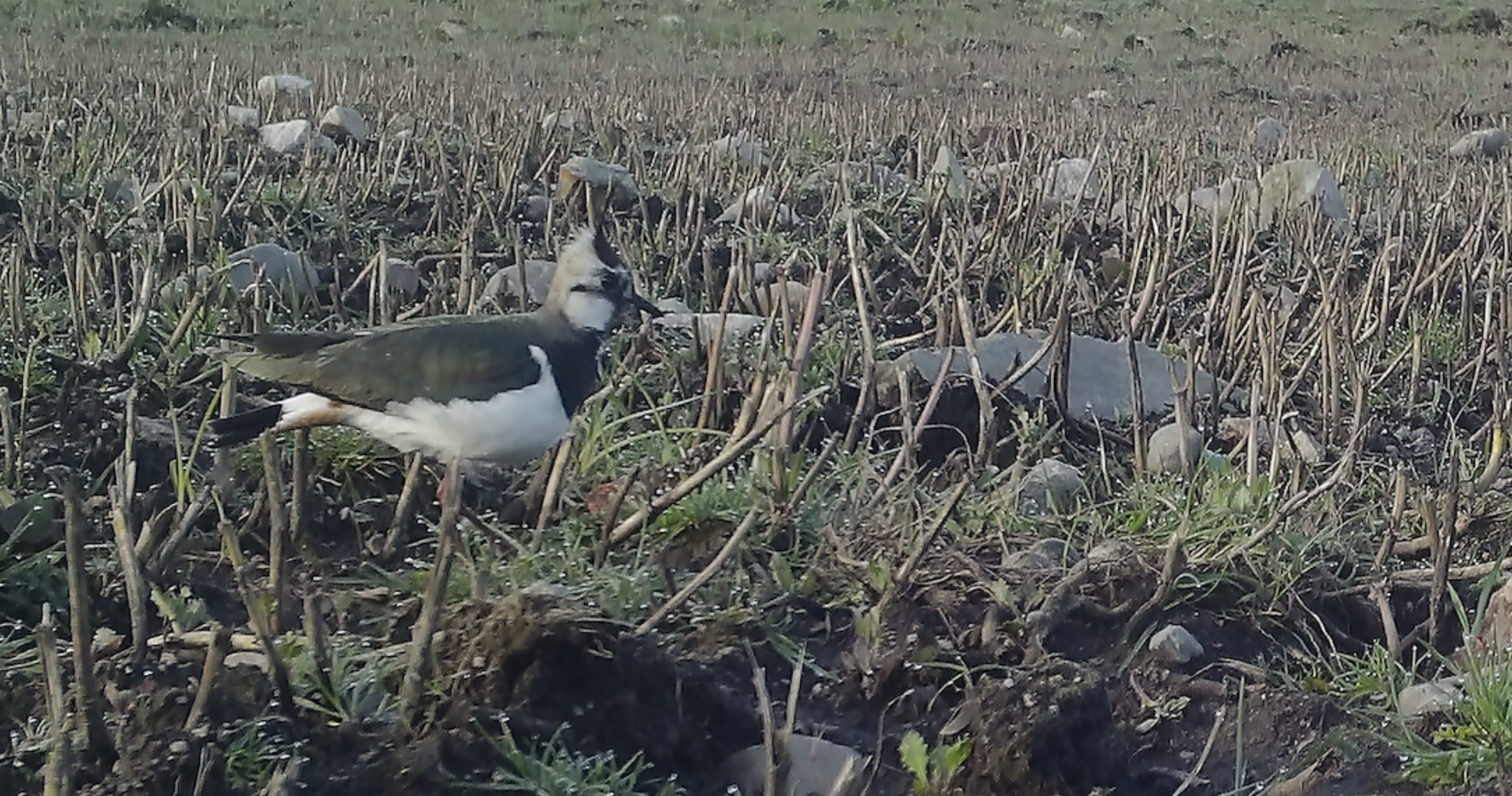
The lapwings which were so heavily trailed on this blog in March have never gone away. I feel sure that three pairs laid eggs and all were washed away in a sudden flood which struck in early April, but they stuck at the job and at least two have tried again. All these birds are newcomers here, arriving as if from nowhere to make use of an old crop of kale. They weren’t here last year, but kale is great stuff for lapwings, and it’s not uncommon for them to suddenly arrive when the conditions are right. But just because the birds turn up, there’s no guarantee of success or productivity – as I have begun to realise, providing lapwings with suitable nesting cover is hardly even the first step in the right direction.
I found the first nest fourteen days ago – four perfect eggs in a light cup of grass and root-stems. I just had to watch for where the male bird was sitting, and his white face showed up like a beacon in the soggy clods of soil. I don’t know how long the nest had been there, but it was a mixed pleasure to realise that similar kale stubbles were being ploughed within earshot at that very moment – and the same fate surely awaited this nest. It’s the eternal burden of the wader enthusiast that pleasure is always short-lived and filled with anxiety. There was no time to enjoy the eggs and reflect in the glow of nature’s persistent onflow. Just an immediate surge of responsibility, and the knowledge that unless I acted fast, everything would be lost.
Although little more than a stone’s throw from my house, this not my land. I had my own day and work to pursue in that moment, and it was a crush to realise that I would have to postpone my plans and focus on that nest as my sole priority. And all the while, the world rolled onwards, blissfully unaware of the story which had begun to unfold. I maintain that anybody would act as I do to protect wader nests, but the reality is that most people have no idea that these conflicts or collision points exist – and even if they did, they wouldn’t know how to address them. My feeling is not so much that nobody cares, but simply that nobody’s looking. And the outcome is the same however you choose to understand it, because there’s no backup – and only yourself alone to act. How very dearly I wish that this wasn’t my problem, and yet often there’s nobody else.
I got through to the farmer on the telephone, but he and I have never spoken about birds or wildlife – and I had no reason to believe that he would hear me out. If he was intending to plough this stubble in, I was prepared to mark the nest and hope that tractorman would avoid it. It doesn’t sound like I would be requesting a major change of plan on the farmer’s behalf, but it’s still a countable favour, and you can’t just ask forever. Later, I spoke to a friend who suggested that I could have threatened him with legal action for damaging a wild birds’ nest. I could understand the point, it would never cross my mind to lead with a stick – and too much of conservation is based on a conflict mentality of disempowering the baddies. Surely it’s better to enable the good-guys?
It turns out that the farmer is interested in birds – he explained that he isn’t planning to plough the ground until May, which meant that the nest was granted an immediate reprieve. He went further and said that if the birds were still sitting when the field came to be ploughed, he would gladly work around the nest. I thought this was tremendous news, and I did a small dance when the phonecall was over. But then I was struck with a wave of panic – I should have asked him if I could put an electric fence around the nest – there’s always something else that I could do, and suddenly the progress I had made was completely drowned in all the opportunities I’d missed to do more.
It turns out that when brassica stubbles are left to grow on, they make a really nice weedy jungle for waders. Lapwings which nest in this kind of habitat are probably far more likely to hatch their eggs than those which nest in grazed grassland, and they’re also more likely to have chicks which survive to adulthood. There are all kinds of explanations for this, and many are completely unconsidered and unproven – but as the vegetation grew over the next few days, I put a camera out to watch the birds at the nest. It was fascinating to see them come and go, and each time I saw the birds turning or shuffling their eggs, my hopes were steadily raised.
But nothing lasts forever, and the field was soon green enough to support grazing. A gate was opened, and a dozen bullocks poured in from a neighbouring field. These were joined by a dozen ewes with twin and triplet lambs; they loved the resurgent crop, and it pleased them to lie on the bare soil in the sun. These animals had access to enormous areas of suitable grazing, but they only wanted to be where the lapwings were.
It’s well known that cows can trample nests and sheep sometimes eat lapwing eggs – here was a new realm of concern, and this time it was harder to mitigate the problem with the farmer. It would be unfair to ask him not to graze his own field, and perhaps tricky to convince him that his livestock really were a threat at all. He could easily dismiss my concern as fussiness, just as many farmers simply don’t believe that livestock damage is a major problem. I could have offered to build a little electric fence around the nest, but his sheep are wild hill blackies and the cows hardly give a damn one way or another. They’d pull it down or knock it over in ten minutes – with the added worry that a little fence in an otherwise bare field might actually encourage them to explore and enquire in ways which might not have occurred to them.
It’s tempting to pile on with interventions and throw the kitchen sink at a situation like this. I have decided to stand back. I’m going to watch and see what happens, trusting the knowledge that if livestock guaranteed nest failure, there would be no waders in the world. They’re a problem, but they are not a certain death sentence, and whatever I learn from this experience can be fed back to the farmer in future years. If something terrible happens, I’ll have it on camera and I’ll be able to back up future conversations about waders and conservation – but always gently and alongside him.
The upshot is that this nest is still live, five days after the livestock arrived in the field. There are deep, cavernous hoofmarks within six feet of the eggs, and I suppose that there’s no turning a cow which wants to tread on a nest. But it’s been interesting to watch the lapwings battling the sheep, pricking their curious noses and leading the animals away from harm with strange flapping displays. Some sheep (and certain lambs) are unnaturally curious about nests and won’t stop bothering them until the eggs are destroyed, but that doesn’t seem to have happened so far. I have watched individual sheep show a polite interest in the eggs, then turn away when the birds get loud and noisy. So far, the lapwings are winning – but that’s not to say that there isn’t an enormous additional burden of stress and diversion being placed upon them, and the cost of this is hard to quantify.
Beyond the various agonies of the story so far, it’s important to remember that hatching’s only half the game when the goal is fledged, contented young to fill the gaps of future years. We’re still a long way from success.

 Bog Myrtle & Peat
Leave a comment