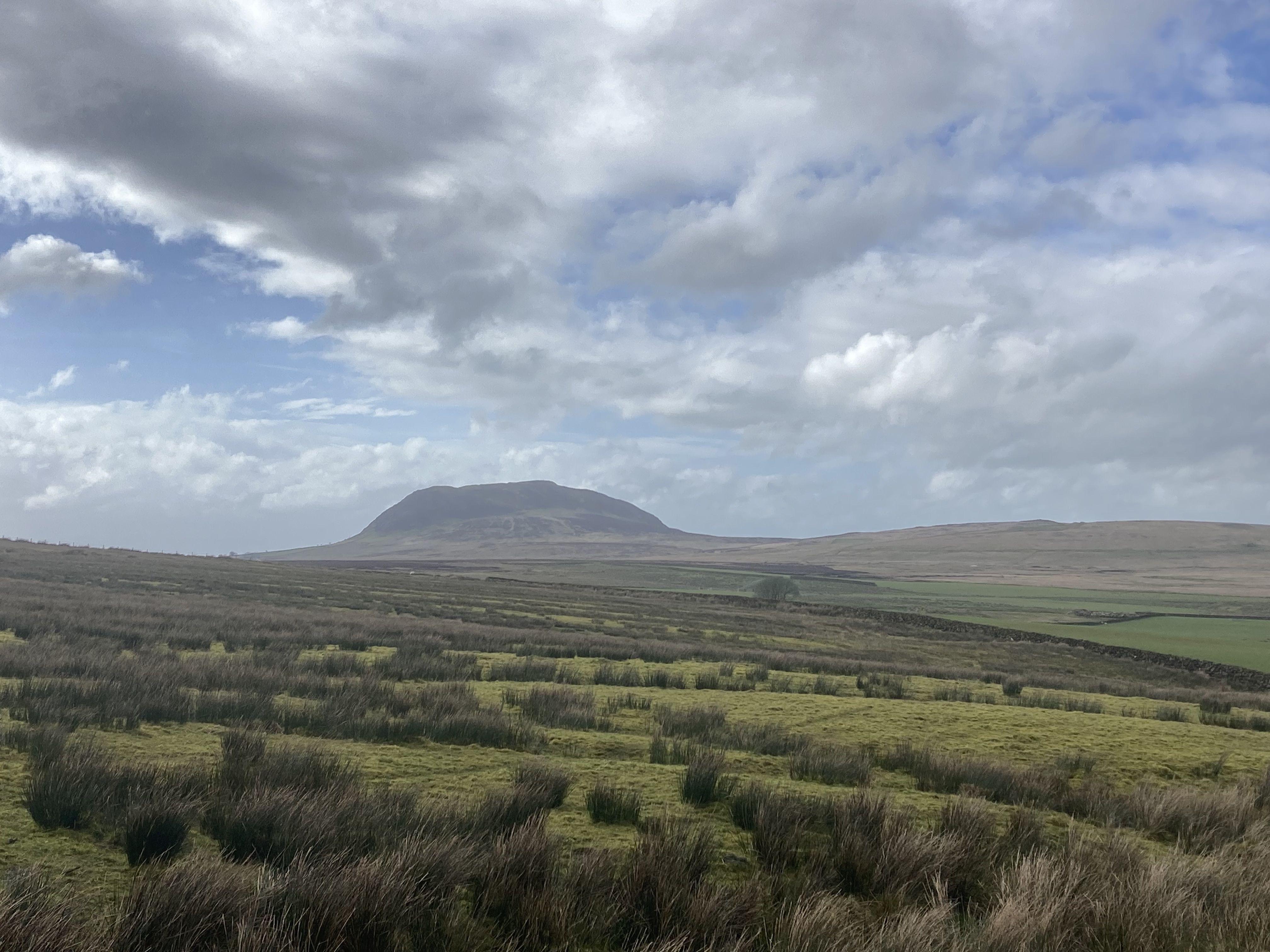
There are curlews in the Antrim Glens, and birds which call from the rush-mown upland fields. Seen from rock-tops and the crosses which stand on the summit of Slemish, moorland glides away to the inner workings of Ulster. Beyond Ballymena, there’s a glimpse of Lough Neagh and the gurly rise of the Sperrins and Eire; rich green fields in a dish of hashed-out heather hills. It’s hill country in the fashion of Galloway and Lanarkshire – shallow, sedgy glens all fringed about with alder scrub and the April flush of primroses on the burnsides. Snipe drum, larks sing and the furthest blue speck of movement on the distant hill resolves to the shape of a hunting harrier. In the face of catastrophic declines across the Island of Ireland, it seems as if curlews hold on at Glenwherry and the hills above Broughshane because nothing has come to unsettle them.
But curlews were declining here, and steady loss through the 1980s and 90s in Antrim has been bucked in recent years by an intensive scheme to reverse the trends. These birds are now some of the most productive for a hundred and fifty miles in any direction, and their prosperity is a sight to behold. It’s been hard work for the people on the ground, but in the context of endless gut-punches, it’s a desperate relief to be shown that success is possible. The best I’ve ever been able to show for my own account is an exhausting delay of the inevitable.
The reality is that these Antrim curlews are thriving because a tremendous amount of money has been spent on restoring their habitats and implementing an extensive programme of predator control. But watching four pairs of curlews display in a field above Ballyboley with a group of twenty conservationists from across the UK, you could imagine that there was enough love and knowledge in the assembled team to guarantee something like a brightness these birds. But the national reality falls deeply short of this enthusiasm – I can think of a dozen places in Galloway where four pairs of curlews display and nobody sees them; where the farmers have done nothing to help the birds and foxes teem through the rough grass in the starlight.
In national terms, Glenwherry is the odd-one-out for having turned the ship around – and despite the coldness of the comparison with home, I was surprised to find hope growing in me again. I want this kind of success so much that it’s hard to recall that it simply isn’t coming for me. It’s painfully clear that we can’t save every curlew, and declines will only accelerate before they slow and stop. A targeted approach is sensible, but it doesn’t account for the birds which are already so far away from productivity that their existence is essentially meaningless. Antrim shows that it’s possible to build in the face of collapse, but when you measure out the ingredients and examine the methodology there, hope for me is even further off than I had thought.
It’s easy to feel at home this part of UIster on a clear day when Arran and Kintyre loom on the horizon. It’s only thirty miles home, but if we had been serious about protecting curlews in southwest Scotland, we should have started work like this at least fifteen years ago. The scale, longevity and budget of the Antrim project vastly outshines anything we could have done to save the birds even then, before curlews were deemed to be a conservation priority. And in this respect, it turns out that timing was a factor too – because many places had to lose their curlews before the alarm bells would sound at a national level and decision-makers would start to take it seriously.
I don’t know how useful it is for me to always look backwards in time to recall this point, because the situation is only now and what’s next. If I want to help, I need to fork my despair and astonishment to one side and engage with the birds in new and ecological terms. I have to start calling farms “curlew sites”, remembering that sheepwalks are described as transects now. And there is some consolation to be found in the fact that my failure was instructive –now my birds have gone, I can take the lessons learned and plough them into other places. I notice that my work now takes me away from the literal geography of my home because the future has nothing to do with my birds or your birds, but any birds at all.

 Bog Myrtle & Peat
Leave a comment