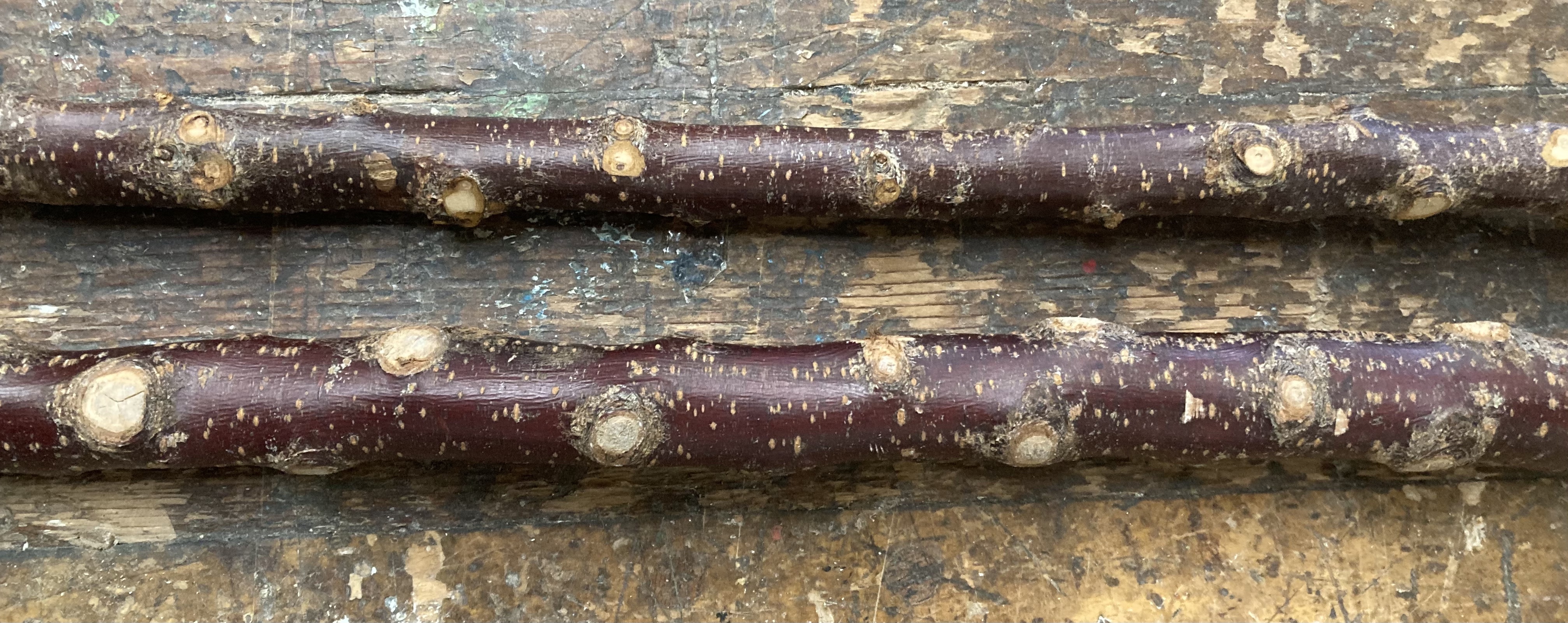
I cut my blackthorn hedge with a handsaw, and I saved the thickest wood for kindling. The work was hard, but now and then I’d find a length of stem which grew in a reasonable expression of straightness. I saved these and carried them home to be hung in a bundle to dry. I hoped to make nice walking sticks, but when I took them to the class in town, the instructor told me that I should have dabbed each end with paint to stop them splitting. He showed me how the sticks had cracked in the hanging, and all but two are almost wasted. I’ll take extra care of the good ones now, and thought again on how the cost of a good lesson is always something lost.
I couldn’t bear to waste those cracked-up sticks. They might be split, but I can use them for rougher work. So I took one and began to clean it up; I sawed off the thorns and filed them down into knuckles. When that was done, I sanded the stumps so that now if you were to touch thumb and forefinger together to make an o, that shank would fall down through the hole like a slip of silk. As I worked, the wood itself seemed to brighten. One end was buffed to a rich and marbled chocolate brown. The other resolved to a wondrous bramble-red and the polka-dot pattern of sawn-off bumps. It’s so beautiful that I could hardly take my eyes off it, and yet all I’d done was tidy up.
Think of all the time required to make sticks for shows and displays; all the fuss of varnish and steam to create something shiny and smart – now take that work and measure it against the simple joy of an unworked blackthorn shank. It’s a close-run thing, but I must confess I actually prefer the natural object. I didn’t see that coming, but it chimes with mythologies of the Irish blackthorn shillelagh, which was often only cut on the eve of a journey – a temporary, makeshift thing that was taken to meet an immediate need, and no less powerful for the lack of forethought.
A decent shillelagh conferred good luck upon the traveller, and Luke Kelly relied upon one to banish ghosts and goblins in the song “Rocky Road to Dublin”. Of course there are some beautiful, well-worked Irish sticks – but I can’t ignore the sudden urge to cut a stick and go out into the world. It reminds me of the old Scottish Gaelic proverb which outlines a kind of ancient allemansrätten to take “Breac a linne, slat a coille, Is fiadh a fireach” – [a fish from the river, a stick from the wood and a deer from the hill]. The word “slat” can be translated as both “stick” and “wand” – that’s a revealing overlap which beckons towards mysticism – but the proverb also presents “a good stick” as one of life’s indispensables; if your stick is lost or broken, simply cut another one – but never be without one. And yet I muddy this ancient use of natural resources by taking my beautiful red sticks only from the blackthorn I own, and that seems to fly against the spirit of taking and communality – because in a modern countryside where every stick belongs to somebody, it’s no longer quite so easy to find courage in shared resources.
The moors turn red in October for the season’s change, and the hills in autumn remind me of Robert Louis Stevenson’s poem To SR Crockett, which shines a light upon our “vacant, wine-red moors”. Stevenson’s letters reveal that he probably thought SR Crockett was little more than a noisy boy, and it’s a mistake to assume that the poem is really devoted to Big Sam. He’s writing to Galloway itself, and it’s a desperately beautiful piece – but “wine-red” has often bothered me. I agree that while autumn’s red consumes the summer’s green in the hills above the western sea, it’s more like the red of rust and stags. Wine-red’s too rich and fleshy for these hills – and besides, wine is no drink for moorland places. The metaphor’s a clash, but Stevenson was never clumsy.
Driving cattle downhill on a cooling day in the autumn, I played To SR Crockett back and forth between my ears. Then looking down at the blackthorn stick in my hands, I leapt to the idea of something more than literal. Because perhaps Stevenson is making a suggestion towards “wine-dark”, (oînops póntos) the Homeric epithet used in both Odyssey and Iliad to describe the sea in a coming storm. The brooding wine-darkness of Homer’s Aegean is both a gateway and a crucible where tiny humans endure the brutality of disinterested gods in a state of pious humility. That chimes with Stevenson’s broader context in To SR Crockett, and it serves to magnify the enormity of his other images he uses to express something of Galloway; the standing stones, the calling birds and the flying rain; things at once both concrete and ethereal. It’s a descriptive masterclass, but that simple twist of association goes further and sheds light upon my ever-shrinking focus upon the small and the dowdy. Because a well-cleaned blackthorn stick is wine-dark too; and yet the colours are somehow drawn from the same palette of the moors themselves. The connection stopped me in my tracks.
The Galloway of To SR Crockett pretends to conjure an illusion of emptiness, but any sense of abandonment is really just an interval between two periods of activity; between an ancient busyness and the rising awareness of change and death. Nothing can exist in this all-too-turbulent space without history or future; inheritance or bequest. In the epic tapestry of Stevenson’s wine-red moors, everything is ready and relevant – even the most humble objects possess sufficient power to cast a charm, and a Gaelic slat or a rough-cut shillelagh is a mighty thing indeed. So perhaps it’s no surprise that I should have found myself unaccountably distracted by that simple “piece of a hedge” in my hands. Blackthorn’s heavy stuff, and I’m surprised that I can lift these sticks at all.

 Bog Myrtle & Peat
Leave a comment