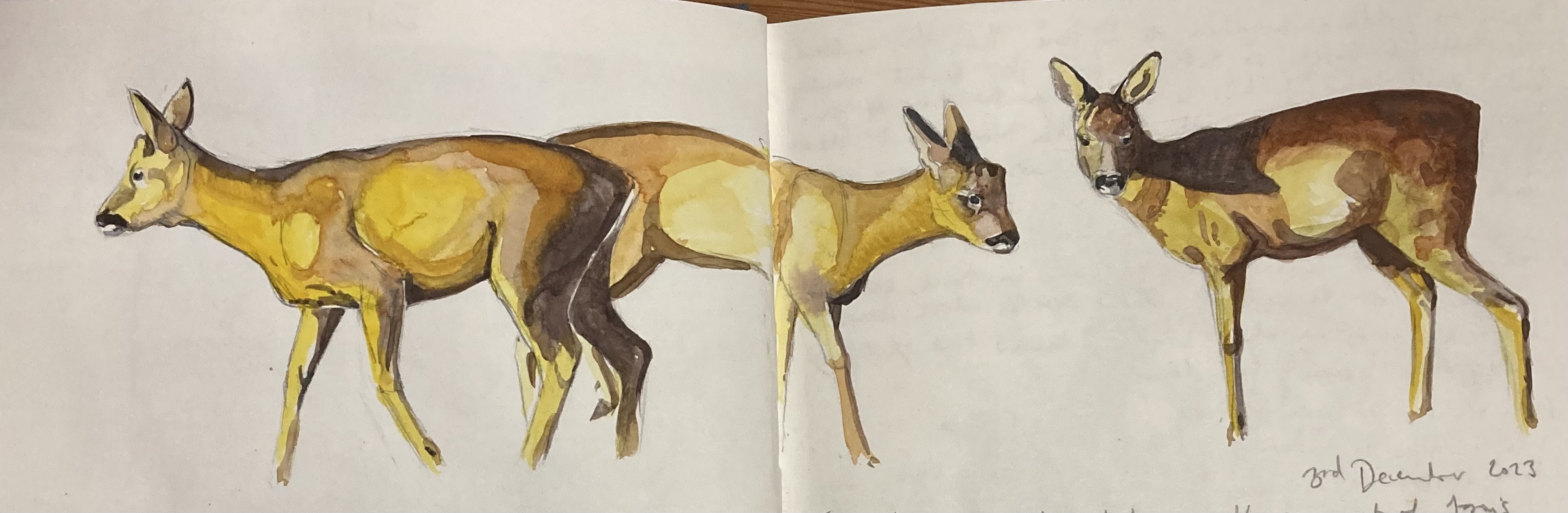
You’ll have seen the way that deer will come together when the weather’s been unkind. They gather in gangs in the frozen fields, and as the rising sun breaks out upon them at the height of their heels, the effect is of freezer blue shade in the soap-green grass, and the whites of their chins gone yellow. In certain fields, it’s not unusual to see five or eight deer at a time in the frost – but at Overlag and Stannersha’ there’s sometimes twelve or fifteen shapes to be found together in the morning. That’s remarkable, not least because it shows how common they’ve become – and they’re normally solitary things anyway. In summer it’s odd to see more than two at a time; a doe and her kid or the clunky imbalance of an old and a younger buck.
But have you noticed how, when something goes awry, those “herds” will immediately break apart into a number of constituent factions? They do not move away as one like springboks on the wild enormity of the veldt. Under pressure (or in response to a gunshot’s surprise), the group will separate. Certain does will lead their followers on well-drilled paths to safety, but bucks may choose another route and some will only run from a sense of feeble-mindedness. Each animal knows the clearest escape, but it’s only a matter of opinion.
Given that so many deer have come together from all around to form these groups, specific fields belong more to some individuals than others. The doe who reared a pair of kids in this place during the height of June will know the exact number of fenceposts which lie between the gateway and the low-strung wire. Escape for her is a matter of muscle-memory.
In the starburst of disturbance, I watch for the older bucks who understand that running is a mug’s game anyway. They’ll have clocked the thickest cover in advance, pocketing the knowledge and keeping it warm in case of emergency – so when the moment comes, they respond with well-drilled calm. Running directly for a wicked stand of blackthorn or a particular deepness of fallen bracken, they’ll suddenly vanish into hiding. And even when you walk out to collect a fallen carcass or drive on with a trailer of bales, they’ll keep their heads down like hunkered hares – achieving the same safety by hiding than they would ever find in a mile or more of wide-eyed, fretful run.
But visiting deer and young ones are often caught on the hop in strange acres. They don’t know the place, and they’re only fleeing because the others are. So they’ll run in unpredictable angles, finding themselves trapped in the margins or blocked in the neck of a hedge. I know that roe are well shod with stiff and horny hooves, but it stands my teeth on edge to hear them bounding in panic through frost-stiffened gateways and the minefield of ruts which are trampled in wet weather around the troughs. Their high-heels make a nasty clatter as they go towards frozen ground, and even my size nines are too small to save me from turning my ankles in the ice. So I’m inclined to shout “careful you fools, or you’ll do yourselves a mischief”. But perhaps if I have just killed one of their number, they find it hard to believe my sudden concern.

 Bog Myrtle & Peat
Leave a comment