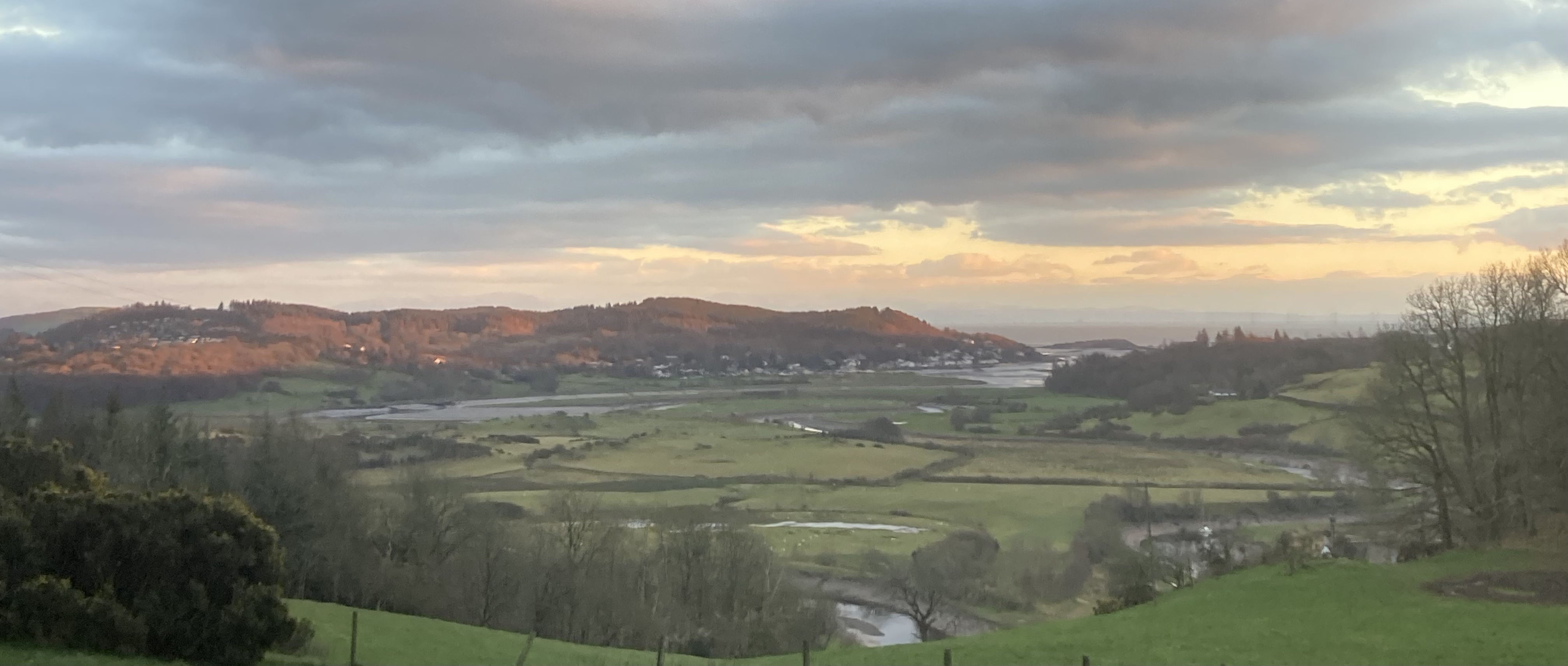
There are ancient hillforts all around the bay, and on my father’s farm the outline of a Roman encampment which has been overgrown with trees and a thousand generations of roots. When I was twelve or fourteen years old, I fitted out an expedition to explore these deep remains. I took a spade from the workshop and crossed the dyke to study my past. It’s hard to dig when you’re little, and even the turf is thatched against you. But I had taken a bag of supplies for the labour – sandwiches and a flask, as if any kid really liked the taste of tea.
After an hour’s honest labour, I had succeeded in uncovering a large, flat stone. My excitement billowed between the roots and the severed heads of a dozen worms; a stone, and surely something of enormous historical significance. It was flat on one side, and it had an edge. So of course I concluded that I had found the doorstep to a villa, or the fallen lintel of a Centurion’s office. Trees turned overhead in the breeze, and squirrels jumped between them – but that stone glowed with a million white-hot connections.
Of course it was only a stone, made special only because I had uncovered it. And even when I afterwards learned that most of these fortifications were built from timber, that stone loomed large in my imagination. I should have been looking for post-holes, but I didn’t know that and I wouldn’t have cared if I did. Besides, who’d dig a hole in search of a hole anyway? I had everything I needed to confirm the certain knowledge that I was a Roman; that we were all Romans, carrying our eagles inland from the flame-red bay.
In the subsequent landslide of excitement, I learned everything I could about my ancestors. I studied them hard, and I imagined triremes churning up the petty foam of the Solway. When I lobbied my parents to show me Hadrian’s Wall, my excitement roared into a furnace because here were remnants of mosaics, fragments of sandals and glassware so clean and transparent that I could see myself reflected in every shattered bulge. There were racks of bones on display in the museum at Vindolanda; pickings from the middens to show that the Roman garrison ate more black grouse than any other bird; and cattle too – heavy-handled auroch heads to conjure a picture of beasts I knew from the fields and pens of home. I was present in every finding.
But in a small display beside a wealth of pottery fragments and textile shreds, there was a human skull. It was brown and reconstructed with the same bitty hesitance as a vase or a bottle. The teeth were gone and the cheekbones bent a little too-far inwards, but a caption nearby explained that the head had been found without a body – and careful examination had shown where knifemarks had sawn a gap between the uppermost vertebra. And more, there was evidence to suggest that this disembodied head had been on display, possibly above the main gates to the camp. That was thrilling, and my eyes widened with lust and delight to discover another villain crushed beneath the gleaming heel of imperial conquest. I thought “That’ll teach you!” – until I read how more detailed analysis had revealed that the head had come from a boy of my own small age; and the isotopes shown that he’d been born and raised in Galloway, somewhere near the sea.

 Bog Myrtle & Peat
Leave a comment