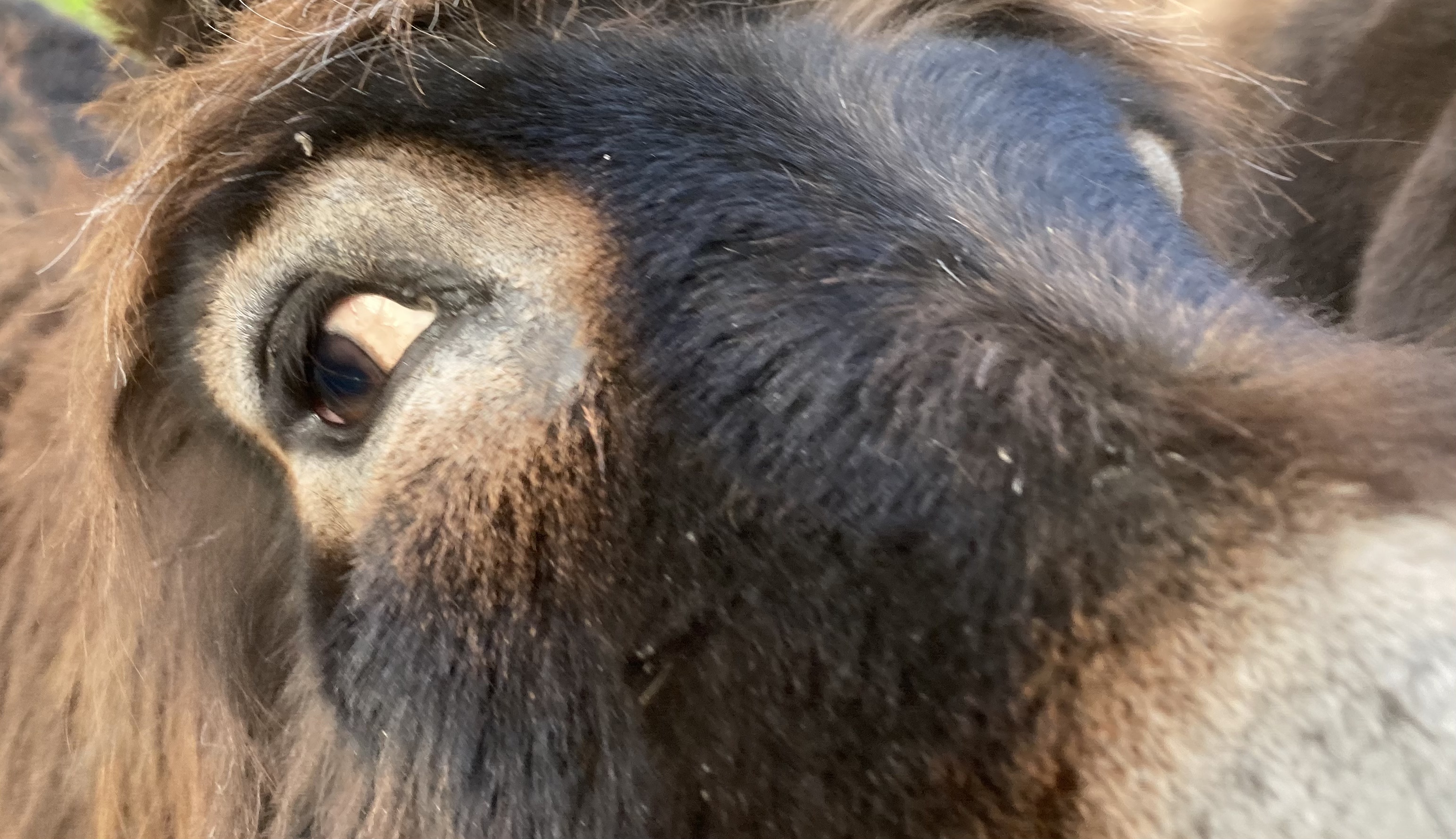
They used to keep donkeys on the cliffs above the bay. The animals were penned outside the dyke where more profitable livestock was set to graze, right on the brink of a three hundred foot tumble to the sea. It sometimes made my hair stand on end to see those donkeys perched so close to the edge, but the living was easy out there – and I doubt that any slipped or were blown to their deaths. Accidents which haunt a human’s imagination are rarely of any interest to animals, and walking on the steepest faces of Wester Ross with my dog, I was often conscious of the interplay between my terror and her boredom.
There’s a neat symbolism to donkeys on the margins. That’s how they gradually vanished; not tumbling from cliffs like lemmings, but a soft and gentle squeezing-out until there was simply no space for them anymore. After generations of loyal service, the animals were already failing in Galloway when my grandfather was born. They were kept as novelties, and sometimes as companions for lonely bulls – although temperamentally the two animals are rarely a good mix. But they were utterly gone from the southwest by the Second World War, and only a few vestigial remnants persisted on the sea cliffs on land that nobody else could use. And if there was sometimes a risk of a donkey falling to the sea on a wild night, at least it was only a donkey.
A pen of donkeys was offered for sale at the Mart five years ago. They’d been brought across by an enterprising Irishman, and quite a few people said they’d take one just for the fun of it. But when enough people play for “a bit of fun”, things get serious. The animals made good money, and when the same Irishman returned a year later with more donkeys, the game was up. He ended up taking them all home again.
The story is different in Ireland – the destination remains the same, but the decline has been slower. Donkeys still had some sense of purpose in the early 1970s, particularly amongst a cadre of old-timers in the west who had been raised in the habit of working slowly. When I stayed in Connemara, I’d see a dozen donkeys a day. Stopping to chat with a man on the roadside, I learned how the animals were a crucial tool in the gathering of peat, and I also heard them compared favourably against quad bikes and tractors as a means of working on soft and squishy ground. In County Monaghan, I met another man who took me to a shed and showed me a full set of harnesses and creels which are still used to bring a symbolically important load of peat from the bog – much to the derision of his son and grandson. And then it seemed that the world of Patrick Kavanagh is not so dead and buried after all, and there are still small truths in Ireland which defy the final failing threads of an old tradition.
There’s an appealing universal symbolism around donkeys. The Biblical donkey looms large, but the animals have been enormously significant for traditional peasant communities across Europe – something like a four-legged cross between a wheelbarrow and a quadbike. And that’s essentially how we remember them – from the gaudily adorned Spanish burro to Modestine, the surly donkey which carried Robert Louis Stevenson through the Cévennes. I think of donkeys and conjure up writing by Emile Zola, Marcel Pagnol and the life-affirming Federico García Lorca – in Ireland, my mind’s eye goes to William Carleton and Walter Macken’s jennets – but the background noise of donkeys in literature is potentially misleading. It’s possible that they were even more abundant than it sometimes seems – they simply went without saying.
In a modern world so heavily predicated upon comfort and speed, it’s sometimes useful to challenge those precepts. When you pick up the habit of asking why this or that task is performed in a certain way, it’s usually traceable to the sale of some product or gadget which was designed to “make life easier”. Do this often enough and you begin to wonder if we have our priorities in order, and whether we can be trusted to determine what’s good for us. It’s reasonable to reckon that life is actually meant to contain a germ of difficulty, and it’s more than simple pig-headedness which continually provokes me to take a steer against the popular direction of travel. Perhaps I’m stretching this point by pondering the idea of buying a donkey for myself – but even if the idea dies tomorrow, it’s useful to push back against a world that is always so very well equipped to tell us what we need. And now that those donkeys have vanished from the clifftops, I’m left to wonder what else vanished with them.


 Bog Myrtle & Peat
Leave a comment