Jim was on the hayshed roof when I arrived. He waved and I went inside to the kitchen and put the kettle on. Then as I walked round to the stackyard, I saw the ladder had slipped and realised that was marooned on the tin. I shouted “Christ sake man, how long have you been up there?”, but he was ill-tempered. “Never heed that” he said. “Just fetch my fags”. I put the ladder back in place and carried his day-glo jacket with me to the roof. The cigarette was out of its pocket, into his mouth and lit before I could make sense of the movement, and only then did he pull the coat over his back to recover what he’d lost to the wind. I reckon he’d been up there for about an hour – long enough to feel the bite, but lacking the soreness to justify a jump.
He’s still cleaning up after the gales which came from the north in 2021. I lost my hayshed roof in its entirety; it blew away like an egg box, and the owls were baffled by its absence. It took me two years to find folk who’d replace it, and now I’m back to something like normal. But Jim lost a thousand trees on the hill, and his fences were all to cock with the falling. It’s taken him this long to fix the farm, and these were the final repairs to skylights which were lost or blown out in the wind. I’d found him patching the gaps with sheets of crackling Perspex – a job which he’d have long-since finished if the ladder hadn’t slipped and left his silicone in a tub on the ground. Supposing that this work was more important than any of my own, I decided to stay for an hour to help.
Jim’s shed is nothing large or remarkable. It’s an open-fronted thing, covered in sheets of red tin of a kind which no longer finds favour on farms. It was built by Jim’s father in the 1970s, and now the post-bottoms are rotten; the floor is two feet higher in places for the sheer weight of shite and straw that’s grown and dried like the crust of an overdone loaf. Rabbits nest in the dregs of a few old bales, and there’s often a cat which moons around the Vicon spreader as if it reckons to make Jim an offer.
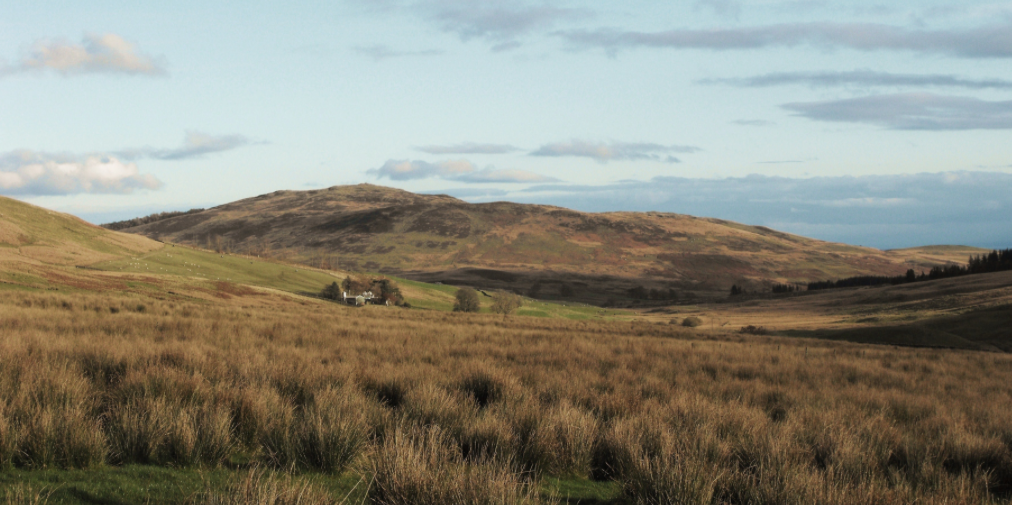
When the heart of the work was done and the tools tossed down to be collected from the nettles, I carried two mugs of tea to the top and sat with Jim for a time in the cold sun. What a difference it makes to be up, even in close or familiar places. Perspective is important, and if all you ever do is trail the same lines back and forth across the dew, life slows down accordingly. A few feet in either direction makes all the difference, and height’s a downright revelation. I had a sudden, astonishing view of the hills on the far horizon; a view which is usually hidden by lines of conifer plantations. I saw the blue gurly hump of Cairnsmore standing up to her knees in shreds of failing mist, and all the clints and corries where the stags and the billygoats roam. There are taller and more striking hills above Loch Trool, but from this angle they’re all nested together like a row of cabbages. You can hardly see where one hill ends and another begins, and parts of them fall into Ayrshire anyway. Cairnsmore stands far out on her own; a monument of her own making, and a stern reminder that if you want to catch the Belfast ferry, you’ll need to go the long way round.
I didn’t know you could see Cairnsmore from Jim’s farm – and being fair to me at six feet tall, I can’t. The view is only possible from the hayshed roof, and as soon as you introduce conditional ups and downs, the comment becomes meaningless – as if you can’t see Cairnsmore, but you and a hayshed can; just as the heron which flies above my house every morning can see everything from Annan to Carsphairn as he passes, but I wouldn’t claim the same credit for myself. It reminded me of that fad in the ‘90s when folk would go up in aeroplanes and take photographs of your farm, and afterwards come round and try to sell you pictures of a place you’d never seen in all your life, even though you might’ve been born in that upstairs room. I said as much to Jim, then remembered that he’d one of those photos on the wall in his own front room. I felt embarrassed, then remembered that there’s no shame in it – everybody has them.
Even with an additional five metres of height, there’s only one other farm to be seen from Jim’s shed roof. That’s a total of three houses in a span of twenty miles. It isn’t to say that Jim lives in the Great Sahara, but when you’re out on the brink of the moors, sightlines are sometimes deceptive. Houses are usually tucked between trees anyway, and often they’ll lie at the back of an incline, exactly where a fox would lie out the wind on a bright day at this time of year. You can’t see houses, but they’re there – and the only sign of company comes on cold, still evenings when the chimney smoke is free to rise tall and slender as the flags they fly on putting greens at the golf, and you remember that the world is full of holes after all.
The way and the shape of Galloway is mainly endless rolling; but there are sudden gullies and rummly peaks as if there were faults in the graphite which drew these flowing lines. And that’s what we saw from the hayshed roof, with the sun trailing cool across the moorgrass, and rain rising from the sea towards North Barrule. There was a hen harrier hunting hard through the myrtle, but Jim suddenly rose and descended from the roof when I said it, saying “bloody birds”. Then walking to the sheep shed door, he grabbed a bucket from the floor and filled it with cake for the shearling tups. “Mon see these bastards” he said, as if we’d finally got to the guts of the day.

 Bog Myrtle & Peat
Leave a comment