Rats sprang from the winter’s rick like sparks from a pinewood fire. They rose in a glitter of chaff, and we killed them one at a time. Uel slapped them down with the underside of a spade, and Jackie Pole screamed for the dogs and laughed. The men had come when they saw smoke rising from my yard, knowing that I was burning the birchwood racks and had reached the dregs of the oat-heap. I didn’t invite them, but after days of threshing with flails and sticks in the barn, I finally had company. You can get more help than you need when the work is light and exciting, and nothing much happens in these parts anyway. You might not cross the street to see a rat in Glasgow, but men walk many fields to see them killed round here.
In the old days, people would build a little fence around the straw and the rats would have nowhere to run. They were clubbed or torn apart by dogs in a tight, redacted circle. But now we have poisons, and modern rats usually die in curled-up balls beneath the beaten floor, snivelling through blood which runs from their noses. This was only a bit of fun by comparison, and there was no need to make sure of every one. A collie caught and killed a greyling youth, then three brooners came at once and two survived. Recognising that we could only handle so much at a time, they rushed us.
I love rats for their wickedness and that glossy, muscular snarl of ingenuity. But the rats in this rick had come to ply an honest trade as seed-eaters. I could hardly grudge them a share, and no rat alive can eat a stack to their own account. They have to work through each selected bite, and I bet that even they’re surprised when they turn around and see the harm they’ve done. Besides, they’re only recent arrivals in the yard since the cold weather came. Perhaps they’d passed the summer in the town, lapping at the exudate of condoms or nappies in the street light’s glow. Rats take our filth and spin it into objects of worth; they see the worst of us, and in creeping out between the slats and hoardings of our homes, they show us where the gaps are. Finders of the un-looked-for, their ability to discover wonder in the commonplace elevates them to the same philosophical niche as the artist and the poet.
As the ring tightened and the rats were killed in a workable drip, one held fast to the rick. I built this heap in August, on a network of planks and hoarding. I wanted to let the air circulate beneath the crop to keep the mould at bay, but these last few months have turned this undercroft into a bunker. Responding to various pressure-points and provocations, the other rats had panicked and abandoned the refuge of those boards. Only one remained, and we winkled him out at last. We’d had the time to regroup – everybody was ready for him to break cover. But when he came, he ran between my legs and out towards Uel, who turned and pressed him back into the race. The dogs missed, and so did Eddie with his fearsome blackthorn rod. Then he ran into a blind alley – a gap between two pallets which came to a dead end. The dogs were behind him, and the exit was sealed.
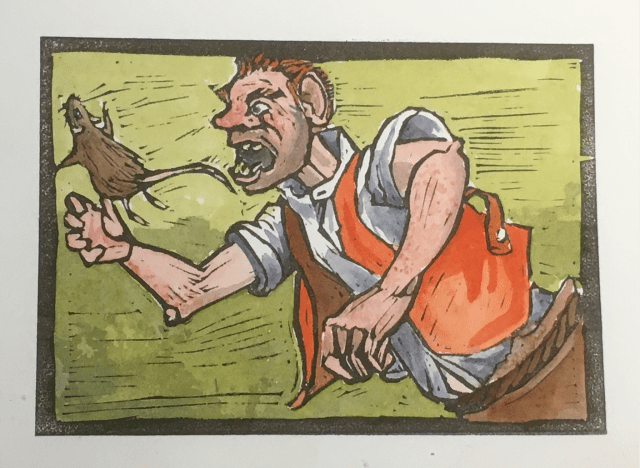
Afterwards, Jackie laughed at how this rat had turned and risen up towards the dogs in a gesture of defiance. He stood on his hind legs with his hands out before him like a boxer; he hopped towards the rabble with his tail stiff as a knitting needle. If only there had been time to work it out this way, he might have made it – he would have pulled us all within range of his yellow teeth and taught us each a lesson, one by one. But the world fell upon him in a rush, and what he did would have to do. Those grasping hands were good and sound, but they were too small to hold us all at once. So having adjusted himself to small gleanings from the twilight rick, he died in the glare of our yelling.
Picture: an imagined illustration for the short story Sunday by Ted Hughes


 Bog Myrtle & Peat
Leave a comment