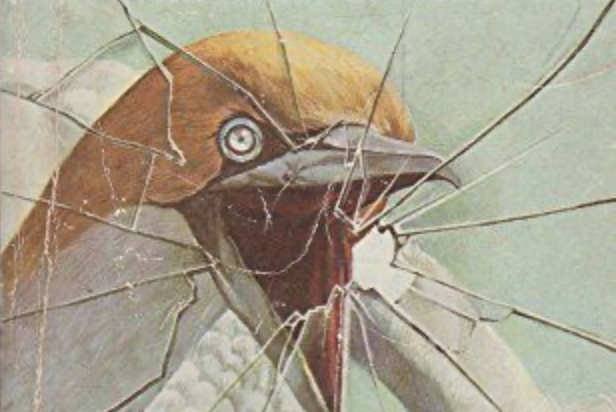
Just look at Nat Hocken. Blown to pieces by the Second World War, he’s enjoying a quiet and peaceful existence as a farm labourer in the Cornish countryside. When wildlife starts to behave strangely, he’s the first to notice the change. And when birds begin to turn up dead at his doorstep, his ability to interpret danger is almost uncanny. The protagonist of Daphne du Maurier’s famous short story The Birds is a cast iron example of a once-bitten man, so it’s no surprise that he should take his own survival seriously. His calm and level-headed pragmatism in the face of an emerging apocalypse is extraordinary to modern readers who are used to a life of calm and placid stability. It would be easy to cast him as a conspiracy theorist, wigged out on worst-case scenarios – but when hawks begin to tear at the shutters he’s nailed to the windows of his cottage, Nat Hocken is absolutely vindicated. He alone understands that help is not coming. The state has failed him before in the carnage and horror of conflict; when shit hits the fan, it’s every man for himself.
In a dozen tiny ways, the drama of The Birds is a commentary on the flaws of emerging modernity. Hocken’s wife has been slackened by the luxury of convenience; she doesn’t keep food in the house, knowing that it’s much easier to buy supplies from the shop as she needs them. That might seem obvious to us nowadays, but Nat remembers a time when food was hard to find. So his shock at her lack of preparedness borders on contempt – it’s clear that she is not ready for the rising tide of terror; the best she can do is tug at his cuff in panic. She offers no solutions, and as the story unfolds, she actually does little more than pose a list of panicked questions. As Nat strives to protect his family from imminent collapse, one of his main concerns is to keep her calm; to protect her from the trauma of gannets which bomb their house and the flocks of menacing, insidious bramblings hunting through the hedgerows. He knows that if she sees how bad things are, she’ll simply fall apart. There’s no doubt that the Hockens would be sunk without Nat, but as the story grinds to an appallingly ambiguous conclusion, it’s likely that they’re sunk anyway.
Nat Hocken’s reflexive trauma was written across an entire generation of people; men and women of my grandparents’ age who survived the certainty of destruction in conflict. And it seemed to them that when the chips were down, it was every man for himself. Right up to their dying days, my grandparents nursed a simmering antipathy towards the police. It was no reaction to any specific experience of criminality or injustice, but rather a sense that everybody is responsible for their own affairs – and only a baby would run to “the grownups” for justice. If a problem emerges, you sort it out yourself, and that attitude is simply another way to approach the same ideas of personal responsibility. It’s as if War had allowed that generation people to see behind the curtain; to understand that all the paraphernalia of governance is just an illusion. Sure, the state is there to help – but if you’ve lived through the experience of state failure as they had, it makes sense to act as if the safety net doesn’t exist.
This is very much the feeling I get from biographies of Henry Williamson, who has become an object of fascination to me in this blog. Shattered by his experiences of the First World War, he’d seen how comfortable normality could be overturned – and in the light of that trauma, he was profoundly dissatisfied by the political establishment. Modern readers might find Williamson’s right-wing political activities repugnant, but he belonged to a generation which had been brought to a shuddering standstill by ineffectual leadership. Outraged by that failure and desperate to create a new future, Williamson lunged towards expressions of strength and personal accountability. He seemed to believe that centralised authority was flawed – and in that void, the onus was placed entirely upon the resourceful individual.
None of this is to explain or excuse Williamson’s politics, but rather to place it in a context. It’s now too late for many of us to remember the people of Williamson’s generation – the irascible old war horses who were an almost stereotypical fixture of stubbornness and ferment in the rural scene – from Ted Hughes’ sinister Major Hagen in Gaudete to the dotty old “Major” in Fawlty Towers. These men (and they were chiefly men) were little more than amusing antiques by the 1970s, but their days as renegades were not so far behind them. And if that’s how Henry Williamson worked in his world, it’s no wonder we find him so hard to understand today.
Picture – Front Cover of Daphne du Maurier’s The Birds, Pan, 1977

 Bog Myrtle & Peat
Leave a comment